Carbide Speeds and Feeds
The math that sets RPM and feed for any flute count.
VIEW PAGE →Flute count is a trade between chip space and core strength. Pick wrong and the tool chokes on its own chips or flexes through the cut. Here is the selector machinists use.
Fewer flutes mean bigger gullets — room for chips to escape. More flutes mean a thicker core — rigidity and more cutting edges sharing the work. Every flute-count decision is this trade.
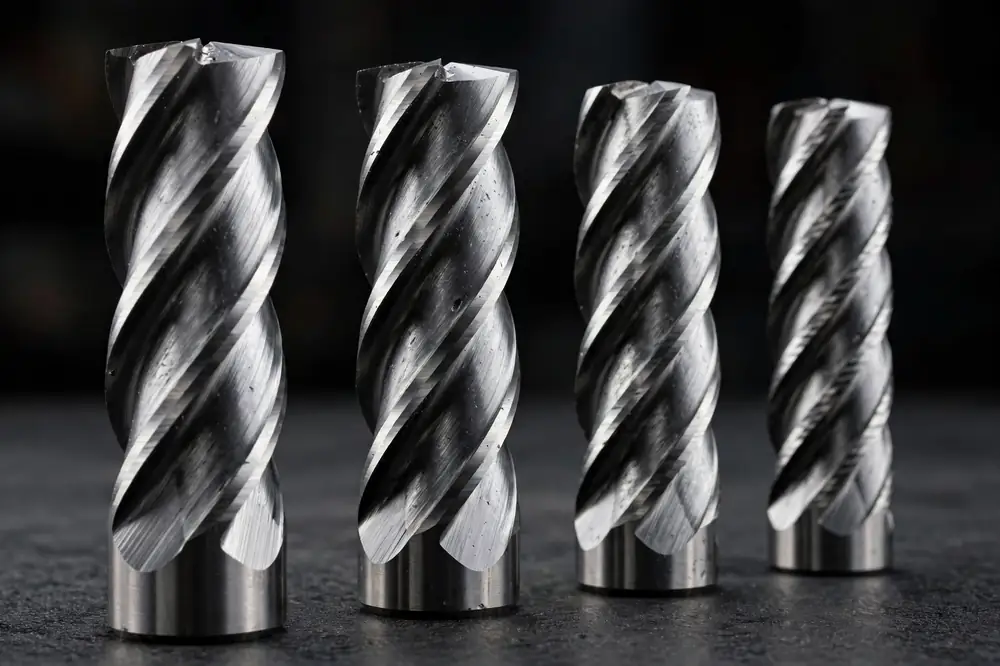
In soft, gummy materials like aluminum, chips are big and sticky — they need room. A 2-flute end mill has the largest gullets and clears those chips instead of packing them into the flutes and welding them to the tool. In steel, chips are smaller and the cut demands rigidity — a 4-flute's thicker core resists deflection and its extra edges let you feed faster.
The general rule: the softer and gummier the material, the fewer the flutes; the harder the material, the more flutes the cut can use. Everything below is that rule applied to real jobs.
| Flutes | Best materials | Best operations | Why it wins there |
|---|---|---|---|
| 2 | Aluminum, plastics, wood | Slotting, pocketing, roughing | Maximum chip clearance; gummy chips escape instead of packing |
| 3 | Aluminum, brass, copper | High-speed roughing and finishing | Balance of clearance and feed rate; the aluminum specialist's favorite |
| 4 | Steels, stainless, cast iron | General milling, side milling, finishing | Rigid core for harder materials; double the feed rate of a 2-flute at the same chip load |
| 5–7 | Steels, titanium, superalloys | High-efficiency milling, finishing | Maximum edges engaged; fastest feed rates in stable, rigid setups |
Flute count interacts with everything else on the tool. Here are the combinations that matter.
Full-width slotting traps chips on both sides of the cut. Even in steel, dropping to fewer flutes (or reducing radial engagement) gives chips an escape route. If a 4-flute keeps packing flutes in a slot, the fix is often chip evacuation — fewer flutes, better coolant delivery, or a smaller stepover — not a different brand.
Adding flutes does not mean feeding the same speed: each tooth still needs its proper chip load. A 4-flute at the same feed rate as a 2-flute takes half the chip per tooth — which rubs, work-hardens, and kills the tool. When you change flute count, recalculate the feed: feed rate = RPM × chip load per tooth × number of flutes.
Many modern end mills vary the helix angle or the spacing between flutes to break up harmonic vibration. These are chatter fighters, and they stack with flute count: a 5-flute variable-helix tool is built for aggressive, stable cuts in steel where a standard 4-flute would sing.
Finishing passes take light cuts where chip clearance is not the constraint — so more flutes win: better finish from more edges per revolution and higher feed rates. Roughing wants fewer flutes for the heavy chip load. Many shops rough with a 3-flute and finish with a 5-flute as standard practice.
Diameter matters too: small-diameter end mills (under 1/8 inch) run fewer flutes because there is physically no room for more gullets. Do not hunt for a 6-flute 1/16-inch tool — it barely exists, for good reason.
More flutes mean a thicker core — the solid center of the tool — which is where rigidity comes from. A 4-flute 1/2-inch end mill has a substantially stouter core than a 2-flute of the same diameter, and that stiffness is what lets it take heavier side loads in steel without deflecting. Deflection is the enemy of accuracy and finish: a tool that bends leaves tapered walls and chatter marks. When a cut demands rigidity, flute count is doing structural work, not just adding edges.
Corncob-style roughing end mills break the simple rules on purpose. Their serrated flutes divide the chip into small pieces, which drops cutting forces dramatically and lets the tool take enormous depths of cut. A rougher with many serrated flutes can out-remove a standard end mill several times over in the right material. They leave a rough finish by design — the finisher follows with the appropriate flute count for the material.
Two or three. Aluminum makes big, gummy chips that need room to escape — a 2-flute for heavy slotting and pocketing, a 3-flute as the high-performance all-rounder. Four or more flutes pack chips and weld them to the tool.
Four is the standard: rigid core, good feed rates, versatile across operations. Five to seven flutes for high-efficiency milling and finishing in rigid setups where the machine can use the extra edges.
You can, with light cuts and excellent chip evacuation — but it is fighting the tool's design. A 2 or 3-flute will clear chips better, run faster, and last longer in aluminum. Match the tool to the material.
The core is thicker, so yes, more rigid — but each flute is also a cutting edge that needs its chip load. More flutes only help if you feed fast enough to load every tooth properly.
Four flutes minimum for rigidity, more for finishing. Stainless work-hardens if the tool rubs, so the setup must feed aggressively enough to keep every tooth cutting — which is easier with the right flute count and rigid workholding.
Yes — every flute count is still solid carbide when it is done cutting. Two-flute, five-flute, rougher, finisher: all the same tungsten carbide by the pound. There are no minimums: every bucket counts. Call 312-880-8174.
Every flute count is still solid carbide when it is done cutting. Two-flute aluminum roughers, five-flute steel finishers — the geometry differs, the material does not. There are no minimums: a handful of worn end mills or a full drum, every bucket counts. On bigger lots, we handle the freight so you do not lift a finger. Call 312-880-8174.