How to Sharpen Carbide Tools
The grinding process itself: wheels, angles, wet grinding, and safety.
VIEW PAGE →A quality end mill can live several lives through resharpening — at a fraction of the price of new. But not every dull tool earns a second life. Here is the economics-first framework for deciding.
Regrinding a carbide end mill typically costs a fraction of a new tool — industry reporting puts the savings at 35–80% versus buying new, according to Cutting Tool Engineering's coverage of the reconditioning industry.
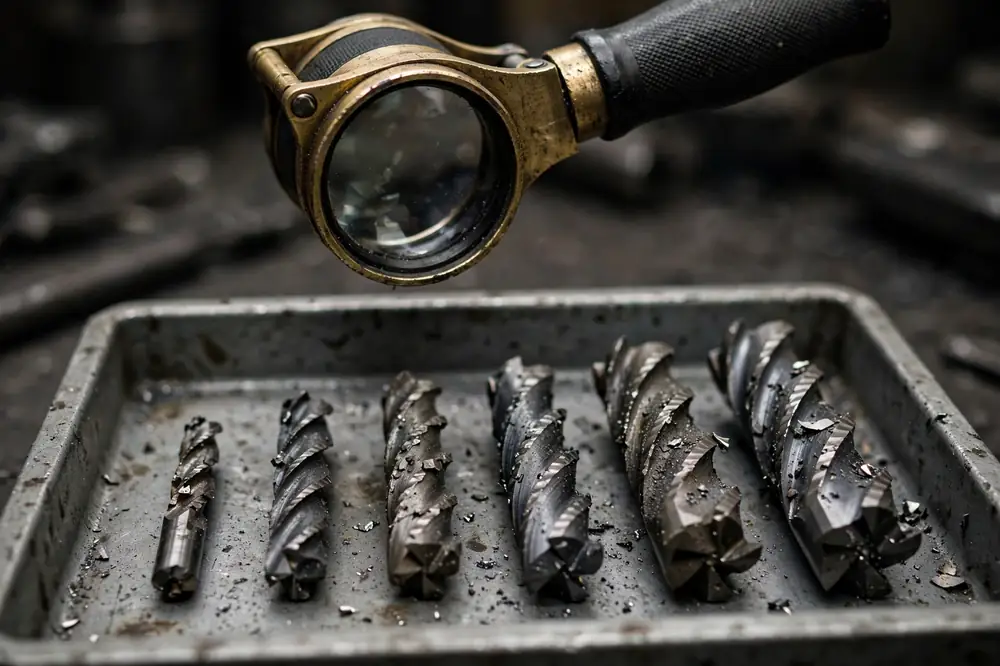
The economics are straightforward. A regrind removes a few thousandths of stock from the flutes and the end, restoring a sharp edge on a tool whose shank, core, and geometry are still perfectly good. You pay for grinding time instead of new carbide, new coating, and new manufacturing. For standard end mills in production, that trade wins almost every time.
The 1/4-inch rule is the industry's rough line: end mills under about 1/4 inch in diameter usually cost more to resharpen than to replace. The grinding labor is nearly the same regardless of size, so small tools do not pencil out. At 1/4 inch and above — and especially at 1/2 inch and up — resharpening is typically the clear winner.
Most shops get two to four good regrinds from a quality end mill before the diameter drops below what the work tolerates. Track each tool's size after every regrind and mark it on the shank; a tool is only as good as the tolerance it can still hold.
| Situation | Resharpen | Replace |
|---|---|---|
| Light edge wear, tool at 1/2" or larger | Yes — the classic regrind win | |
| Tool under 1/4" diameter | Yes — labor exceeds new-tool cost | |
| Deep chipping needing heavy stock removal | Yes — geometry will not survive it | |
| Already reground 3–4 times, near minimum size | Yes — sell it as carbide scrap | |
| Coating was critical to the job | Only if recoating pencils out | Often yes — compare recoat + regrind vs new |
| Special form tool or custom geometry | Yes — long lead time makes regrind valuable |
Two details decide whether a regrind program actually saves money: what happens to the coating, and how fast the tools come back.
Coating realities. Regrinding strips the coating from the cutting edge. For many jobs the bare reground edge cuts just fine. But if the original coating — TiAlN on stainless, for example — was doing real thermal work, running uncoated can cut tool life noticeably. Recoating restores it, at a price. Get the regrind-plus-recoat quote and compare it against new before committing; sometimes the honest answer is a new tool.
Turnaround matters. A regrind program only works if tools come back before you need them. Ask the grinding shop about turnaround time, minimum quantities, and whether they hold your tools to the original geometry and tolerances. A shop that returns tools in two weeks when your production needs them in three days is not saving you money.
A proper regrind is not just sharpening the end. The grinding shop restores the outside diameter, regrinds the end teeth and the gash, and re-establishes the relief angles on every flute — essentially remanufacturing the cutting portion of the tool. That is why a quality regrind performs like a new tool rather than a compromised one. When comparing regrind quotes, ask what is included: a cheap regrind that only touches the end teeth is not the same service as a full OD-and-end regrind.
Mark the tool after each regrind: the new diameter, the date, and the regrind count. A tool on its third regrind with 0.012 inch removed is a different tool than it was new — setup sheets, speeds, and feeds should reflect the actual size. Shops that track regrinds get the full two-to-four lives from every tool; shops that do not end up scrapping tools that still had a life left, or running undersize tools into tolerance trouble.
Industry reporting puts regrind savings at 35–80% versus new, according to Cutting Tool Engineering's coverage of the reconditioning trade. The exact number depends on tool size, coating, and whether recoating is needed.
The shop rule of thumb that end mills under about 1/4 inch diameter usually cost more to resharpen than to replace, because grinding labor is nearly the same at any size. At 1/4 inch and above, resharpening typically wins clearly.
No — the regrind removes the coating from the cutting edge. The tool still cuts, often very well uncoated, but jobs that depended on the coating's heat resistance may need recoating. Price the recoat into the decision.
Typically two to four times for a quality tool, limited by diameter loss. Each regrind removes a few thousandths of stock; once the tool can no longer hold the tolerance the work needs, it retires to the scrap stream.
Turnaround time, minimum quantities, tolerances they hold, whether they recoat, and what they do with tools they reject as un-regrindable. That last answer matters: rejected tools are still valuable carbide.
Sell them as carbide scrap. Tools below resharpen size or too damaged for the wheel are pure scrap value — solid tungsten carbide by the pound, with no minimums. Every bucket counts. Call 312-880-8174.
Resharpen what is worth it — sell the rest. Tools below resharpen size, tools ground down past tolerance, tools the grinding shop rejects: they are all still solid tungsten carbide, worth real money by the pound. There are no minimums and no lot is too small: every bucket counts, and on bigger lots we handle the freight so you do not lift a finger. Call 312-880-8174.