Carbide Grades Explained
What the grade suffix means: ISO letters, C-grades, and what separates grades.
VIEW PAGE →Every insert carries a code that describes its exact shape, size, and features — if you can read it. Here is the full decoder, position by position, in plain language.
Take the most common turning insert in the world as the example. Each character is a specification.
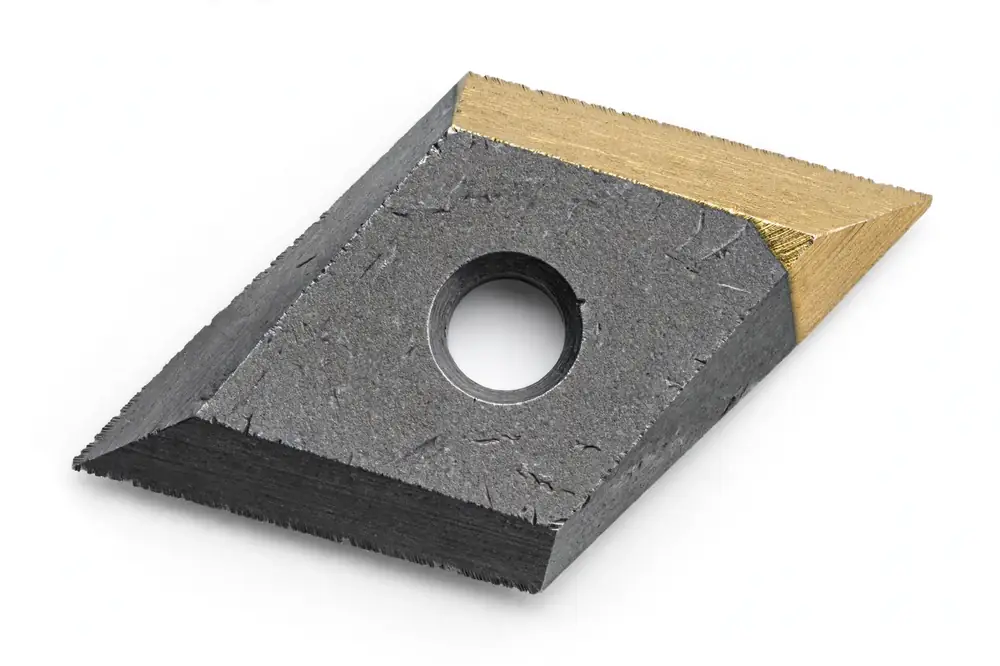
| Position | Code | Meaning |
|---|---|---|
| 1 — Shape | C | 80° diamond (rhombic). The workhorse turning shape: strong corners, good for facing and turning. |
| 2 — Clearance | N | 0° relief angle. A negative-rake insert: strong edge, needs a rigid setup, usually double-sided. |
| 3 — Tolerance | M | Medium tolerance class on the inscribed circle and thickness. G would be tighter (ground). |
| 4 — Hole / chipbreaker | G | Through-hole with chipbreaker on both faces — the insert clamps through the center hole. |
| 5 — Size | 12 | 12 mm cutting-edge length (the 1/2-inch nominal size). |
| 6 — Thickness | 04 | 4.76 mm thick (the 3/16-inch nominal size). |
| 7 — Nose radius | 08 | 0.8 mm nose radius (the 1/32-inch nominal size). |
After the size code comes the manufacturer's own suffix: the chipbreaker style and the grade. So a full designation like CNMG 120408-PM 4325 reads as the insert above, with a PM chipbreaker in grade 4325. The grade is the manufacturer's recipe — the first seven characters are the universal language.
The three tables shops reach for most. Bookmark this page.
| Code | Shape | Used for |
|---|---|---|
| C | 80° diamond | General turning and facing — the most common |
| D | 55° diamond | Profiling and lighter turning |
| S | Square, 90° | Strong edges, heavy turning and milling |
| T | Triangle, 60° | General turning, three edges per side |
| V | 35° diamond | Profiling and finishing |
| W | 80° trigon | Strong multi-corner turning |
| R | Round | Profiling, heavy depths, long edge engagement |
| Code | Relief angle | Meaning |
|---|---|---|
| N | 0° | Negative rake — strongest edge, double-sided inserts |
| B | 5° | Positive — lighter cutting |
| C | 7° | Positive — common in milling |
| P | 11° | Positive — the classic positive turning insert |
US shops still speak ANSI (CNMG 432); the rest of the world speaks ISO metric (CNMG 120408). They describe the same insert:
| ANSI | ISO | Edge length | Thickness | Nose radius |
|---|---|---|---|---|
| CNMG 432 | CNMG 120408 | 1/2 in (12.7 mm) | 3/16 in (4.76 mm) | 1/32 in (0.8 mm) |
| CNMG 431 | CNMG 120404 | 1/2 in (12.7 mm) | 3/16 in (4.76 mm) | 1/64 in (0.4 mm) |
| CNMG 433 | CNMG 120412 | 1/2 in (12.7 mm) | 3/16 in (4.76 mm) | 3/64 in (1.2 mm) |
| DNMG 432 | DNMG 150408 | 1/2 in (12.7 mm) | 3/16 in (4.76 mm) | 1/32 in (0.8 mm) |
| SNMG 432 | SNMG 120408 | 1/2 in (12.7 mm) | 3/16 in (4.76 mm) | 1/32 in (0.8 mm) |
The tolerance trap: M-tolerance inserts are the economical standard; G-tolerance inserts are ground to tighter tolerances for precision work. Do not pay for G when M holds your tolerance — and do not run M when the print demands G.
Turning inserts get the most attention, but milling has its own common codes using the same position logic. APKT 1604: A = 85° parallelogram shape, P = 11° clearance, K = tolerance class, T = hole with single-sided chipbreaker, 16 = 16 mm length, 04 = 4.76 mm thick. SEKT 1204: S = square, E = 20° clearance, K = tolerance, T = hole. Once the position system clicks, every manufacturer's catalog reads the same way.
Everything after the seven universal characters is the manufacturer's own language: chipbreaker style first, then the grade. In "CNMG 120408-PM 4325," PM names the chipbreaker geometry — each maker has its own chipbreaker lineup for finishing, medium, and roughing — and 4325 names the grade recipe. Two inserts with identical seven-character codes but different suffixes can cut very differently. The universal code tells you the shape; the suffix tells you the personality.
C = 80° diamond shape, N = 0° clearance, M = medium tolerance, G = hole with chipbreaker both sides, 12 = 12 mm edge length, 04 = 4.76 mm thick, 08 = 0.8 mm nose radius. The ANSI equivalent is CNMG 432.
The shape: C is an 80° diamond, D is a 55° diamond. The 55° point reaches into profiles and shoulders the 80° cannot, but its pointed corner is weaker. Same code system, different geometry.
The manufacturer's chipbreaker and grade — for example, -PM 4325 means a PM-style chipbreaker in grade 4325. That part is brand-specific; the first seven characters are the universal ISO language.
Read the three digits as fractions of an inch: 432 means 4/8-inch (1/2) edge length, 3/16-inch thickness, 2/64-inch (1/32) nose radius — which is ISO 120408. The tables above cover the common sizes.
The pressed or ground groove near the cutting edge that curls and breaks the chip into manageable pieces. Different chipbreaker styles suit finishing, medium, or roughing — and the wrong one turns a good insert into a bird's-nest machine.
Decode them with the tables above, keep what your machines can use, and sell the rest. Mystery inserts you will never run are still tungsten carbide with real value. There are no minimums: every bucket counts. Call 312-880-8174.
Decode the drawer — identify what is in the tool crib, use what you will use, sell the rest. Orphan inserts in odd sizes and grades you will never run are still tungsten carbide, worth real money by the pound. There are no minimums: a box of mystery inserts counts, and on bigger lots we handle the freight so you do not lift a finger. Call 312-880-8174.