Insert Designation Chart
Decode the code stamped on every insert: CNMG 120408 explained piece by piece.
VIEW PAGE →An insert talks before it fails. The wear on the edge, the finish on the part, and the sound of the cut all say when it is time to index or replace. Here is how to read those signs like a machinist.
Every insert dies in one of a few recognizable ways. Learn to name what you see, and you will know whether to index the edge, adjust the cut, or retire the insert.
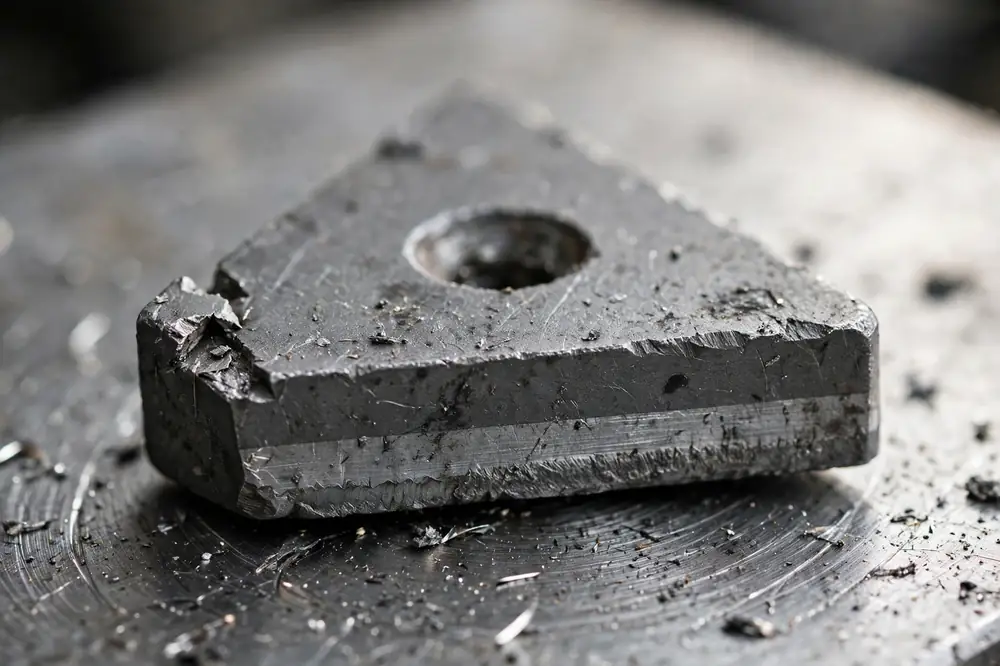
Flank wear is the flat worn band that forms on the clearance face just below the cutting edge. It is the most predictable wear mode: it grows steadily as the insert cuts, and it is how most inserts are supposed to die. When the wear land gets wide, cutting forces climb, heat climbs, and the edge is done. Index to a fresh corner or replace the insert.
Crater wear is a hollow scooped out of the rake face where the hot chip slides across the insert. It is driven by heat and chemical wear at high speeds, especially in steel. A deep crater weakens the edge until it collapses all at once. If you see cratering, the speed is usually too high for the grade — slow down or move to a more heat-resistant grade.
Chipping is small edge fractures along the cutting edge, common in interrupted cuts, scale-covered material, and unstable setups. A little micro-chipping is tolerable in roughing; gross chipping that you can feel with a fingernail means the edge is gone. Chipping often points at the setup, not the insert: check rigidity, runout, and entry conditions before blaming the grade.
Built-up edge is workpiece material welded onto the cutting edge, common in stainless steel, aluminum, and low-carbon steels at the wrong speeds. It changes the geometry, tears the finish, and eventually breaks off, taking carbide with it. Sharper geometry, the right coating, and enough speed to keep the chip moving usually clear it up.
Fine cracks across the edge, running perpendicular to the cutting edge, come from rapid heating and cooling — typically heavy coolant hitting a hot edge in interrupted cuts. If the cracks are there, back off the coolant in the interrupted cut or switch to a tougher grade. Cracked edges fail suddenly.
| What you see | What it means | What to do |
|---|---|---|
| Even wear band below the edge | Normal flank wear — the insert lived its life | Index or replace; this is the good outcome |
| Hollow on the rake face | Crater wear from heat at high speed | Reduce speed or upgrade the grade's heat resistance |
| Small fractures along the edge | Chipping from interruption or instability | Check rigidity and runout; consider a tougher grade |
| Material welded to the edge | Built-up edge | Sharper geometry, correct coating, adjust speed |
| Fine cracks across the edge | Thermal cracking | Ease coolant in interrupted cuts; tougher grade |
| Sudden edge collapse | Crater breakthrough or overload | Replace; review speed, feed, and grade choice |
You do not always need a loupe. The part and the cut itself report insert condition in real time.
Finish degradation is the earliest signal most operators trust. When a finish that was holding starts tearing, showing chatter marks, or drifting out of tolerance, the edge is usually the cause. Do not chase it with offsets for long — a worn edge work-hardens the material and makes the next insert's life harder too.
Sound and load are the second signal. A cut that gets louder, a spindle load meter climbing on the same program, or visible sparking in a cut that should not spark all point to an edge that is rubbing instead of cutting. Rubbing generates heat, heat accelerates wear, and the spiral ends with a failed edge or a scrapped part.
Burrs are the third. When exit burrs grow on a part that used to come off clean, the edge has lost its sharpness. In production, many shops set a hard parts-per-edge count based on when burrs or finish start to move, then index on schedule instead of waiting for failure. Predictable indexing beats heroic edge-stretching every time.
The money rule: an insert pulled early still has value, and an insert run to catastrophic failure can damage the part, the holder, or the next edge. Index on schedule. The pulled inserts — even chipped ones — go in the carbide bin, not the trash.
Look at every corner under magnification. If unused corners are still sharp, index to a fresh one. If all corners show heavy flank wear, cratering, or chipping, the insert is done. A used-up insert is still tungsten carbide with scrap value.
Sometimes in roughing, where finish does not matter and the chip is small. But chipping usually spreads, and a chipped edge hammers the workpiece and the machine. In finishing, a chipped insert is done the moment you see the chip.
Cratering is heat-driven chemical wear, most common running steel too fast for the grade. Drop the surface speed, make sure the grade suits the material, and check that the coating is intact. Persistent cratering at correct speeds means the grade is wrong for the job.
Stainless loves to weld itself to the cutting edge at moderate speeds with the wrong geometry. Use a sharp, positive-rake insert meant for stainless, the right coating, and enough speed to keep the chip flowing instead of sticking.
It depends on the material, the cut, and the grade — there is no universal number. The professional approach is to track parts per edge on your own jobs and index on a count with margin, so inserts retire predictably instead of failing mid-part.
Yes. Every insert you pull is sellable carbide, even chipped and cratered ones. Most shops toss thousands of inserts a year without realizing the bin has value. There are no minimums: a coffee can of used inserts is worth a call to 312-880-8174.
Every insert you pull is sellable — even chipped ones. Most shops toss thousands of inserts a year without a second thought. There are no minimums here: a coffee can of used inserts counts, and a drum counts too. On bigger lots, we handle the freight so you do not lift a finger. Call 312-880-8174 and cash in the bin.