How to Tell Carbide from HSS
Weight, spark, and marking tests that identify which material you are holding.
VIEW PAGE →Carbide cuts faster and lasts longer. High-speed steel costs less and forgives more. The right choice depends on your machine, your material, and your volume — here is the framework shops actually use to decide.
Neither material wins everywhere. Here is the straight comparison, without the sales pitch.
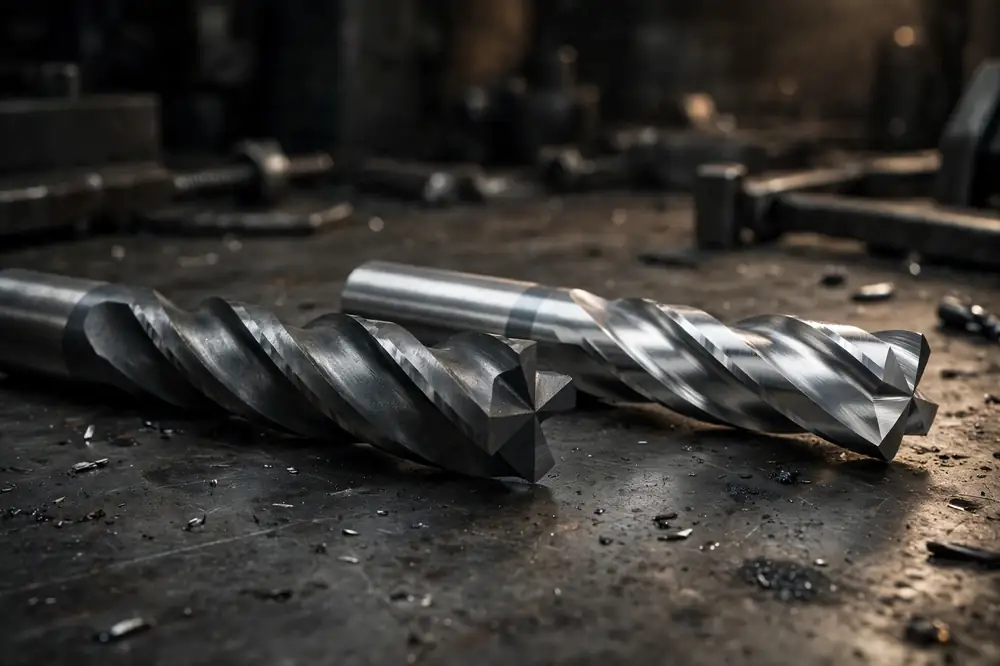
Carbide is dramatically harder and holds an edge at far higher temperatures. In practice that means three to five times the cutting speed of HSS, much longer tool life in production, and better finishes at those speeds. The trade: carbide is brittle. It hates vibration, interrupted cuts in weak setups, and any machine that cannot hold rigidity. It also costs more up front.
High-speed steel is tougher and far more forgiving. It survives chatter, shaky setups, and hand-fed work that would shatter a carbide tool. It is cheaper per tool, easy to resharpen on an ordinary wheel, and still the right answer for one-offs, delicate work, and machines without the rigidity or spindle speed to use carbide properly.
| Factor | Carbide | High-speed steel |
|---|---|---|
| Cutting speed | 3–5x faster than HSS | Slower, limited by heat |
| Tool life in production | Much longer at speed | Shorter, more tool changes |
| Toughness | Brittle — hates vibration and shock | Forgiving — survives shaky setups |
| Machine requirement | Needs rigidity and spindle speed | Works on lighter, slower machines |
| Up-front cost | Higher per tool | Lower per tool |
| Resharpening | Needs diamond or green-SiC wheels | Ordinary wheels work fine |
| Best for | Production, hard materials, CNC work | One-offs, manual machines, delicate cuts |
Run every tooling decision through these four questions and the answer usually picks itself.
This is the first question because it is disqualifying. Carbide in a shaky setup — worn spindle, long stick-out, flimsy workholding — chips and breaks, and then it was the most expensive way to fail. If the machine cannot hold the cut steady, HSS will actually outperform carbide by surviving. Fix the rigidity, or run HSS.
Hard, abrasive, or high-temperature materials push hard toward carbide: hardened steels, titanium, Inconel, cast iron in volume. Soft and gummy materials are the interesting middle — aluminum loves carbide at high speed, but HSS with a polished flute still does fine work in a home shop. Match the tool to the material's demands, not its reputation.
Volume is where carbide's higher price pays for itself. One bracket on a manual mill: HSS is cheaper and faster to set up. Five hundred brackets on a CNC: carbide's speed and tool life crush HSS on cost per part, and fewer tool changes mean more spindle time making money.
Do the real math: tool price divided by parts per edge (or per tool). A $40 carbide end mill that cuts 200 parts costs $0.20 per part in tooling. A $12 HSS end mill that cuts 20 parts costs $0.60 per part — triple, despite the cheaper sticker. Shops that run this math on their real numbers almost always find production belongs to carbide.
Not sure which you are holding? Carbide and HSS look similar at a glance. Our guide to telling them apart walks through the weight, spark, and marking tests: How to Tell Carbide from HSS.
Changing a shop from HSS to carbide — or back — costs more than the tools. Speeds and feeds change completely, holders and collets may need upgrading to control runout, and operators need time to learn the new material's temperament. Price the transition honestly: the first month of carbide in an HSS shop includes broken tools while everyone learns that carbide punishes the habits HSS forgives. The payoff comes after the learning curve, not during it.
Most real shops run both. Carbide on the CNCs where rigidity and volume justify it; HSS on the manual machines, for one-offs, and for the delicate work where forgiveness matters more than speed. There is no prize for purity — the prize is the lowest tooling cost per part on every job, and that number often comes from a mixed tool crib.
No. Carbide wins on speed and tool life in rigid, production setups. HSS wins on toughness, forgiveness, and price in shaky setups, one-off work, and manual machines. The machine and the job pick the winner, not the material's reputation.
Carbide is hard but brittle — it does not bend, it fractures. Vibration, excessive stick-out, loose workholding, and interrupted cuts in weak setups all chip or snap it. If carbide keeps breaking, the setup needs stiffening before the tool gets blamed.
Yes, with care. Keep stick-out short, the setup rigid, and the speeds reasonable. Many manual machinists run carbide successfully; the failures come from treating it like HSS and pushing it through chatter.
Usually carbide in production, HSS in one-offs. Divide the tool price by the parts it produces. Carbide's higher price spreads across far more parts at far higher speeds, which is why production shops standardized on it decades ago.
Very little compared to carbide. HSS is a steel alloy with small amounts of tungsten, molybdenum, and other elements — worth something as alloy scrap, but nothing like solid tungsten carbide. This is one more reason carbide's higher up-front cost comes back at end of life.
Yes — there are no minimums, and every bucket counts. A handful of worn end mills is worth the call just as much as a full drum. On bigger lots, we handle the freight so you do not lift a finger. Call 312-880-8174.
Carbide costs more up front — and it is worth more at end of life. HSS has no comparable scrap value, which is one more line in carbide's favor on the real cost-per-part math. When your carbide tools are done, there are no minimums: a few worn end mills or a full drum, every bucket counts. On bigger lots, we handle the freight so you do not lift a finger. Call 312-880-8174.