Carbide Grades Explained
What separates one carbide formulation from another: ISO letters, C-grades, and binders.
VIEW PAGE →Carbide tools are not machined from a block of metal. They are built from powder, pressed into shape, and baked until the particles fuse — a process that explains exactly why your worn tools are still valuable.
Tungsten carbide tooling is made by powder metallurgy: fine powders are blended, pressed, and sintered into a solid. No melting, no casting — the metal never becomes liquid.
It starts with tungsten: tungsten ore is refined and reacted with carbon at high temperature to form tungsten carbide powder — extremely hard, microscopic grains. That powder is then blended with a metal binder, almost always cobalt, typically between about 3 and 25 percent depending on the grade. More cobalt means a tougher tool; less cobalt means a harder, more wear-resistant one. Grain size is controlled too: fine micrograin for sharp precision edges, coarser grain for impact resistance.
The blended powder is pressed into shape in dies, or compacted uniformly from all sides by cold isostatic pressing for larger parts. What comes out is called a green compact: it holds its shape but is fragile, like a pressed sugar cube. It is deliberately made oversize, because the next step shrinks it.
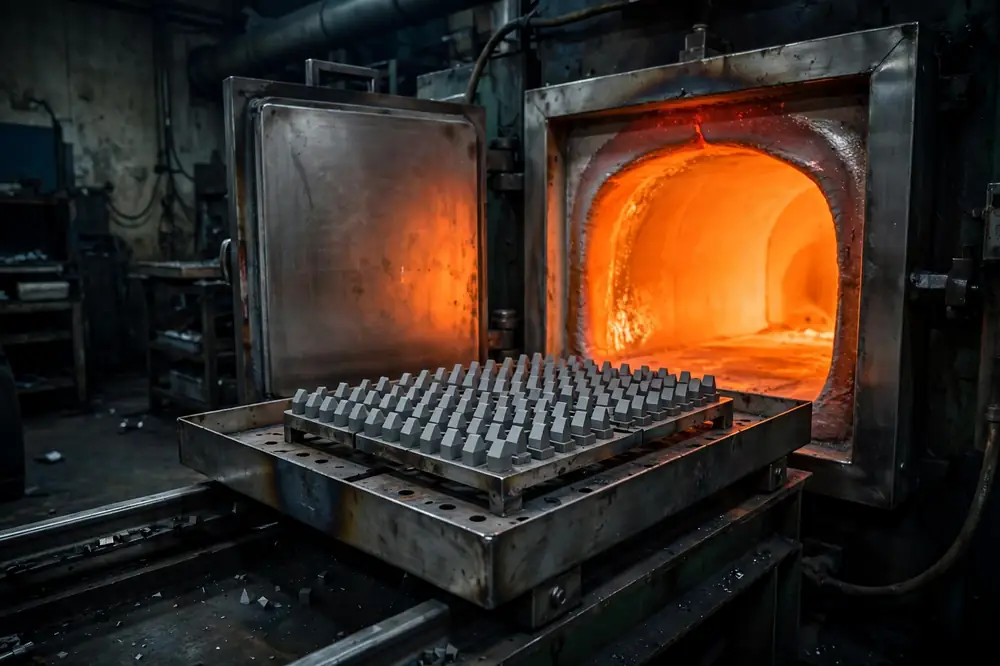
The compacts go into vacuum or controlled-atmosphere furnaces and are heated to roughly 1,400°C and beyond. The cobalt binder melts and flows between the tungsten carbide grains, which bond together without the carbide itself melting. The part densifies and shrinks — roughly a fifth smaller in every dimension — emerging as fully dense, fully hard tungsten carbide. Modern sinter-HIP (hot isostatic pressing) cycles apply pressure during sintering to eliminate any remaining porosity.
Sintered carbide is already near final shape, but cutting edges need precision. Diamond grinding wheels finish the edges, flutes, and critical surfaces to final tolerance, and coatings like TiN or AlTiN go on last for grades that need them.
Here is the fact that makes the whole carbide recycling industry possible: tungsten is effectively indestructible in use.
A cutting edge fails because the microscopic edge geometry breaks down — wear, chipping, heat damage at the very tip of the tool. But the tungsten atoms themselves are unchanged. Melt down a worn end mill and recover the tungsten, and it is chemically identical to freshly mined tungsten. Carbide does not degrade, fatigue, or lose its properties with use the way a steel spring or a battery does.
That is why tungsten carbide is one of the most recycled industrial materials on earth, and why recycled carbide performs identically to virgin carbide in new tools. The tungsten in a worn insert you pull today can become the cutting edge of a new insert tomorrow, with zero loss of quality. When people say tungsten does not wear out — only the edge does — this is what they mean.
Tungsten carbide cannot be cast like steel — its melting point is far too high and the chemistry would not survive the melt. Powder metallurgy sidesteps the problem entirely: instead of melting the material, it presses the particles together and fuses them with heat and a molten binder. The result is a fully dense part with a uniform microstructure that no casting process could produce at these hardness levels. Nearly every ultra-hard industrial material — from carbide to ceramics — is made this way for the same reason.
The same four stages produce every carbide grade on earth; what changes is the recipe. More cobalt for toughness, less for hardness. Finer grain for sharper edges, coarser for impact. Titanium and tantalum carbides for steel-cutting grades, none for the straight grades. When you hold two inserts that look identical but carry different grade codes, you are holding two different recipes from the same kitchen — and the recipe is what the grade code describes.
The takeaway for your shop: every worn tool in the building is a small package of virgin-quality tungsten waiting for its next life. The recycling loop is closed, proven, and pays the shop that feeds it.
Tungsten carbide powder bonded with a metal binder, almost always cobalt. The tungsten carbide grains provide extreme hardness; the cobalt holds them together and adds toughness. Typical binder content runs from about 3 to 25 percent.
Heating pressed powder compacts until the particles fuse into a solid without melting the main material. In carbide, the cobalt binder flows at sintering temperature and bonds the tungsten carbide grains. The part shrinks roughly a fifth in every dimension as it densifies.
The pressed powder compact is full of microscopic voids between particles. As sintering fuses the grains together, those voids close and the part densifies, which makes it physically smaller. Tooling is pressed oversize to account for it.
Yes. Recovered tungsten is chemically identical to virgin tungsten, so recycled carbide performs identically in new tools. The recycling loop loses no quality — which is why the industry recycles it so aggressively.
It is extremely hard, dense, and heat-resistant, with limited global supply concentrated in a few countries. Those properties make it irreplaceable in cutting tools, mining, and wear parts — and make every scrap of it worth recovering.
Worn tools are still solid tungsten carbide, and the tungsten in them is as valuable as ever. There are no minimums: a drawer of dead tools or a drum of shop cleanout, every bucket counts. On bigger lots, we handle the freight so you do not lift a finger. Call 312-880-8174.
This is why your worn tools are valuable — they are sintered tungsten and cobalt, and tungsten does not wear out. Only the edge does. Every dull end mill, every used insert, every broken drill in the shop is virgin-quality tungsten waiting for its next life as a new tool. There are no minimums: every bucket counts, and on bigger lots we handle the freight so you do not lift a finger. Call 312-880-8174.