How to Tell Carbide from HSS
The full identification guide: weight, spark, and marking tests.
VIEW PAGE →A magnet sticks to tungsten carbide — and that surprises everyone who was told carbide is non-magnetic. The magnet is not lying, and the tool is not steel. Here is what is actually happening.
Tungsten carbide tooling is tungsten carbide grains held together by a metal binder — almost always cobalt. Cobalt is ferromagnetic, and that is the whole story.
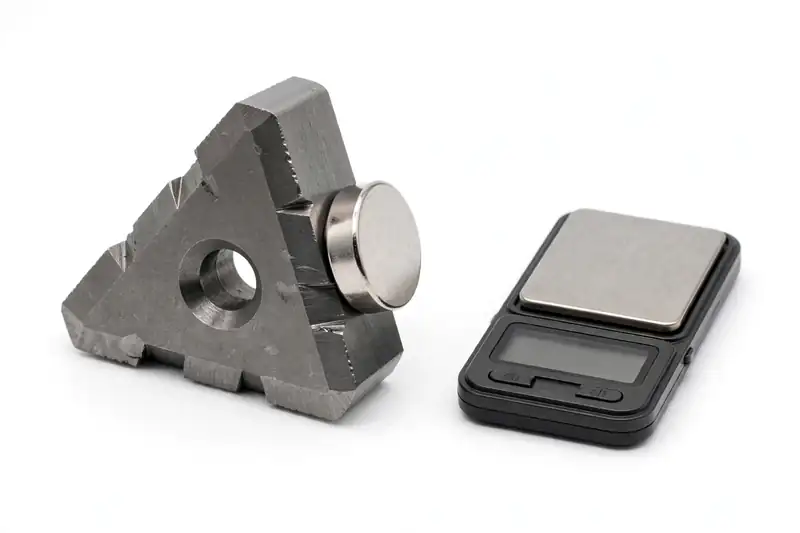
Tungsten carbide itself is only weakly magnetic. But the cobalt binder — typically 3 to 25 percent of the tool — is strongly ferromagnetic, just like iron and nickel. The magnet is attracted to the cobalt distributed through the tool, so the whole insert or end mill responds to a magnet. It is not steel, it is not a fake, and nothing is wrong with it. That is simply how cemented carbide behaves.
The magnetism varies with the recipe. Higher-cobalt grades — the tougher ones — pull a magnet more strongly. Lower-cobalt grades pull more weakly. Some specialty grades use nickel binder instead of cobalt, and those respond differently. But for the standard tooling in your shop, expect the magnet to stick.
The myth, corrected: "carbide is non-magnetic" is one of the most repeated falsehoods in machining and scrapping. Real tungsten carbide tooling is magnetic. Anyone testing carbide with a magnet and concluding "it sticks, so it must be steel" has it exactly backwards.
If the magnet cannot tell carbide from steel, what can? Density.
Tungsten carbide is extraordinarily dense: roughly 14 to 15 grams per cubic centimeter, nearly twice the density of steel at 7.85. Pick up a carbide end mill and a steel end mill of the same size, and the carbide one feels shockingly heavy — that heft is unmistakable once you have felt it, and it is the most reliable field test there is.
The practical identification sequence for a mystery tool:
For sellers, the practical upshot: do not let a magnet talk you out of money. Plenty of shops have tossed magnetic carbide assuming it was steel. If it is heavy, marked like tooling, and came from cutting service, it deserves a carbide quote before it goes anywhere.
The "carbide is non-magnetic" claim likely started as a garbled version of a real fact: tungsten carbide powder and pure tungsten are only weakly magnetic, and some non-cobalt specialty grades behave differently. Somewhere along the way, "some forms" became "all carbide," and the myth stuck because it sounds scientific. The cemented carbide in actual cutting tools — with its cobalt binder — has always been magnetic.
Professional carbide buyers do not grade with a magnet. They identify the tooling type, weigh it, and test for carbide content — by XRF analyzer, chemical assay, or density checks depending on the lot. The magnet never enters the valuation. Any buyer who prices carbide off a magnet test is not grading it professionally.
Carbide's magnetism has one practical shop consequence worth knowing: magnetic chip conveyors and magnetic separators in coolant systems pull carbide fines out of the coolant along with the steel chips. That is good news twice over — cleaner coolant and a concentrated carbide stream collecting exactly where the separator dumps. If your shop runs magnetic separation, the separator's catch is a tungsten stream: keep it apart from the steel chips and it has real value as carbide-bearing material.
No. The magnetic response is far too weak to influence cutting forces, chip formation, or tool performance. It matters for identification, for separation equipment, and for winning arguments — not for speeds and feeds.
Yes. The cobalt binder in standard cemented carbide is ferromagnetic, so a magnet sticks to real carbide tooling. Non-magnetic carbide is the myth, not the rule.
No. It means it has a cobalt binder, which is what the vast majority of real carbide tooling uses. Magnetism says nothing about authenticity either way.
Higher cobalt content means stronger magnetic pull. Tougher grades with more binder respond more; harder low-cobalt grades respond less. Nickel-binder specialty grades behave differently again.
By weight. Tungsten carbide is nearly twice as dense as steel — about 14–15 g/cm³ versus 7.85. A carbide tool of a given size feels dramatically heavier than its steel lookalike. Markings and the spark test confirm it.
Iron, nickel, and cobalt are the three ferromagnetic elements at room temperature — and many of their alloys. Plenty of non-steel materials respond to magnets, which is why the magnet test alone misleads so often.
No. The magnet sticks because of the cobalt — not because it is steel. Ironcrest pays on carbide content, not magnet tests: identified, weighed, and graded honestly. There are no minimums: every bucket counts. Call 312-880-8174.
The magnet sticks because of the cobalt — not because it is steel. Weight is the real test, and Ironcrest pays on carbide content, not magnet tests. If you have tooling you are unsure about, there are no minimums and no silly questions: a single mystery tool or a full drawer, every bucket counts. On bigger lots, we handle the freight so you do not lift a finger. Call 312-880-8174.