Fixture the tip and shank
Seat the carbide tip in the milled pocket with flux on both faces. Fixture or wire it so it cannot shift when the alloy flows — a tip that moves mid-braze makes a bad joint.
Carbide cannot be welded like steel — it is brazed, with a silver alloy that flows between the tip and the shank. Done right, the joint outlasts the tool. Here is the shop-grade process.
Brazing fumes are hazardous. Some silver braze alloys contain cadmium, and cadmium oxide fume is severely toxic. Even cadmium-free alloys produce metal fumes that demand ventilation.
Brazing safety baseline: Braze only with local exhaust ventilation or outdoors with the wind at your back, and wear a respirator rated for metal fumes. Know whether your alloy contains cadmium — if it does, the fume controls are critical, not casual. Never imply or assume any braze fume is safe to breathe. This guide is information, not training or certification.
One more absolute: carbide is never fusion-welded. There is no puddle, no arc on the carbide, no TIG bead joining carbide to steel. Brazing works because the silver alloy wets both surfaces and flows into the joint by capillary action at temperatures the carbide tolerates. Anyone telling you to weld carbide is telling you to destroy it.
Brazing is capillary action: molten alloy flows into a tight, clean gap. The gap and the cleanliness matter more than the torch work.
Fit-up: aim for a joint clearance of roughly two to five thousandths of an inch between the carbide tip and the steel seat. Too tight and the alloy cannot flow in; too loose and the joint is weak and alloy-hungry. Mill or grind the seat flat, and make sure the tip sits fully supported with no rocking.
Cleanliness: both surfaces must be bare metal — no oil, no oxide, no fingerprints. Degrease, then abrade or pickle the steel seat. Carbide tips are usually supplied ready to braze; do not grind the brazing face aggressively, just make sure it is clean.
Alloy selection: silver brazing alloys (the BAg family) are the standard for carbide-to-steel joints, flowing in the roughly 1,100–1,300°F range. Match the alloy to the service: higher-silver alloys for demanding joints, and check cadmium content so your ventilation plan matches the fume hazard. Use a flux rated for the alloy and the temperature — flux keeps oxides off the joint while the alloy flows.
Seat the carbide tip in the milled pocket with flux on both faces. Fixture or wire it so it cannot shift when the alloy flows — a tip that moves mid-braze makes a bad joint.
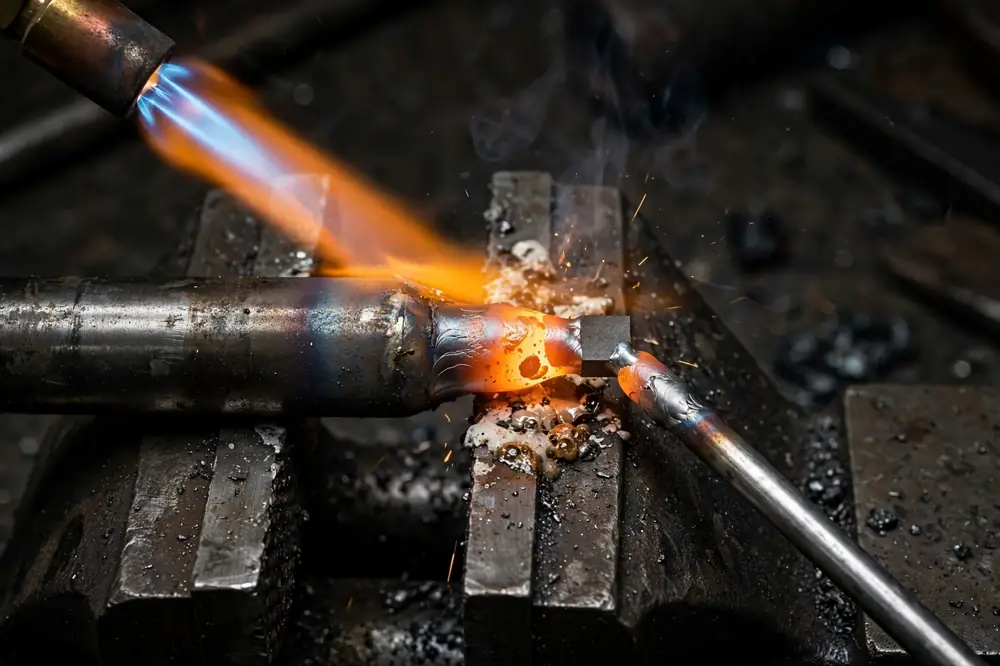
Play the torch on the steel shank around the joint, letting conduction bring the carbide tip up to temperature. Heating the carbide directly risks thermal shock; the steel is the heat sink and the heat source in one.
Watch the flux: it goes clear and active as the joint approaches brazing temperature. Keep the flame soft and slightly carburizing, moving to heat the joint evenly rather than blasting one spot.
Touch the silver alloy rod to the joint edge. When the temperature is right, the alloy melts and wicks into the joint by capillary action. Feed until a small, even fillet shows all around — then stop. More alloy does not make a stronger joint.
This is where carbide tips are lost. Let the assembly cool slowly in still air. Quenching or forced cooling thermally shocks the carbide and cracks the tip, sometimes invisibly, until it fails in the cut. Slow cooling is part of the joint's strength.
Remove flux residue with hot water and a brush — leftover flux corrodes. Inspect the fillet all around the tip: it should be continuous and even. Then grind the tool to final geometry with a green silicon-carbide or diamond wheel, wet, with dust controls.
Almost every brazed-tip failure traces to one of three causes, and all three are preventable.
Thermal shock is the big one: heating the carbide too fast, cooling it too fast, or quenching. Carbide handles steady heat well and sudden temperature change badly. Preheat through the steel, cool in still air, and never water-quench a fresh braze.
Bad fit-up is the second: a rocking tip or an oversized gap starves parts of the joint of alloy and concentrates stress. The two-to-five-thousandths clearance and a flat seat are not suggestions.
Overheating the alloy is the third: cooking the joint past the alloy's range burns out the flux and boils off alloying elements, leaving a porous, weak joint. Heat to flow temperature, feed the alloy, and get the torch off.
Brazed vs solid carbide: brazed tooling and solid carbide tooling are different animals — in the cut and in the scrap bin. Our comparison walks through both: Brazed vs Solid Carbide Tooling.
No — not by fusion welding. Carbide is joined to steel by brazing, where a silver alloy flows between the parts by capillary action. An arc or fusion weld on carbide destroys it. If a job needs a carbide edge on a steel body, brazing is the process.
A silver brazing alloy that wets both the carbide and the steel and solidifies in the joint gap. The bond is metallurgical, not glue — a properly brazed tip is stronger than the stresses of cutting.
Almost always thermal shock: heated too fast, cooled too fast, or quenched. Slow, even heating through the steel and slow air cooling prevent it. A cracked tip cannot be saved — replace it.
Know what your alloy contains and ventilate for it. Cadmium-bearing alloys produce severely toxic fume and demand serious ventilation; cadmium-free alloys still produce metal fume that needs exhaust. The ventilation decision starts with reading the alloy's safety data sheet.
Stronger than the cutting forces it will see, when the fit-up, alloy, and thermal cycle are right. Brazed tooling has held carbide edges in production for the better part of a century.
Brazed tooling is its own scrap category: the carbide tip plus the steel shank, both recoverable, priced on the carbide content. There are no minimums — a box of worn brazed tools counts. On bigger lots, we handle the freight so you do not lift a finger. Call 312-880-8174.
Brazed tooling is its own scrap category — carbide tip plus steel shank, both recoverable. When brazed tools retire, the carbide does not stop being carbide. There are no minimums: a box of worn brazed lathe tools counts, and a drum counts too. On bigger lots, we handle the freight so you do not lift a finger. Call 312-880-8174.