Carbide Grades Explained
The full ISO P/M/K system and what separates one grade from another.
VIEW PAGE →Stainless punishes the wrong insert: it work-hardens, welds to the edge, and runs hot. The right insert is sharp, positive, coated for heat — and chosen for stainless on purpose, not by accident.
Stainless steel is not just hard — it is adversarial. Three properties gang up on the cutting edge.
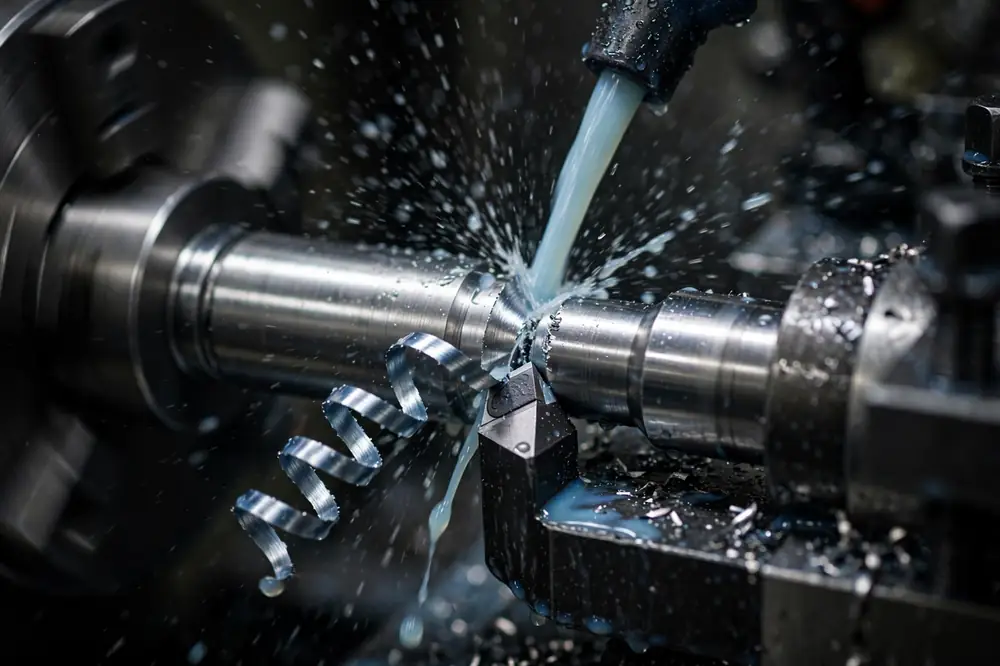
Work hardening is the headline act. Let the tool rub instead of cut — even for a moment — and the stainless surface hardens into something far tougher than what you started with. Every subsequent pass then fights that hardened skin. The rule is absolute: the edge must always be cutting, never rubbing.
Built-up edge is the second attacker. Stainless loves to weld itself to the cutting edge, changing the geometry and tearing the finish. Sharp, polished edges with the right coating resist it; dull or wrong-coated edges invite it.
Heat is the third. Stainless conducts heat poorly, so the heat of cutting stays at the edge instead of flowing into the chip and the part. The insert needs a grade and coating built for sustained high edge temperature.
The independent note: this guide is brand-agnostic. Every major manufacturer — Sandvik, Kennametal, Iscar, and the rest — makes stainless grades that follow the same principles below. Ironcrest is an independent carbide buyer, not affiliated with any tool brand. Match the principles to whatever brand your crib stocks.
Four choices define a stainless insert. Get all four right and stainless becomes just another material.
In the ISO system, M is the stainless application group (blue is steel's P, yellow is stainless's M). M-class grades balance the toughness to survive stainless's demands with the wear resistance to hold an edge. Within M, lower numbers (M10–M20) suit finishing and stable conditions; higher numbers (M30–M40) bring the toughness for roughing and less-than-ideal setups.
Stainless wants a keen edge and positive rake — the geometry that slices instead of pushing. Positive inserts (11° clearance and similar) cut with lower forces, which means less heat and less work hardening. Negative-rake brute-force geometry belongs on carbon steel, not here.
TiAlN, AlTiN, or AlCrN: the coatings that form a protective oxide skin at high temperature. In stainless, the edge runs hot by nature — the coating is not optional decoration, it is thermal armor. Match the coating to the operation's heat: finishing can run lighter coatings, heavy roughing wants the toughest.
Stainless makes long, stringy chips that wrap around everything. A chipbreaker designed for stainless — usually an open, positive design — curls and breaks the chip before it becomes a bird's nest around the toolholder.
| Operation | Insert guidance | Key notes |
|---|---|---|
| Turning / facing | M-class, positive geometry (e.g., CCMT/DCMT style) | Keep depth of cut below the work-hardened skin from prior passes |
| Milling | M-class with AlTiN/AlCrN, sharp edges | Climb mill to keep the edge cutting, not rubbing, on entry |
| Drilling | Stainless-rated carbide drill, polished flutes | Peck carefully — dwelling work-hardens the hole bottom |
| Threading | Sharp-profile stainless threading insert | Full-profile inserts reduce passes and heat |
| Parting / grooving | Narrow, sharp, well-cooled | Flood coolant; parting is the highest-risk stainless operation |
Run stainless slower than carbon steel. A conservative starting range for carbide is roughly 200–350 surface feet per minute, with the lower end for gummy austenitic grades like 304 and 316 and the higher end for free-machining grades. Feed aggressively enough that every tooth cuts on every revolution — a timid feed rubs, work-hardens the surface, and destroys the edge faster than pushing too hard. Depth of cut should get under the work-hardened skin left by the previous pass; skim passes on stainless are an edge-killer.
First, dwelling: letting the tool spin in the cut without feeding, which work-hardens a skin the next pass must fight. Second, recutting work-hardened skin with a shallow finishing pass — take the finish pass deep enough to get under it. Third, running a dull edge a little longer: in stainless, a dull edge does not just cut poorly, it hardens the part for every tool that follows. Index early in stainless; the pulled insert still has full scrap value.
The M group — yellow-coded in the ISO system. M-class grades are formulated for stainless steel's combination of work hardening, heat, and built-up edge. P is for carbon steel, K for cast iron.
Its metallurgy: deforming the surface without cutting it transforms the grain structure into a harder layer. Any rubbing — a dull edge, too-light feed, dwelling in a cut — hardens the surface the next pass must cut through.
Yes, generously, in most operations. Stainless keeps heat at the edge, and coolant carries it away while preventing built-up edge. The exception is some interrupted cuts where thermal shock from coolant can crack the edge — there, air blast or dry with the right coating wins.
Slower than carbon steel — typically in the 200–350 SFM starting range for carbide, adjusted to the alloy. Austenitic grades like 304 and 316 are the gummiest; keep the edge sharp and the feed positive so it never rubs.
You can finish the job, but you will pay for it in tool life. Steel (P-class) grades and geometry are not built for stainless's heat and work hardening. The right M-class insert usually pays for itself in edges saved.
Premium grades, premium scrap — specialty stainless and superalloy grades are still tungsten carbide at end of life, and they are all worth real money. There are no minimums: every bucket counts. Call 312-880-8174.
Premium grades, premium scrap — specialty grades are still carbide at end of life. Every stainless insert you retire, from M-class turners to AlCrN-coated mill inserts, is tungsten carbide worth real money. There are no minimums: a coffee can of used inserts or a full drum, every bucket counts. On bigger lots, we handle the freight so you do not lift a finger. Call 312-880-8174.