Resharpen or Replace?
What regrinding does to coatings — and when recoating pencils out.
VIEW PAGE →That gold, bronze, or violet-gray finish on a carbide tool is a coating only microns thick — and it can double tool life in the right material or do nothing in the wrong one. Here is what each coating does and where it belongs.
Modern carbide coatings go on by PVD (physical vapor deposition): the tool sits in a vacuum chamber while vaporized coating material condenses onto it in a layer a few microns thick. Thin, but transformative.
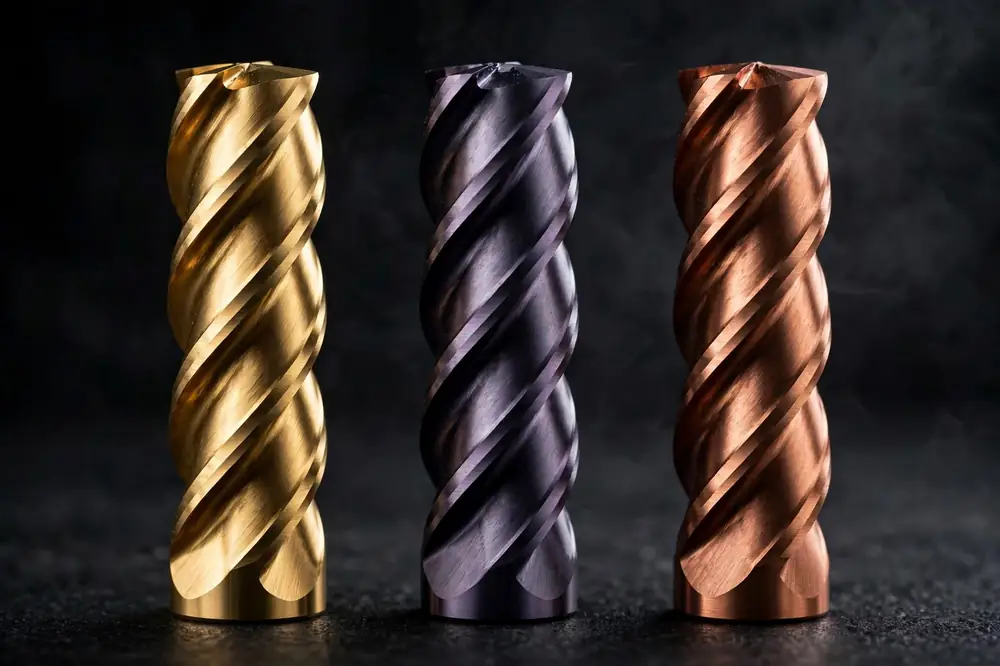
The original and still the general-purpose workhorse. The familiar gold color. TiN adds surface hardness and lubricity, reduces built-up edge, and suits a wide range of steels and general machining. If a coating had a default setting, this would be it.
Harder than TiN, with better abrasion resistance. The step up for harder steels and more abrasive work where TiN wears through too fast. The blue-gray color distinguishes it on the tool.
The high-heat coatings. Aluminum in the coating forms a protective aluminum-oxide skin at cutting temperature, which is why these coatings thrive in high-speed and dry machining where the edge runs hot. AlTiN (higher aluminum content) pushes this further for hard milling and difficult steels. The violet-gray to nearly black appearance is the giveaway.
Built for stainless steel, titanium, and superalloys: excellent hot hardness and oxidation resistance where the cut runs hottest and the material fights back hardest.
For non-ferrous and abrasive materials: aluminum with high silicon content, graphite, composites, ceramics. Diamond coatings are brutally hard and chemically inert against aluminum — but never for steel, where the carbon in the coating reacts with the iron at cutting temperature and the coating dies fast.
Match the coating to the material and the heat of the cut. The wrong coating is just expensive decoration.
| Material | First-choice coatings | Why |
|---|---|---|
| Carbon and alloy steels | TiN, TiCN | General hardness and lubricity; TiCN where abrasion is higher |
| Stainless steel | TiAlN, AlTiN, AlCrN | High-heat resistance fights work hardening and hot edges |
| Cast iron | TiN, AlTiN | Abrasion resistance against the abrasive iron structure |
| Aluminum | Uncoated polished, ZrN, diamond | Prevent built-up edge; diamond for high-silicon alloys |
| Titanium and superalloys | AlTiN, AlCrN | Maximum hot hardness where the cut runs hottest |
| Hardened steels (45+ HRC) | AlTiN, TiAlN | Heat resistance for hard milling and finishing |
| Graphite, composites | Diamond | Extreme abrasion resistance; nothing else survives |
The aluminum exception: many shops run aluminum with uncoated, highly polished carbide. Coatings can actually promote built-up edge in gummy aluminum — sometimes the best coating is no coating and a mirror polish.
About scrap value: coatings are microns thin and do not change what is underneath. A gold TiN end mill and a bare one are the same tungsten carbide — coatings neither add nor reduce scrap value.
Most modern tool coatings go on by PVD — physical vapor deposition. The tools hang in a vacuum chamber while vaporized coating material condenses onto them atom by atom, building a layer just a few microns thick. PVD runs cool enough that the carbide's properties survive the process, which is why it dominates cutting-tool coatings. The older CVD (chemical vapor deposition) process runs hotter and builds thicker layers; it still rules for some indexable inserts where the heat is tolerable and the thickness is an advantage.
A coating is only as good as the edge underneath it. Coaters hone the cutting edge before coating — a microscopic rounding that gives the thin film something to grip. Too sharp an edge and the coating flakes at the very tip; too much hone and the tool pushes instead of cutting. When a coated tool underperforms, the edge prep is as likely a culprit as the coating chemistry.
Titanium nitride (TiN), the general-purpose PVD coating. It adds surface hardness and lubricity and suits a wide range of steels. The gold color is the classic identifier.
Both are titanium aluminum nitride; AlTiN has higher aluminum content, which forms a tougher protective oxide skin at high temperature. AlTiN generally handles hotter, harder cuts — hard milling and difficult steels — better than standard TiAlN.
In the right material, dramatically — sometimes multiples of uncoated life. In the wrong material, barely at all. The coating has to match the material and the heat of the cut to earn its keep.
Yes, but the regrind removes the coating from the cutting edge. The tool still cuts well uncoated for many jobs; recoating restores full performance at a price. Compare recoat-plus-regrind against new.
TiAlN, AlTiN, or AlCrN — the high-heat coatings. Stainless work-hardens and runs hot, which is exactly the environment these coatings are built for.
No. Coatings are microns thin and do not change the underlying carbide. A coated tool and an uncoated tool of the same size are the same scrap value — the carbide underneath is what counts. There are no minimums: every bucket counts. Call 312-880-8174.
That gold or violet-gray coating is not decoration — and it does not hurt scrap value either. The carbide underneath is what counts, coating or no coating. When coated tools retire, there are no minimums: a handful of worn end mills or a full drum, every bucket counts. On bigger lots, we handle the freight so you do not lift a finger. Call 312-880-8174.