Your Friendly Guide to All Things Electrical Wire
The hub page: learning paths, the full wire family, and every tool in one place.
VIEW HUB →I am Sonny, and this is the page I built for the truck visor and the phone bookmark. Every common copper gauge from 14 AWG to 4/0, with diameters, uses, and real NEC ampacity.
This chart gives you the numbers — diameters, ampacities, and the code behind them — so you can understand wire sizing and check your own knowledge. Sizing conductors and overcurrent protection for a real installation, with derating, voltage drop, and termination ratings all accounted for, belongs to licensed electricians. Use the chart to learn and to verify. When the work starts, bring in the pro, and always check your local amendments.
Ampacity per NEC 2023 Table 310.16, 75°C column, copper conductors. Diameters are for solid conductors. This chart is the star tool of your friendly guide to all things electrical wire — pair it with how to choose electrical wire when you are picking a product, not just a size. Tip: use your browser's print function for a clean one-page copy.
| AWG | Diameter (in) | Diameter (mm) | Ampacity 75°C | Typical breaker | Common uses |
|---|---|---|---|---|---|
| 14 | 0.0641 | 1.63 | 20 A | 15 A * | Lighting circuits |
| 12 | 0.0808 | 2.05 | 25 A | 20 A * | Receptacles, kitchens, bathrooms |
| 10 | 0.1019 | 2.59 | 35 A | 30 A * | Water heaters, 30 A appliances |
| 8 | 0.1285 | 3.26 | 50 A | 40–50 A | Electric ranges, large AC units |
| 6 | 0.1620 | 4.11 | 65 A | 50–60 A | EV chargers, hot tubs, subpanel feeders |
| 4 | 0.2043 | 5.19 | 85 A | 70–80 A | Subpanel feeders, large equipment |
| 3 | 0.2294 | 5.83 | 100 A | 80–100 A | Feeder circuits |
| 2 | 0.2576 | 6.54 | 115 A | 90–100 A | Feeders, small services |
| 1 | 0.2893 | 7.35 | 130 A | 100–125 A | Service and feeder conductors |
| 1/0 | 0.3249 | 8.25 | 150 A | 125–150 A | Service entrance, large feeders |
| 2/0 | 0.3648 | 9.27 | 175 A | 150–175 A | 200 A residential services |
| 3/0 | 0.4096 | 10.40 | 200 A | 175–200 A | Large services and feeders |
| 4/0 | 0.4600 | 11.68 | 230 A | 200–225 A | 200 A+ services, large feeders |
Code note — 240.4(D) small-conductor rule: 14, 12, and 10 AWG copper are hard-capped at 15, 20, and 30 amps of overcurrent protection, regardless of the ampacity column. For larger gauges, the breaker is sized to the load by the pro per NEC 240.4 — the ranges above are the pairings you will see most often.
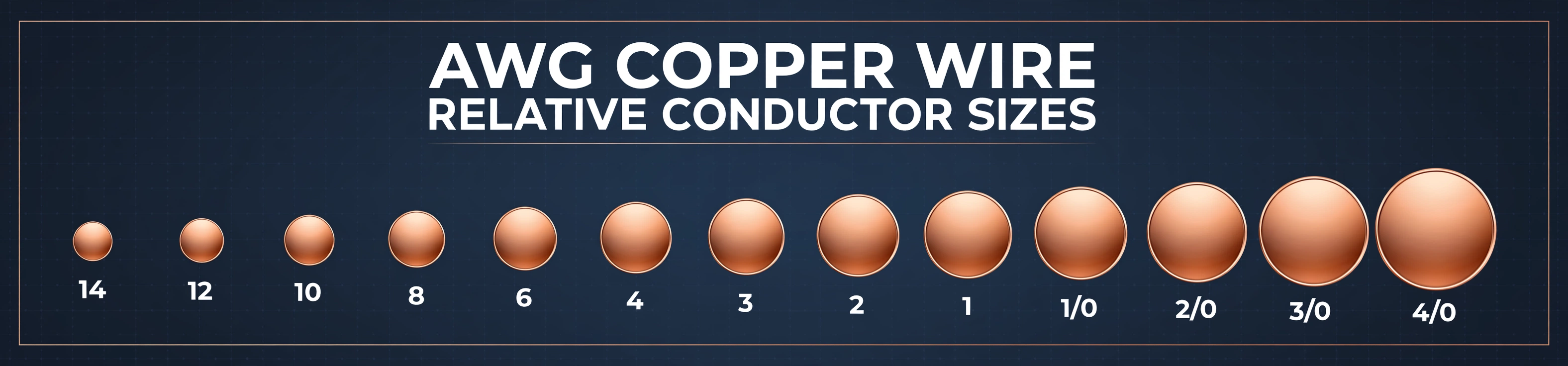
This chart's ampacity comes from the 75°C column because most modern breakers, panels, and devices carry 75°C-rated terminations, and the lowest-rated termination in the circuit governs. Older 60°C equipment — and cable types capped at 60°C by their own articles, like NM-B and AC — use the 60°C column instead. When you are unsure, the termination rating decides, and the pro on the job knows it.
The table assumes 30°C (86°F) ambient temperature and no more than three current-carrying conductors in a raceway or cable. A hot attic in August or a conduit packed with circuits changes the math: the code's correction and adjustment factors multiply the ampacity down, sometimes a lot. Derating calculations are licensed-pro territory — but now you know they exist, which puts you ahead of everyone who sizes straight off the chart.
The diameters above are for solid conductors. Stranded wire of the same gauge has the same copper cross-section (and the same ampacity) but a slightly larger overall diameter, because the strands do not pack perfectly. For pulling, bending, and terminating, stranded is friendlier; for the chart, the gauge is what matters.
American Wire Gauge — the standard system for sizing electrical wire in North America. The numbers run backwards from what you would expect: bigger number means thinner wire. So 14 AWG is thinner than 12 AWG, and 12 AWG is thinner than 10 AWG. Past 1 AWG the system switches to zeros — 1/0, 2/0, 3/0, 4/0 — with 4/0 the thickest.
This chart uses the 75°C column of NEC 2023 Table 310.16, because most modern terminations (breakers, panels, devices) are rated 75°C and that column governs the installation. The 60°C column applies to older equipment and to NM-B and AC cable, which are capped at 60°C by their own articles. When in doubt, the termination rating decides.
NEC 240.4(D) — the small-conductor rule — caps overcurrent protection at 15 amps for 14 AWG, 20 amps for 12 AWG, and 30 amps for 10 AWG copper, regardless of what the ampacity table allows. It is a hard ceiling written into the code, and it is why 12 AWG always means a 20-amp breaker in practice.
Yes. Table 310.16 assumes 30°C (86°F) ambient and no more than three current-carrying conductors. Hotter surroundings or more conductors bundled together require derating — multiplying the ampacity down by the code's correction factors. Derating is where the 90°C column earns its keep as a starting point for the math, and it is squarely licensed-pro territory.
Yes — use your browser's print function and the table prints cleanly on one page. Many electricians keep a printed copy in the truck and the bookmark on the phone. The numbers are sourced from NEC 2023 Table 310.16, so note the edition and check your local amendments.
No. This chart is a reference for understanding wire sizes and their ampacity, but sizing conductors and overcurrent protection for a real installation belongs to licensed electricians. Every figure here names its NEC source — verify it and check your local amendments before any real work.
A gauge chart is really a map of copper. Every gauge on the table above is copper you will cut, strip, and toss in a bucket over a career — 14 AWG lighting ends, 12 AWG receptacle cutoffs, the big feeder offcuts that weigh real pounds. On most crews the bucket gets split.
Wire is bought by weight and graded by type, so keep the gauges and types separated the way the chart separates them: Romex in one pile, THHN in another, bare copper by itself. When the bucket is full, call Sonny at 312-880-8174 for a number on it. One call, one person, and the chart becomes a price list for your leftovers.
Suggested next read: The Copper Wire Weight Chart — turn feet and gauge into pounds.
Every quote, pickup, and payment runs through one person who answers the phone: Sonny Johns at 312-880-8174. No portals, no ticket queues, no waiting on a committee.