Your Friendly Guide to All Things Electrical Wire
The hub page: learning paths, the full wire family, and every tool in one place.
VIEW HUB →I am Sonny, and I watch electricians make this decision every day — application first, environment second, gauge last. Here is the whole decision process, in the order the pros actually use it.
This page teaches the decision process licensed electricians use to select wire, so you can understand plans, quotes, and the work itself. Actually sizing feeders, opening service panels, and installing circuits belongs to licensed electricians — the work is permitted and inspected under the National Electrical Code. Every reference here names the NEC article and edition so you can verify it, and you should always check your local amendments.
Before the decision steps, here is the whole field on one table. This is the page electricians screenshot. It is part of your friendly guide to all things electrical wire, where each of these products gets its own deep-dive guide.
| Type | Where it goes | Typical use | Key limits |
|---|---|---|---|
| NM-B (Romex) | Dry interior only | Residential branch circuits | NEC 334; ampacity capped at 60°C column |
| UF-B | Wet locations, direct burial | Outdoor feeds, garages, landscape | NEC 340; sunlight- and moisture-resistant |
| THHN / THWN-2 | Conduit, dry and wet | Commercial/industrial in pipe | 90°C dry; THWN-2 marking adds 90°C wet |
| XHHW-2 | Conduit, wet or dry | Feeders, service, harsh environments | 90°C wet and dry; tougher insulation |
| MC cable | Dry (listed types: wet) | Commercial branch circuits | NEC 330; armor is not the ground path |
| AC ("BX") cable | Dry interior only | Older and some new interior work | NEC 320; 60°C column; bonding strip ground |
| SE cable | Service entrances | Meter to panel, overhead or underground | NEC 338; utility coordination required |
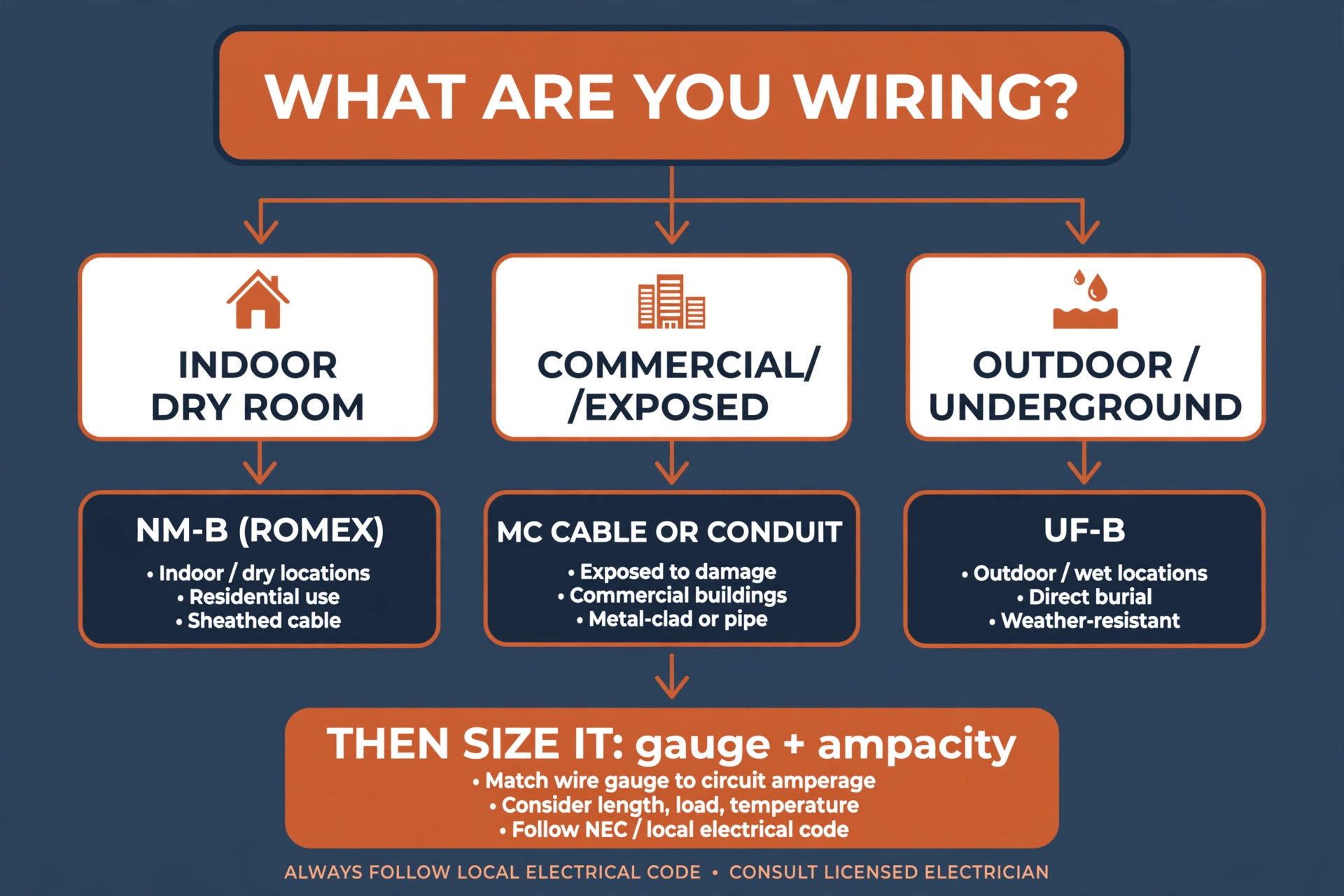
Every wire decision starts with the same question: what is this circuit feeding, and where does it live? A 15-amp bedroom receptacle circuit, a 20-amp commercial lighting run, and a 60-amp feeder to a detached garage are three different jobs, and starting with the application keeps you from shopping by gauge — the most common beginner mistake. Write down the load (what it powers), the voltage (120, 240, or 208/480), and the location (which room, which building, inside or outside). That short description already points at a product family.
Residential work lives in the cable world: NM-B for dry interiors, UF-B the moment you go outside or underground. Commercial work lives in the armor-and-pipe world: MC cable for fast branch-circuit runs, conduit with THHN or XHHW-2 where the spec, the future, or the local code demands pipe. Industrial work adds the heavy cable types — tray cable, armored feeders, MCM sizes — which have their own guides in this hub. If you can name the building type, you have already eliminated half the table above.
The environment is the great eliminator. Dry, damp, wet, buried, exposed to damage, or inside conduit — each answer knocks products off the table until one or two remain. This is the step people skip, and skipping it is how Romex ends up buried in a backyard.
Dry interior is the easy one: inside walls, ceilings, and floors that stay dry. That is NM-B territory in homes, and MC or conduit territory in commercial buildings. Wet and damp locations — outdoors, bathrooms' wet zones, anywhere water reaches — rule out NM-B and AC entirely; UF-B cable or wet-rated conductors (THWN-2, XHHW-2) in conduit take over. Underground means direct-burial-rated cable (UF-B) or conduit with wet-rated conductors, buried at the depths the code requires. And exposed to physical damage means armor or pipe, full stop — no bare cable where it can be hit, which is the entire reason MC and conduit exist.
This surprises people: conduit run outdoors is legally a wet location, because water gets into conduit no matter how well it is put together. So the wire inside outdoor conduit must be wet-rated — THHN/THWN-2 or XHHW-2, never NM-B. The rating that matters is on the wire, not the pipe. When you read a wire's markings and see THWN-2 or XHHW-2, that wet rating is exactly what you are looking at.
Once the environment has narrowed the field, the insulation type finishes the choice. For cable products (NM-B, UF-B, MC), the insulation comes with the package — you chose it when you chose the cable. For conduit work, you choose the conductor, and that means understanding the alphabet soup.
THHN stands for thermoplastic, high heat-resistant, nylon-coated — the single insulated conductor electricians pull through conduit more than any other. It is rated 90°C in dry locations, and in practice it is almost always dual-marked THHN/THWN-2, where the THWN-2 marking extends the 90°C rating to wet locations. If you are pulling wire in pipe and nobody specified anything exotic, THHN/THWN-2 is the answer.
XHHW-2 uses cross-linked polyethylene insulation instead of thermoplastic, and it is rated 90°C in both wet and dry locations. It handles heat and abrasion better than THHN, which is why it shows up on feeders, service work, and harsh environments. It costs more and is stiffer to pull, so it is specified where its toughness earns its keep — not as the default for every pipe run.
The 90°C rating is mostly about derating math — adjusting ampacity for hot attics or bundled conductors — because the final ampacity is still limited by the lowest-rated termination, usually 75°C or 60°C. Do not let the big number tempt you into smaller wire: the terminations govern. This is exactly the kind of detail the licensed pro handles, and it is why the gauge step comes with a pro attached.
Last step, not first: pick the gauge. The process is simple to describe and easy to get wrong, which is why it belongs to the licensed pro on a real job. Here is how the thinking works.
Ampacity is just how much current a wire can safely carry, and NEC Table 310.16 is the official chart. At the 75°C column — the one that governs most terminations — copper runs 14 AWG at 20 amps, 12 at 25, 10 at 35, 8 at 50, 6 at 65, and up from there. But the small-conductor rule (NEC 240.4(D)) caps the overcurrent protection at 15 amps for 14 AWG, 20 for 12 AWG, and 30 for 10 AWG — so in practice, 14/12/10 AWG mean 15/20/30-amp circuits. Our wire gauge chart lays out every gauge from 14 AWG through 4/0 with diameters and ampacity, and our ampacity explainer teaches the table in five minutes.
Long runs need bigger wire than the ampacity table alone suggests, because voltage drops over distance — and motors, lights, and electronics all notice. A 20-amp circuit that is fine on 12 AWG at 50 feet may want 10 AWG at 150 feet. Voltage drop is not a code violation at any particular number, but it is the difference between equipment that runs right and equipment that runs hot and short-lived. When the run is long, the pro upsizes. That judgment call is the job.
Three mistakes account for most bad wire choices. All three are avoided by the four steps above.
Running Romex outside, underground, or anywhere wet is the single most common wire-selection mistake, and it is a straight code violation under NEC Article 334. If the run leaves the dry interior, the product changes — UF-B, or wet-rated conductors in conduit. No exceptions, no "it will be fine."
Picking "12 AWG" before picking the product is backwards. Twelve-gauge Romex and twelve-gauge THHN in conduit are different answers to different questions. Product first (by environment), gauge second (by load). The order matters.
The NEC is the national floor, and cities build on it. Chicago requires conduit where the NEC allows cable. Some jurisdictions restrict NM-B beyond the NEC's own limits. The wire that is perfect in one town fails inspection in the next — which is why "check your local amendments" is not boilerplate on this site. It is the step.
Name the application: what the circuit feeds and where it lives. A bedroom receptacle circuit, a commercial lighting run, and an underground feed to a garage are three different jobs, and the wire choice starts there — never with the gauge. The environment (dry, wet, buried, or in conduit) narrows the field to one or two products, and only then do you size the gauge.
Match the gauge to the circuit's amperage using NEC Table 310.16, then apply the small-conductor limits: 14 AWG is capped at 15 amps, 12 AWG at 20 amps, and 10 AWG at 30 amps of overcurrent protection (NEC 240.4(D)). Long runs may need the next size up to control voltage drop. The wire gauge chart in this hub lays out every common gauge with its ampacity.
Both are single-conductor building wires, but their insulation differs. THHN (thermoplastic, nylon-coated) is rated 90°C in dry locations and is usually dual-marked THHN/THWN-2, which extends the 90°C rating to wet locations. XHHW-2 (cross-linked polyethylene) is rated 90°C in both wet and dry locations and is tougher against heat and abrasion. Either is a fine choice in conduit; the environment and the spec decide between them.
Only if the wire itself is rated for wet locations. Conduit outdoors is legally a wet location — water gets in — so NM-B is never acceptable there, but THHN/THWN-2 or XHHW-2 conductors in conduit are fine because the THWN-2 and XHHW-2 ratings cover wet use. The rating that matters is on the wire, not the pipe.
Using indoor cable outdoors. Running Romex (NM-B) outside, underground, or in a wet location is the most common wire-selection mistake there is, and it is a code violation under NEC Article 334. The second biggest is undersizing the gauge for the load or the distance. Both mistakes are avoided by the same habit: match the product to the environment first, then size it.
No. This page teaches the decision process professionals use so you can understand quotes, plans, and the work itself — but sizing feeders, opening panels, and installing circuits belongs to licensed electricians. Every code reference here names the NEC article and edition — check your local amendments before any real work.
Choosing wire leaves wire behind. The ends cut off every homerun, the short pieces too short to pull, the coil tails, the demo pulls that the new wire replaced. On most crews it goes into a bucket, and on most crews the bucket gets split.
Every type on the table above grades as insulated copper wire, bought by weight. Keep the types separated — Romex in one pile, THHN in another, MC in a third — because each grades differently, and keep aluminum conductors out entirely. When the bucket is full, call Sonny at 312-880-8174 for a number on it. One call, one person, and the leftovers turn into money instead of a dump run.
Suggested next read: The Wire Gauge Chart — every gauge, every ampacity, ready to bookmark.
Every quote, pickup, and payment runs through one person who answers the phone: Sonny Johns at 312-880-8174. No portals, no ticket queues, no waiting on a committee.