T
Thermoplastic insulation. The standard plastic (PVC) insulation on most building wire. When T is the first letter, you're reading thermoplastic.
That string of letters stamped on the jacket is a full product description: the wire's type, size, temperature rating, voltage rating, and manufacturer. Once you can read it, you know exactly what you're holding.
 WE BUY
Every legitimate roll of building wire has its markings printed or embossed right on the outer jacket, repeating every couple of feet along the run. On a spool or reel, you'll also find the same information on the reel tag or box label — sometimes clearer than the jacket print, which can be faint on old stock.
The markings always follow the same pattern: size, then conductor count, then the type letters, then the voltage and temperature ratings, then the listing mark (UL), the manufacturer, and a footage number. Miss the printing entirely — no letters, no numbers, nothing legible — and you're holding either very old wire or something made outside the listing system. Either way, that matters.
The letters follow a system set by the NEC and UL (NEC Article 310 for building wire, Article 400 for flexible cord). Each letter is a property. Here's the full key:
Thermoplastic insulation. The standard plastic (PVC) insulation on most building wire. When T is the first letter, you're reading thermoplastic.
Heat resistant — rated 75°C. One H means the insulation handles 75 degrees Celsius.
High heat resistant — rated 90°C. Two H's means 90 degrees Celsius. HH outranks H.
Moisture resistant — rated for wet and damp locations. A wire without a W is dry-location only.
Nylon jacket. A thin nylon coating over the insulation that resists oil, gasoline, and abrasion. When you feel that slick, hard skin on a THHN conductor, that's the nylon.
Crosslinked polymer insulation (XLPE). A thermoset insulation — tougher than thermoplastic, better in heat and wet locations. This is the X in XHHW.
Thermoset insulation. A heat-cured rubber-style insulation, found in RHW and RHH types.
90°C rated in wet locations. THWN-2, XHHW-2, and USE-2 all carry the 90°C rating dry and wet. Without the -2, the wet rating drops to 75°C.
Nonmetallic-sheathed cable — "Romex." The B means the conductor insulation inside is rated 90°C (the older NM was 60°C). The whole cable is used at 60°C ampacity, but the B matters for identification.
Underground feeder. Gray, sunlight-resistant, rated for direct burial. The B again means 90°C-rated conductor insulation.
Metal-clad cable. Conductors inside flexible metal armor, usually aluminum. The armor is the ground path on most modern MC.
Armored cable — "BX" is the old trade name for what's technically Type AC cable. You'll find it all over older Chicago buildings. It has a bonding strip inside the armor.
Service-entrance cable. SEU is the flat, unarmored version; SER is the round version that can carry more than three conductors.
Underground service-entrance. USE-2 is the 90°C wet/dry version — common for service laterals.
Tray cable. Multi-conductor cable rated for industrial cable tray. TC-ER is also rated for exposed runs.
Machine tool wire. Stranded building wire rated for industrial control panels and machine wiring — 90°C dry, oil resistant.
Service cord. S is extra-hard-usage cord (600V); SJ is junior hard-service (300V) — the lighter extension-cord stuff.
Oil resistance. One O means the jacket is oil resistant; two O's (as in SOOW) means both the jacket and the conductor insulation are oil resistant.
Weather and water resistant — outdoor-rated. That's the W in SOOW.
After the first letter in a cord type, T means thermoplastic — as in STW, the thermoplastic version of SOOW.
Gauge (AWG) is the wire's size — American Wire Gauge. The counterintuitive part: a bigger number means a smaller wire. 14 AWG is thinner than 12 AWG, which is thinner than 10 AWG. The sizes homeowners and shops actually touch every day are 14, 12, 10, 8, and 6 AWG.
Conductor count comes next, and this is where people misread markings. 12-2 means two 12 AWG insulated conductors — plus a bare ground, which is always there and never counted. So 12-2 Romex has three physical wires inside (black, white, bare) but only two insulated current-carrying conductors. 12-3 adds a red conductor: three insulated, plus ground. On a single conductor like THHN you'll just see 12 AWG, sometimes with a strand count like "19 STR" — 19 strands making up the conductor.
600V is the voltage rating stamped on virtually all building wire. It means the insulation is rated for circuits up to 600 volts — which covers every residential and most commercial application. It's not the voltage the wire carries; it's the maximum the insulation is rated to handle safely.
Temperature ratings show as 60°C, 75°C, or 90°C, sometimes split: "90°C dry / 75°C wet." These feed directly into how much current the wire can carry (ampacity). A higher temperature rating doesn't automatically mean you can load the wire harder — terminations and code rules usually cap you at the 60°C or 75°C column — but it's the first thing an inspector checks. Want the full ampacity table? Here's the wire gauge chart — what size wire for every amperage.
The jacket tells you the conductor metal too. CU means copper. AL means aluminum — usually the 8000-series aluminum alloy used in modern feeder and service wire, which is fine when terminated properly.
The tricky one is copper-clad aluminum (CCA): an aluminum core with a thin copper skin. It looks copper on the outside and is sometimes marketed in language that blurs the line. Legitimate CCA is marked — look for "COPPER-CLAD ALUMINUM," "CU-CLAD," or similar wording on the jacket. But cheap or unlisted wire sometimes skips the marking, which is why the physical check matters.
The file-a-strand test: take an exposed end or cut conductor and lightly file or scrape a strand with a pocketknife or file. Solid copper shows copper all the way through. Copper-clad aluminum shows a silver-gray aluminum core under the copper skin. That's the whole test — one scrape tells you. Do not use a flame or lighter test. Burning insulation gives off toxic fumes and tells you less than the file does.
Why this matters: CCA is not the same as copper. It carries less current for the same gauge, it's more brittle, and scrap buyers price it as aluminum — not copper. If the jacket says AL and the outside looks copper, check before you assume.
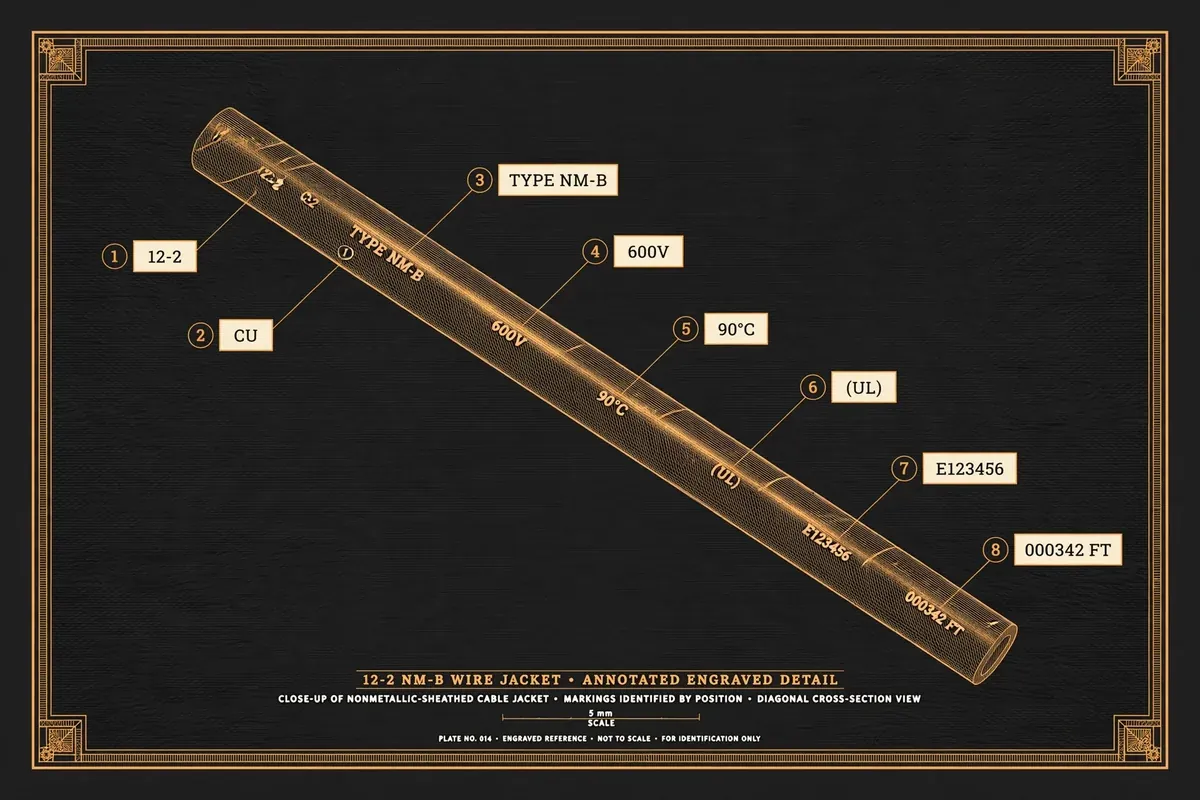
12-2 CU TYPE NM-B 600V 90°C (UL) E123456 — SOUTHWIRE — 000342 FT
12-2 — two 12 AWG insulated conductors (black and white), plus an uncounted bare copper ground. CU — copper conductors. NM-B — nonmetallic-sheathed cable with 90°C-rated conductor insulation. 600V — standard building-wire voltage rating. 90°C — the conductor insulation rating (used at 60°C ampacity per code). (UL) — UL listed, with E123456 as the UL file number identifying the manufacturer. SOUTHWIRE — the manufacturer ("Romex" is Southwire's brand name for NM-B). 000342 FT — a sequential footage mark: this point on the jacket is 342 feet from the start of the run, used for measuring what's been pulled.
12 AWG CU TYPE THHN/THWN-2 600V 90°C DRY / 90°C WET — GASOLINE AND OIL RESISTANT II — MTW — (UL)
12 AWG — 12-gauge single conductor. CU — copper. THHN/THWN-2 — dual rated: T = thermoplastic insulation, H = heat resistant, H = high heat (90°C), N = nylon jacket, W = wet rated, and the -2 means 90°C in wet locations too. 600V — standard rating. 90°C dry / 90°C wet — full rating in both conditions thanks to the -2. GASOLINE AND OIL RESISTANT II — passes oil and gasoline exposure testing (Category II). MTW — also rated as machine tool wire for industrial control panels. (UL) — listed.
6 AWG 3/C CU TYPE MC 600V 90°C DRY (UL)
6 AWG — 6-gauge conductors. 3/C — three conductors. CU — copper. TYPE MC — metal-clad cable: the conductors ride inside flexible interlocked metal armor. 600V — standard. 90°C dry — rated 90°C in dry locations only (no W, so not a wet-location cable). (UL) — listed.
10-2 CU TYPE UF-B 600V SUNLIGHT RESISTANT DIRECT BURIAL (UL)
10-2 — two 10 AWG insulated conductors plus bare ground. CU — copper. UF-B — underground feeder with 90°C-rated conductor insulation. 600V — standard. SUNLIGHT RESISTANT — the gray jacket won't break down under UV exposure above ground. DIRECT BURIAL — rated to be buried in the earth without conduit. (UL) — listed.
Can read your wire now? If it's good copper still on the roll, we buy usable leftover wire — anywhere in the country. Fast, free quote.
It's dual rated. The wire meets the THHN standard (90°C dry, nylon jacket) and also the THWN-2 standard (90°C wet). Manufacturers print both so one product covers both applications — electricians stock one reel instead of two.
Two insulated conductors (black and white 12 AWG), plus a bare copper ground that isn't counted in the number. So 12-2 cable physically contains three wires, but only two are insulated current-carrying conductors.
Romex is Southwire's brand name for NM-B cable. Other manufacturers make NM-B too, under their own brand names. Same product type, same marking system.
It means the wire carries its 90°C temperature rating in wet locations as well as dry ones. Without the -2, the wet-location rating is 75°C.
Look for CU (copper) or AL (aluminum) in the printing. Copper-clad aluminum is marked "COPPER-CLAD ALUMINUM" or "CU-CLAD" on legitimate product. If the marking is missing or worn off, file a strand: copper is copper all the way through, while CCA shows a silver-gray aluminum core.
It's the maximum voltage the insulation is rated to handle safely — not the voltage the circuit runs at. Virtually all residential and most commercial building wire is 600V rated.
Sequential footage (or meter) marks — a running count like 000342 FT that tells you how far along the reel or box that point is. Crews use them to measure how much wire they've pulled without a tape measure.
Reading a jacket is the first thing we do when a roll comes in — the letters tell us the type, the gauge, the rating, and whether it's resale inventory or scrap. That's also how we know when usable wire is worth more than the yard pays for it.