Wire Gauge Chart: What Size Wire for Every Amperage
The NEC ampacity table tells you how much current each wire size can carry — but the table alone doesn't tell you which column to read, why your breaker is smaller than the wire's rating, or when a long run changes the answer. Here's the whole thing, in plain English.
 WE BUY
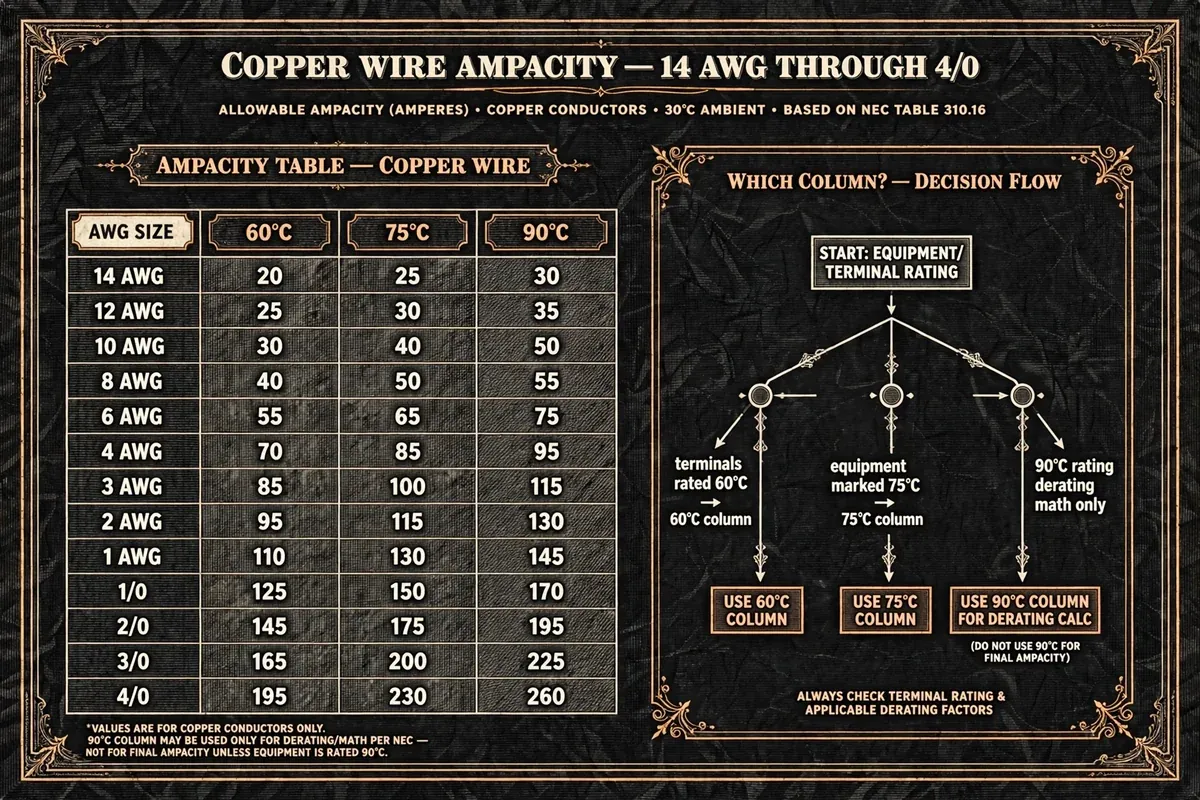
Allowable ampacity by gauge — copper and aluminum
This is the NEC's ampacity table (Table 310.16) reduced to the gauges you'll actually touch: 14 AWG through 4/0. Ampacity is the maximum current a conductor can carry continuously without exceeding its temperature rating. The numbers assume no more than three current-carrying conductors in a raceway or cable, at 30°C (86°F) ambient — a normal room. Hot attics and bundled cables get derated from here.
Picked your gauge? Here's how to read the printing on the jacket to make sure the roll in your hand matches what you need.
| Wire size (AWG) | COPPER — allowable amps | ALUMINUM — allowable amps | ||||
|---|---|---|---|---|---|---|
| 60°C | 75°C | 90°C | 60°C | 75°C | 90°C | |
| 14 | 20 | 25 | 30 | — | — | — |
| 12 | 25 | 30 | 35 | 15 | 20 | 25 |
| 10 | 30 | 35 | 40 | 25 | 30 | 35 |
| 8 | 40 | 50 | 55 | 30 | 40 | 45 |
| 6 | 55 | 65 | 75 | 40 | 50 | 60 |
| 4 | 70 | 85 | 95 | 55 | 65 | 75 |
| 3 | 85 | 100 | 115 | 65 | 75 | 85 |
| 2 | 95 | 115 | 130 | 75 | 90 | 100 |
| 1 | 110 | 130 | 145 | 85 | 100 | 115 |
| 1/0 | 125 | 150 | 170 | 100 | 120 | 135 |
| 2/0 | 145 | 175 | 195 | 115 | 135 | 150 |
| 3/0 | 165 | 200 | 225 | 130 | 155 | 175 |
| 4/0 | 195 | 230 | 260 | 150 | 180 | 205 |
Based on NEC Table 310.16 (allowable ampacities of insulated conductors rated 0–2000V, not more than three current-carrying conductors, 30°C ambient). Aluminum building wire starts at 12 AWG — that's why the top row is blank on the aluminum side.
The 60°C vs. 75°C vs. 90°C question — this is where people go wrong
The chart has three columns because wire insulation comes in three temperature ratings. But you don't get to just pick the biggest number. The column you read is decided by the weakest link: the terminals the wire lands on. That's NEC 110.14(C), and it's the rule that trips up more DIYers than anything else in this article.
The short version:
Most residential work uses the 60°C column. Breakers, receptacles, and switches in homes are generally rated 60°C (or unmarked, which defaults to 60°C). So even if your THHN is good for 90°C, a 12 AWG conductor landing on a standard breaker is a 20-amp wire, not a 30-amp wire.
The 75°C column applies when the equipment is marked for it — common on commercial gear, subpanels, and larger breakers (circuits over 100A default to 75°C-rated terminations).
The 90°C column almost never sets your circuit size. Its real job is derating math: when you have to reduce ampacity for bundled conductors or hot ambient temperatures, you start from the 90°C number and derate down — but the final answer still can't exceed the 60°C or 75°C column your terminations allow.
Romex (NM-B) is always 60°C for sizing. NEC 334.80 says NM cable is used at the 60°C ampacity even though the conductors inside are 90°C rated. So 12-2 Romex is a 20-amp wire, period — the 90°C column is only for derating calculations.
Chicago note: the City of Chicago requires conduit for most residential wiring — Romex generally isn't allowed inside city limits. So in the city, your sizing usually runs through THHN in conduit, where the 75°C column often applies if the terminations are marked for it. The suburbs are a different story, and local amendments vary — another reason the electrician gets the final word.
Why 12 AWG is a 20-amp wire, not a 30-amp wire
Look at the chart: 12 AWG copper shows 25 amps in the 60°C column. So why is every 12 AWG circuit on a 20-amp breaker? Because NEC 240.4(D) puts a hard ceiling on overcurrent protection for small conductors, regardless of what the ampacity table says:
14 AWG copper → 15 amps max. 12 AWG copper → 20 amps max. 10 AWG copper → 30 amps max.
Same logic for small aluminum and copper-clad aluminum: NEC 240.4(D) caps 12 AWG aluminum at 15 amps and 10 AWG aluminum at 25 amps — after any derating math. (The rule only names those sizes; anything larger goes by the ampacity table and your terminal ratings.)
This is the difference between ampacity (what the wire itself can carry) and breaker size (what protects it). They're related but they're not the same number, and the breaker is what the inspector checks. There are narrow exceptions for specific equipment like motors and HVAC units — your electrician knows them — but for general branch circuits, those ceilings are the law.
The 125% rule: EV chargers, heaters, and anything that runs for hours
A continuous load — anything expected to run at full current for three hours or more — gets special treatment under NEC 210.19: the conductors must be sized at 125% of the continuous load. Flip it around and you get the version most people know: a circuit's continuous load can't exceed 80% of the circuit rating.
The classic example is the EV charger. A 48-amp charger runs for hours, so it's continuous: 48 × 1.25 = 60 amps. That means a 60-amp breaker and wire good for 60 amps — which is 6 AWG copper. And here's where the columns bite: 6 AWG in the 60°C column is only 55 amps, so NM-B (Romex) can't do this job. 6 AWG THHN in conduit at the 75°C column is 65 amps — that works, if the terminations are 75°C rated.
Other continuous loads that catch people: electric heat, grow lights, pool pumps, commercial lighting. When in doubt, multiply by 1.25 first, then pick the wire.
When distance changes the answer
Wire has resistance, and resistance over distance eats voltage. The NEC recommends keeping voltage drop under 3% on a branch circuit (5% total from service to outlet) — it's guidance, not hard code, but it's the number electricians design to.
Here's the practical math for a copper run (single phase). Voltage drop = (2 × 12.9 × amps × one-way distance in feet) ÷ circular mils of the wire. (Use 21.2 instead of 12.9 for aluminum.) 12 AWG is 6,530 circular mils; 10 AWG is 10,380; 8 AWG is 16,510.
Worked example: a 120-volt, 20-amp circuit running 100 feet to a garage, loaded to 16 amps (the 80% continuous max). Drop = (2 × 12.9 × 16 × 100) ÷ 6,530 = 6.3 volts — that's 5.3% of 120V, over the 3% guideline. Bumping to 10 AWG drops it to 4.0 volts, or 3.3%. Close enough that most electricians would upsize and move on.
The rule of thumb: once a 120V run passes about 75–100 feet at near-full load, go up a gauge. At 240V you get twice the distance for the same percentage drop, so dryers and subpanels are more forgiving. Long runs are also the most common reason a job ends with a half-used spool of the bigger wire — which is exactly the kind of leftover worth selling instead of scrapping.
The circuits you'll actually wire
| Circuit | Typical use | Copper wire |
|---|---|---|
| 15A | General lighting, living-room receptacles | 14 AWG |
| 20A | Kitchen, bathroom, garage receptacles | 12 AWG |
| 30A | Dryer, water heater, small AC | 10 AWG |
| 40A | Electric range | 8 AWG |
| 50A | Range, EV charger (40A continuous) | 6 AWG |
| 60A | EV charger (48A continuous) | 6 AWG THHN in conduit — not Romex (60°C column = 55A) |
| 100A | Subpanel feeder | 2 AWG copper — or 1/0 aluminum |
Sized the circuit and now you've got half a roll left? We buy usable leftover wire — anywhere in the country. Fast, free quote.
When bigger wire is wasted money
Copper is expensive, so upsizing "just to be safe" has a real cost — and most of the time it buys you nothing. If your terminations are 60°C rated, a 90°C wire doesn't carry a single extra amp for sizing purposes; the higher rating only helps in derating math. A 12 AWG THHN conductor on a standard 20-amp breaker is a 20-amp wire whether it cost you the THHN price or twice that.
The legitimate reasons to upsize: distance (voltage drop, above), future capacity (running 6 AWG to the garage today because the EV charger comes next year), and aluminum economics (aluminum feeder is legitimately cheaper than copper at large sizes — 1/0 aluminum does a 100-amp subpanel for less than 2 AWG copper, with proper terminations). Everything else is just paying for copper you can't use.
The disclaimer that matters
This chart is general guidance based on the NEC ampacity table. Sizing wire for a real installation also depends on ambient temperature, how many conductors share a conduit, your terminals' temperature ratings, and — critically — your local code amendments, which in the Chicago area can be stricter than the NEC. This article teaches you how the sizing works; it doesn't replace a licensed electrician or your local inspector. When in doubt, the electrician wins.
Wire sizing questions, answered.
What size wire do I need for a 30-amp circuit?
10 AWG copper. The ampacity table shows 30 amps in the 60°C column, and the small-conductor rule caps 10 AWG protection at 30 amps — so 10 AWG on a 30-amp breaker is the standard answer for dryers, water heaters, and small AC units.
Can 12 AWG wire handle 30 amps?
The wire itself can carry 30 amps at the 75°C column — but the small-conductor rule limits 12 AWG copper to a 20-amp breaker on general branch circuits. There are narrow exceptions for specific equipment like motors and HVAC units, but for normal receptacle and lighting circuits, 12 AWG means a 20-amp breaker.
What's the difference between ampacity and breaker size?
Ampacity is how much current the wire can safely carry continuously. Breaker size is the overcurrent protection the code allows on that wire — and the code often sets it lower than the ampacity, like the 15/20/30-amp ceilings on 14/12/10 AWG. The breaker protects the wire; it's not a rating of the wire.
My THHN says 90°C — why can I only use 12 AWG at 20 amps?
Because the terminals at both ends decide. Most breakers, receptacles, and switches are rated 60°C (or unmarked, which defaults to 60°C), so the code makes you read the 60°C column. The 90°C rating still matters for derating math — hot attics, bundled conductors — but it doesn't raise your circuit size.
What size aluminum wire equals 6 AWG copper?
4 AWG aluminum. At the 75°C column, 6 AWG copper and 4 AWG aluminum both carry 65 amps. That's the general pattern: aluminum runs about two gauge sizes larger than copper for the same ampacity. Use terminations rated for aluminum and the proper antioxidant compound.
How far can I run 12-gauge wire on a 20-amp circuit?
At the full 16-amp continuous load, 12 AWG starts exceeding the 3% voltage-drop guideline around 55–60 feet of run on 120V. Lighter loads go further — at 10 amps you can reach roughly 90 feet. Past that, upsize to 10 AWG or accept the drop.
Is 8 AWG good for 50 amps?
Only in the right column. 8 AWG copper is 50 amps at 75°C — so THHN in conduit landing on 75°C-rated terminations works. But 8 AWG NM-B (Romex) is stuck at the 60°C column, which is 40 amps — no good for a 50-amp circuit. Same wire, different answer, all because of the column.
I know wire. That's how I know what it's worth.
Sizing a circuit right is how you buy the right roll the first time — and how you know when the leftover half-roll is worth more as usable wire than as scrap. We read every roll that comes in the same way: type, gauge, rating, then value.