Set up wet and protected
Mount the green silicon-carbide wheel, set the water drip or have a water cup ready, put on the respirator and eye protection, and make sure ventilation is moving air away from you.
Short answer: yes — for touch-ups and tool-bit sharpening, a home shop can absolutely grind carbide. But the wheel, the water, and the dust control are not optional. Here is the honest setup.
Before anything else: grinding carbide makes fine dust containing cobalt, and cobalt dust is a recognized respiratory hazard. Home shops skip dust control more often than anyone, which makes this section the most important one on the page.
Home-shop safety baseline: grind carbide wet or with dust collection, wear a properly fitted respirator (not a paper dust mask), and never dry-grind carbide in an enclosed garage without dust controls. Read the safety data sheet for the material. This guide is information, not training or certification — if any of this is new to you, learn the safety practice in person before grinding.
The practical home setup that working hobbyists use: a water drip or a wet grinding arrangement that keeps the contact point flooded, a respirator rated for fine particulates, and ventilation that moves air away from the breathing zone. Dry grinding carbide on a bench grinder in a closed garage, breathing the dust, is the single thing this guide is trying to prevent.
You do not need a tool-and-cutter grinder to touch up carbide at home. You need the right wheel and the right habits.
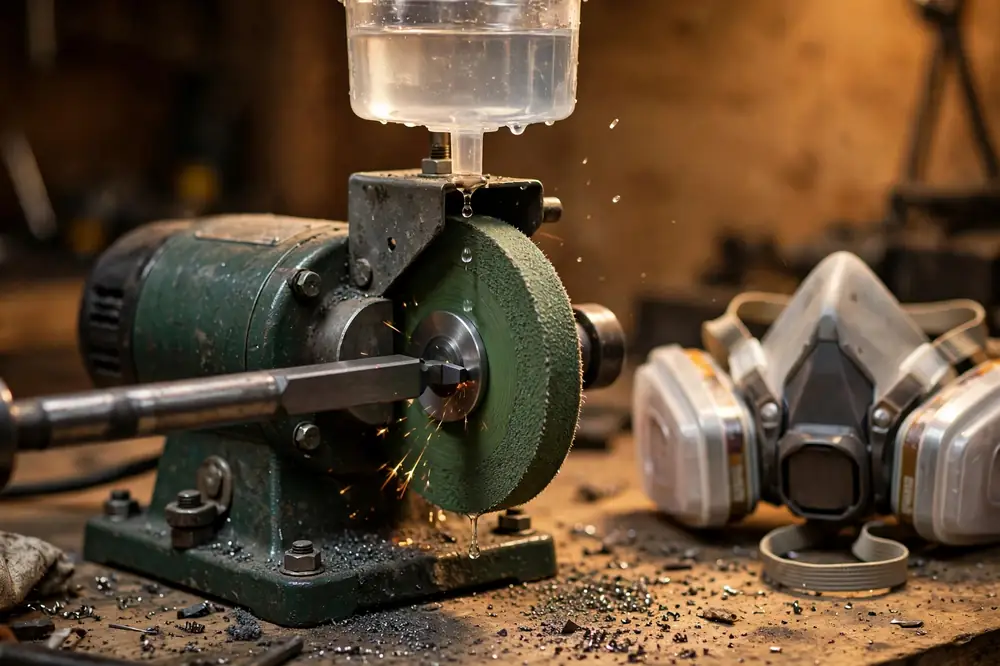
The wheel matters most. A standard gray aluminum-oxide bench wheel will not grind carbide — it glazes, rubs, and overheats the tool. Fit a green silicon-carbide (GC) wheel. It actually cuts carbide, costs little more than a standard wheel, and is the single upgrade that makes home carbide grinding possible. Ring-test the wheel before mounting, keep the guards on, and respect the wheel's maximum RPM.
Keep it wet. A simple water drip above the wheel, or frequent dipping in water, does two jobs: it holds the dust down and it keeps the carbide cool. Carbide cracks from thermal shock, so the rhythm is light passes with cooling between them — never lean on the tool until it blues.
Use the tool rest. Freehand grinding is how edges get dubbed and angles get random. Set the rest close to the wheel, present the tool steadily, and grind the existing angles rather than inventing new ones. For brazed lathe tool bits, touch up the top and side relief to refresh the edge; for drills, a drill-grinding jig beats freehand every time.
Mount the green silicon-carbide wheel, set the water drip or have a water cup ready, put on the respirator and eye protection, and make sure ventilation is moving air away from you.
Clean the wheel face with a dresser so it cuts freely. A loaded wheel generates heat instead of cutting, and heat is what cracks carbide edges.
With the tool on the rest, lightly grind the side and end relief faces of the tool bit, following the existing angles. Light passes, cooling dips between each one.
Take a whisper pass across the top face to restore the cutting edge where it meets the relief. You are refreshing the edge line, not reshaping the tool.
Finish with a fine diamond hone to knock off the wire edge, then check the edge under magnification. A clean, unchipped edge line means the tool is ready to cut.
If the carbide tip is cracked, the edge keeps crumbling, or you have ground the tip down to a nub, the tool is done. Retire it to the carbide bin instead of fighting it.
A bench grinder with a green wheel handles touch-ups. It does not replace a tool grinding shop.
Home grinding is perfect for refreshing brazed lathe tool bits, touching up drills with a jig, and putting an edge back on a carbide-tipped tool. What it cannot do well: full end-mill regrinds with accurate relief angles on every flute, restoring damaged geometry, or anything requiring measured tolerances. Those jobs belong on a tool-and-cutter grinder with a diamond wheel.
There is no shame in that division of labor. Touch up what you can, send out what you cannot, and recognize when a tool has given everything it has. The home-shop drawer of shame — the coffee can of dead end mills and nubbed tool bits every hobbyist accumulates — is a real thing, and it is worth real money when it fills up.
Only with a green silicon-carbide wheel and wet grinding with dust control. The standard aluminum-oxide wheel that comes on most bench grinders will glaze and overheat carbide instead of cutting it.
The dust is the danger. Carbide grinding dust contains cobalt, a recognized respiratory hazard. Grind wet or with dust collection, wear a proper respirator, ventilate the space, and follow the material's safety data sheet.
Light touch-ups on the end teeth are doable with care. A full regrind with accurate relief on every flute needs a tool-and-cutter grinder — home attempts usually produce an unbalanced tool that cuts poorly.
A green silicon-carbide wheel for the bench grinder you already own, a water drip setup, and a proper respirator. That combination handles the vast majority of home-shop carbide touch-ups.
Almost always heat or a loaded wheel. Take lighter passes, dress the wheel, keep the water flowing, and let the tool cool between passes. If the tip is cracked through, no amount of careful grinding saves it.
They are still solid tungsten carbide with real scrap value. The home-shop drawer of shame is real — and when it is full, it is worth a shipment. There are no minimums: every bucket counts. Call 312-880-8174.
The home-shop drawer of shame is real — when it is full, it is worth a shipment. Every dead end mill, every nubbed tool bit, every cracked insert in that coffee can is still tungsten carbide. There are no minimums and no lot is too small: a single drawer counts, and on bigger lots we handle the freight so you do not lift a finger. Call 312-880-8174.