Your Friendly Guide to All Things Copper
Back up to the copper hub: every copper topic, four learning paths, and the tools.
VISIT HUB →I am Sonny, and I grade copper pipe every week at my scale. Green, blue, red, yellow — the stripe on the pipe is telling you the wall thickness and where it belongs, and this guide teaches you to read it.
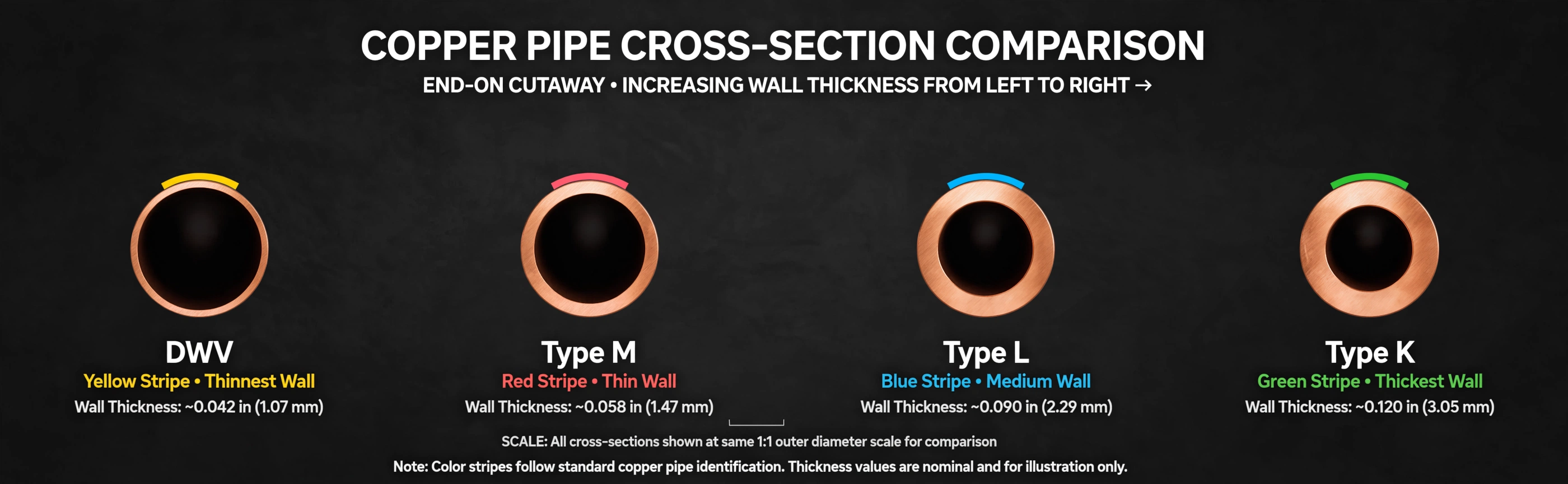
Here is the thing most people get backwards. The letters K, L, and M do not describe different metals or different brands. They describe one thing: how thick the wall is. A half-inch Type K and a half-inch Type M have the same outside diameter and take the same fittings, but the K wall is nearly twice as thick. That thickness decides the pressure rating, the price, and where the pipe is allowed to go.
Manufacturers print the stripe on the pipe so you can identify it at a glance, and they also print the type in ink along the length: "TYPE L" or similar. If the stripe has faded — and on old pipe it always has — the ink stamp is your backup. Learn both and you will never grab the wrong stick again.
Because the outside diameter is identical across types for a given nominal size, one set of fittings works for all of them. What changes is the inside diameter: thicker wall means a slightly smaller bore. In practice this matters most when you are sizing for flow or matching an existing run, and it matters enormously for pressure. Thicker walls hold more pressure and survive more abuse.
Type K is the heavyweight of the three water-tube types. It carries the thickest wall — on half-inch pipe, forty-nine thousandths of an inch — and with that thickness comes the highest pressure rating and the best resistance to physical damage.
This is the pipe you bury. Underground service lines from the main to the house run in Type K because soil load, shifting ground, and the occasional shovel punish thin walls. You will also see it in soft temper (sold in coils rather than straight sticks) snaking through foundations and under slabs, where bending beats jointing.
The trade-off is cost and weight. Type K uses more copper per foot, so it costs more, and it is heavier to hang and handle. Nobody runs it inside a house unless the spec demands it, because Type L does that job for less money.
Type L is the default. When a plumber says "copper pipe" without specifying, this is usually what they mean: the standard choice for interior hot and cold water lines in homes and commercial buildings.
The blue stripe sits in the middle of the thickness range — on half-inch pipe, forty thousandths of an inch — and it balances cost, pressure rating, and durability for the job it does most. It solders exactly like the other types, takes the same fittings, and stands up to decades of service inside walls.
If you are matching an existing run and the stamp has worn off, Type L is your safest guess for interior water pipe in most homes built in the last fifty years. Measure to confirm, but the odds are with you.
Type M is the budget option: thinner walls, less copper, lower price. On half-inch pipe the wall drops to twenty-eight thousandths of an inch, and the pressure rating drops with it.
Where local code allows it, Type M shows up in light residential work — short branch runs and low-pressure situations where the cost savings add up across a whole house. Some jurisdictions restrict it or ban it outright, especially for larger sizes, so always check your local amendments before you buy it.
The honest knock on Type M is longevity margin. Thinner walls mean less metal to lose to pinhole corrosion over decades, and less resistance to a stray nail or a frozen section. It is legal pipe when the code allows it, but it gives you the smallest safety margin of the three.
DWV stands for drain, waste, and vent, and the yellow stripe is a warning as much as a label. This tube is made to carry water downhill by gravity, not under pressure. It is thinner than Type M and it is not pressure-rated at all.
You will find DWV in larger sizes forming drain stacks and vent lines, where the job is moving wastewater away and letting sewer gas escape through the roof. The fittings are different — drainage-pattern fittings with smooth sweeps instead of tight elbows — because gravity needs a gentle path.
The rule is absolute: DWV never goes on a pressurized supply line. It is a code violation and it will fail. If you are sorting a mixed pile and you see the yellow stripe, that stick goes in the drain-pipe pile, not the supply pile.
Wall thickness in inches per ASTM B88, for the three sizes you will meet most. Notice the pattern: K thickest, then L, then M.
| Nominal size | Type K (green) | Type L (blue) | Type M (red) |
|---|---|---|---|
| 1/2 inch | 0.049 | 0.040 | 0.028 |
| 3/4 inch | 0.065 | 0.045 | 0.032 |
| 1 inch | 0.065 | 0.050 | 0.035 |
One more number worth memorizing: the outside diameter of copper pipe is always one-eighth inch larger than its nominal size. Half-inch pipe measures five-eighths across the outside — for all three types.
Choosing pipe is mostly about matching the thickness to the punishment. Underground service line: Type K, green, because dirt and rocks and time do not negotiate. Interior hot and cold water: Type L, blue, the standard that has served millions of homes. Light residential branches where the code allows: Type M, red, with the cost savings and the thinner margin both on the table.
Drains and vents get DWV, yellow, and nothing else — and DWV gets nothing pressurized, ever. Refrigeration and HVAC line sets are their own world: our brazing guide covers that copper in its own terms.
Two judgment calls separate the pros. First, read the ink stamp, not just the stripe — faded stripes have fooled plenty of people into mixing M into an L run. Second, know your local code. The IPC and UPC both accept copper water tube, but individual cities and counties amend the rules, and some are strict about Type M. A two-minute check with your local amendments beats a failed inspection every time.
The stripe marks the wall-thickness series under ASTM B88. Green is Type K (thickest, underground and service lines), blue is Type L (standard interior water lines), red is Type M (thinner, light residential), and yellow is DWV (drains only, never for pressure).
No. DWV is made for drain, waste, and vent service only. It is not pressure-rated and must never carry supply water. Using it on a pressurized line is a code violation and a burst waiting to happen.
Type K, the green stripe. It has the thickest wall of the water-tube types and is the standard choice for buried service lines, where soil load, rocks, and settling punish thin walls.
Type M has a thinner wall, so it uses less copper per foot. It costs less upfront but carries a lower pressure rating and is more vulnerable to pinhole corrosion and physical damage. Some local codes restrict where it can be used, so check your local amendments.
The letter does not change the grade. Scrap copper pipe is graded on cleanliness and condition — clean, uncoated, solder-free pipe grades highest regardless of whether it is K, L, or M. The stripe just tells you what job it came from.
Copper pipe is sold by nominal size, and the outside diameter is always one-eighth inch larger than the nominal size. A half-inch pipe measures five-eighths of an inch across the outside. Read the ink stamp printed on the pipe — it names the type directly.
Every quote, pickup, and payment runs through one person who answers the phone: Sonny Johns at 312-880-8174. No portals, no ticket queues, no waiting on a committee.
I see every pipe type cross my scale, and I hear the same confusion every week: "What is the red one? Can I use the yellow one for this?" The stripe is a free education printed right on the pipe, and now you can read it. Match the thickness to the punishment, check your local code, and you will never grab the wrong stick.
Suggested next read: How to Sweat Copper Pipe — now that you know which pipe to grab, here is how to join it right.