Plumbing Guide
The hub: every plumbing guide in one place, organized by your level.
VIEW HUB →Ask ten plumbers and you will get eleven opinions. I buy the copper that comes out of these jobs, so I have no dog in the fight — here is what each pipe actually does well, where each one loses, and the money angle neither side talks about.
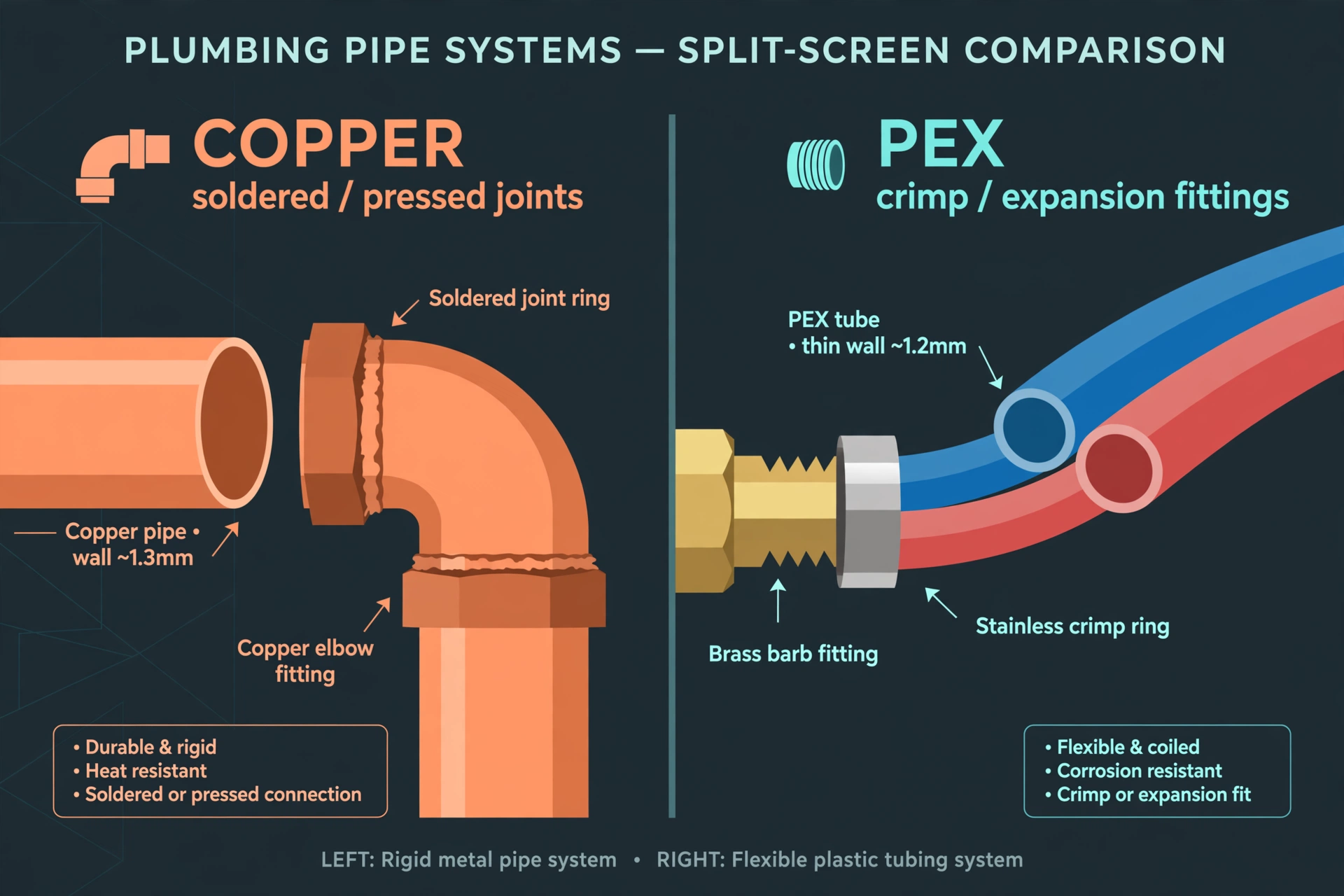
Copper has carried drinking water in American homes for the better part of a century, and that history is its strongest argument. A properly installed copper system in good water routinely lasts 50 to 70 years or more — there are copper installations from the middle of the last century still doing their job today. Plumbers know it, inspectors trust it, and homeowners recognize it.
Copper's strengths are specific and real. It handles high temperatures without complaint, which matters near water heaters and in mechanical rooms. Sunlight does not bother it, so exposed runs are fine. It is rigid and holds its shape, which makes for clean, straight, professional-looking installations. And it is naturally resistant to bacteria growth on its interior surfaces, a quiet advantage most people never think about.
Copper's weaknesses are just as specific. It is expensive — the pipe, the fittings, and the skilled labor to sweat or press every joint. It is rigid, so every change of direction needs a fitting and every fitting is a potential leak point and a labor cost. And it is vulnerable to aggressive water: acidic or low-pH water eats copper from the inside, causing the pinhole leaks and blue-green staining that end many copper systems decades early in bad-water areas.
PEX — cross-linked polyethylene — is flexible plastic tubing that has gone from newcomer to dominant residential water pipe in about two decades. It comes in long coils, bends around corners without fittings, and connects with mechanical fittings instead of a torch. For water distribution inside a house, every major plumbing code approves it.
PEX's strengths start with installation. A flexible coil can run from a manifold to a fixture in one continuous length with no joints in the wall — fewer joints means fewer leak points and far less labor. The material costs much less than copper, the tools are simpler, and a repipe that takes days in copper often takes a fraction of that in PEX. It is immune to the water-chemistry problems that kill copper: acidic water, hard water, and mineral-heavy water do not corrode it.
PEX's weaknesses need honest treatment. Sunlight degrades it — any PEX run must stay out of UV exposure, which rules out some exterior and exposed applications. It is plastic, so it does not have copper's heat tolerance at the extremes, and rodents can chew it in attics and crawl spaces where they would not bother copper. And its lifespan, while projected in the 40-to-50-year range, does not have copper's century of field proof behind it. That is not a verdict against PEX — it is just the calendar.
One thing that confuses homeowners and plenty of apprentices: the letters on PEX describe how the polyethylene gets cross-linked during manufacturing — the process that turns regular plastic into the tougher, heat-resistant tubing. All three types meet the same ASTM standards and carry the same pressure ratings. The differences are about flexibility, fittings, and feel.
PEX-A is made with the peroxide (Engel) method. It is the most flexible of the three, it has shape memory — meaning a kink can often be repaired with a heat gun — and it pairs with expansion fittings, where the tubing is expanded over the fitting and shrinks back to form the seal. It is the premium choice and usually the priciest.
PEX-B is made with the silane (moisture-cure) method. It is stiffer than PEX-A, pairs with crimp or clamp fittings, and carries particularly strong chlorine resistance, which matters on chlorinated municipal water. It is the workhorse of residential PEX and usually the best value.
PEX-C is made with an electron-beam method. It is the stiffest of the three, the least common in residential work, and tends to show up in specific commercial or radiant applications. Match the type to your fitting system and your local code, and check the print on the coil — it tells you everything.
| Factor | Copper | PEX |
|---|---|---|
| Proven lifespan | 50 to 70-plus years in favorable conditions | 40 to 50 years projected; 25-year warranties common |
| Installed cost | Higher — pipe, fittings, and skilled joint labor | Much lower — cheaper material, faster install |
| Freeze behavior | Splits and bursts; repair on thaw | Expands and contracts; far more forgiving |
| Water chemistry | Vulnerable to acidic/low-pH water (pinhole leaks) | Immune to corrosion and scaling |
| Heat tolerance | Excellent, including near water heaters | Good within ratings; not for extreme heat |
| Sunlight | Unaffected | Must stay out of UV — degrades in sunlight |
| Joints | Soldered or pressed; every turn needs a fitting | Crimp, clamp, expansion, or push-fit; long joint-free runs |
| Rodents | Not a target | Can be chewed in attics and crawl spaces |
| Drinking water safety | Long history of safe use | Listed to NSF/ANSI 61 for potable water |
Read the table the way a plumber reads a job: there is no column that wins every row. Copper wins on proven life, heat, and sunlight. PEX wins on cost, speed, freezes, and water chemistry. The right answer depends on the house, the water, the climate, and the budget — which is exactly what a good plumber figures out on site.
PEX usually wins for whole-house repipes, especially retrofits in finished homes. The flexible coils snake through walls with minimal drywall damage, the job finishes faster, and the total cost lands far below copper. In freeze country, PEX is the clear durability pick — the expansion behavior turns a burst-pipe emergency into a non-event. And in areas with aggressive or acidic water, PEX sidesteps the pinhole-leak problem that shortens copper's life.
Copper usually wins for exposed piping — basements, mechanical rooms, and anywhere the pipe is visible and sunlight or physical contact is a factor. It wins near high-heat equipment and in any application where the owner wants the longest proven service life and is willing to pay for it. Many high-end homes and commercial jobs still spec copper throughout, and there is nothing wrong with that choice.
What should not decide it: brand loyalty, what the last guy used, or internet arguments. What should decide it: the water chemistry in that house, the climate, the routing, the budget, and the local code. A plumber who asks about the water before recommending the pipe is a plumber worth hiring.
For most residential water lines, yes — PEX is a proven, code-approved piping material with real advantages in cost, freeze resistance, and water-chemistry immunity. Copper keeps the edge in track record (50-plus years in service), heat tolerance, and UV exposure. Neither is the wrong answer for a house; they are different tools for the same job.
Copper supply lines have a documented track record of 50 to 70-plus years in favorable conditions. PEX is younger, so its lifespan is projected rather than proven: manufacturers and plumbers generally put it in the 40-to-50-year range, with 25-year limited warranties common on professionally installed systems. Actual life for either material depends on water chemistry, installation quality, and operating conditions.
Yes, substantially. PEX tubing itself costs much less than copper pipe, the fittings are simpler, and the flexible coils run long continuous lengths with fewer joints — which cuts labor hours significantly. Repipe contractors often report total installed costs well under copper for the same house. Exact numbers vary by market, so get quotes in your area.
PEX can expand when water freezes inside it and then contract back afterward, which makes it far more forgiving in a freeze. Copper does not expand — it splits. A frozen copper line is usually a burst copper line, and the repair starts the moment it thaws. Neither material is freeze-proof, and both need insulation and proper routing in cold climates.
Yes. PEX tubing for potable water is listed to NSF/ANSI 61, the standard for drinking-water system components, and it is approved by every major plumbing code for hot and cold water distribution. It must be kept out of sunlight, which degrades it, and installed per the manufacturer's instructions like any piping material.
The letters describe how the polyethylene is cross-linked during manufacturing. PEX-A (peroxide/Engel method) is the most flexible, has shape memory for kink repair, and uses expansion fittings. PEX-B (silane method) is stiffer, pairs with crimp fittings, and carries strong chlorine resistance. PEX-C (electron beam) is the stiffest and least common. All three meet the same ASTM standards and pressure ratings.
Here is the money hook neither side of the copper-versus-PEX argument ever mentions. When a repipe pulls the old copper out of a house — and it does, every single time — that copper is worth real money. The pipe, the elbows, the brass valves and fittings: it all has weight, and weight is what buyers pay for.
On most crews the bucket gets split at the end of the job. Either way, the old copper coming out is worth real money — so before any of it goes in the dumpster, call Sonny at 312-880-8174. Send photos of the pile and get a real number back. If you liked this guide, read the Whole-House Repipe Guide next — that is where this decision actually gets made.