Inspect the drill
Check the point under magnification: chipped lips, margin condition, and flute damage. Drills with cracked flutes, severe margin wear, or damage past the flutes are scrap, not regrind candidates.
A carbide drill can be reconditioned several times — if the point geometry is right and the margins survive. Here is the drill-specific economics and technique.
Reconditioning means grinding carbide, and grinding carbide means cobalt dust. The safety baseline is the same as any carbide grinding.
Safety baseline: regrind carbide drills wet or with dust collection, wear a properly fitted respirator, and never dry-grind carbide without dust controls. Ring-test wheels, keep guards on, and never exceed the wheel's maximum RPM. This guide is information, not training or certification.
A drill cuts only at the point. Reconditioning is point restoration — everything else is support.
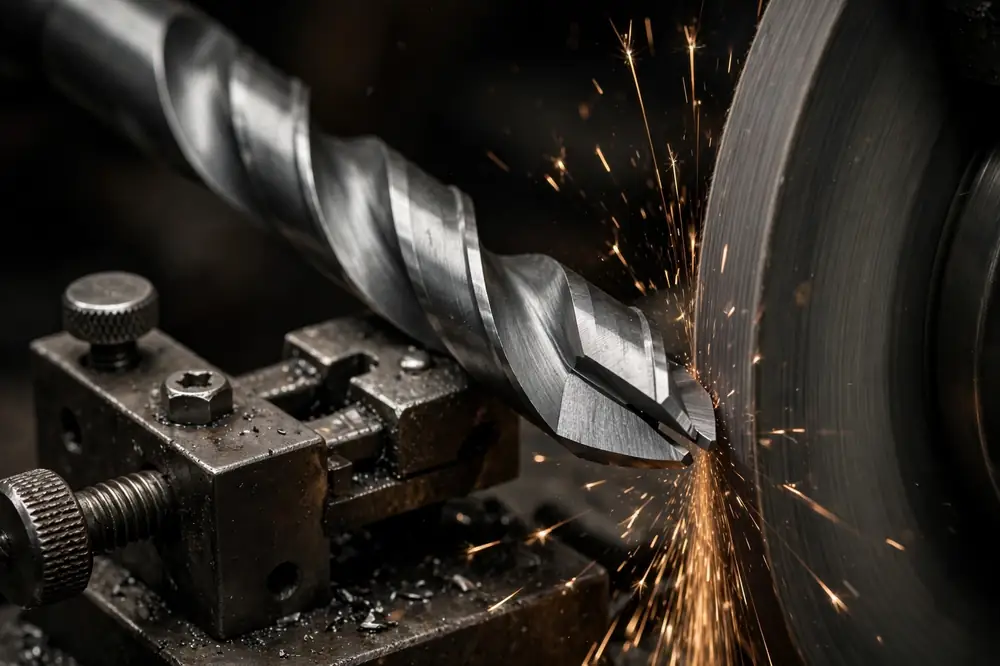
Point angle: the standard 118° point suits most materials; the 135° split point — with its self-centering split and shorter chisel edge — is the choice for harder materials and CNC work where the drill must start on location without wandering. Reconditioning must restore the original point angle, not invent a new one.
Lip symmetry is the make-or-break check. Both cutting lips must be the same length and angle. An asymmetric point drills oversize, wanders, and hammers one lip to death. After every regrind, check lip height and angle under magnification — a drill grinder with proper fixtures holds this; freehand rarely does.
Margin wear is the limit. The margins — the narrow lands along the flutes that guide the drill in the hole — wear with use. Light margin wear regrinds clean; heavily worn or chipped margins cannot be restored without grinding the drill undersize past usefulness. When the margins are gone, the drill is done.
Web thinning extends life. As a drill is shortened by repeated regrinds, the web (the core between the flutes) gets thicker toward the shank, which lengthens the chisel edge and raises thrust. Web thinning at regrind restores the chisel edge geometry and keeps the drill cutting instead of pushing.
Check the point under magnification: chipped lips, margin condition, and flute damage. Drills with cracked flutes, severe margin wear, or damage past the flutes are scrap, not regrind candidates.
Use a proper drill grinding fixture or CNC tool grinder with a diamond wheel — freehand cannot hold lip symmetry. Set the point angle to match the original: 118° or 135° split.
Grind both lips to equal length and angle with steady coolant flow. Light passes: overheating the point draws the temper of nothing (it is solid carbide) but thermal shock cracks the cutting edges.
On drills shortened by prior regrinds, thin the web to restore a short chisel edge. This is what keeps an older drill drilling like a younger one instead of pushing and wandering.
Verify both lips match in length and angle, confirm the margins are intact and the diameter still meets the job's tolerance. Mark the new effective size on the shank.
When margins will not clean up, the drill is undersize for the work, or the flutes are damaged, reconditioning is over. The drill retires to the carbide bin — still solid tungsten carbide, still worth money.
The same economics as end-mill regrinding, with drill-specific lines.
Reconditioning typically costs a fraction of a new carbide drill — the same 35–80% savings range industry reporting cites for regrinds generally (per Cutting Tool Engineering). The math favors larger diameters: a 1/2-inch drill reconditions economically for several cycles, while micro-drills usually do not survive the economics of the grinding time.
Coatings follow the same rule as end mills: the regrind removes the coating from the point. For many jobs the uncoated reconditioned drill performs fine; for high-heat alloys, price the recoat into the decision.
The shop habit: sort dull drills at the machine — regrind candidates in one bin, dead drills in the carbide bin. Never let a dead carbide drill reach the general scrap barrel; its value as sorted carbide is far higher.
Yes, several times, on a proper drill grinder with a diamond wheel. The keys are restoring the original point angle, keeping both lips symmetric, and preserving the margins. Freehand grinding cannot reliably hold lip symmetry.
118° is the general-purpose point; 135° split point is self-centering with a shorter chisel edge, better for hard materials and CNC work where the drill must start exactly on location. Recondition to the original angle.
Grinding relief into the web at the point to shorten the chisel edge. As drills get shorter through repeated regrinds, the web thickens — thinning restores easy cutting and accurate starting.
When the margins will not clean up, the diameter drops below the job's tolerance, or the flutes are cracked or damaged. A drill that cannot hold size or location is done — and still valuable as carbide scrap.
Usually not below about 1/4 inch — the grinding labor costs nearly the same at any size, so small drills do not pencil out. Larger drills recondition economically for multiple cycles.
Drills too worn to recondition are still solid carbide — sell them by the pound. There are no minimums: a handful of dead drills or a full bin, every bucket counts. On bigger lots, we handle the freight so you do not lift a finger. Call 312-880-8174.
Drills too worn to recondition are still solid carbide — sell them by the pound. Every dead drill in the bin is tungsten carbide with real value, whether it is a handful from a job shop or a drum from a production floor. There are no minimums: every bucket counts, and on bigger lots we handle the freight so you do not lift a finger. Call 312-880-8174.