Your Friendly Guide to All Things Copper
Back up to the copper hub: every copper topic, four learning paths, and the tools.
VISIT HUB →I am Sonny, and every pound of copper I buy started in a hole in the ground. Here is the whole journey — open pit to 99.99 percent pure metal — in plain language, with a labeled diagram.
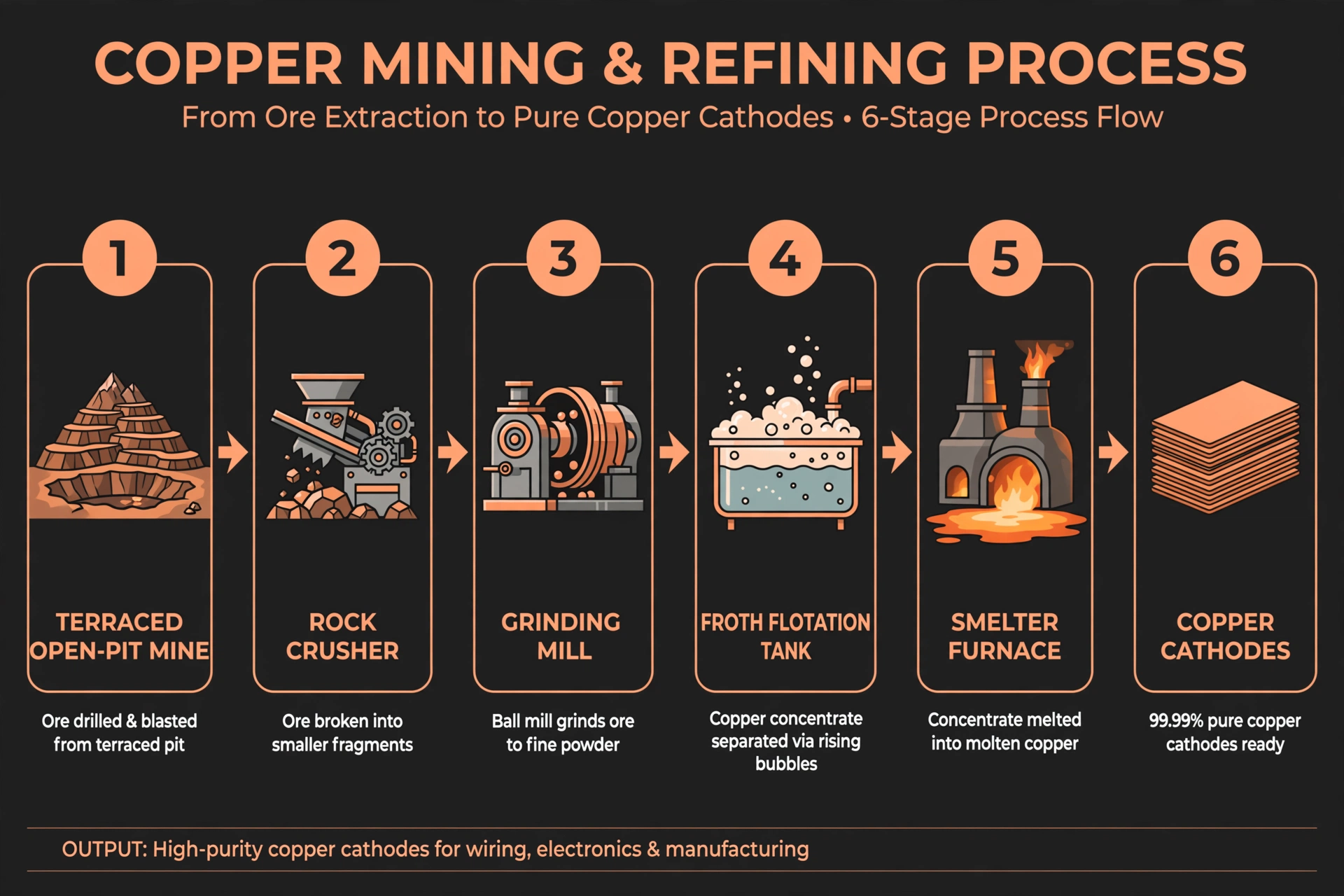
Most of the world's copper comes from open-pit mines: enormous terraced craters, some of them miles across, where the ore body sits close enough to the surface to dig from above. Chile's Chuquicamata is one of the most famous — a pit so big you can see the terraces from space. Drilling rigs punch blast holes, explosives break the rock, and haul trucks the size of houses carry it to the crusher.
Here is the part that surprises people: most of what comes out of the pit is rock. The copper is a small fraction of it — which is why every stage downstream exists to concentrate it. Underground mines handle the deeper ore bodies, but the pit is where the volume lives.
The haul trucks dump their loads into primary crushers — giant machines that break boulders down to gravel size. Then grinding mills take over: enormous rotating drums full of steel balls that pulverize the gravel into a fine powder, mixed with water into a slurry.
The grinding matters because the copper minerals are locked inside the rock at a microscopic level. You cannot separate what you cannot free. By the time the slurry leaves the mill, the copper-bearing minerals are individual grains floating in water, ready for the cleverest step in the whole process.
This is the stage I love explaining. The slurry flows into flotation tanks, where air is blown through it to make bubbles and special oils are added. The copper minerals are naturally water-repellent after treatment — they cling to the bubbles and ride them to the surface, forming a mineral-rich froth. The waste rock, which loves water, sinks to the bottom.
Skimmers scrape the froth off the top, and what they collect is copper concentrate: the same copper, now packed far denser than it was in the ground. The sunken waste — called tailings — goes to engineered storage. One tank of bubbles does more separation work than an army of hand sorters ever could.
The concentrate goes into a smelter, where intense heat — around 2,300 degrees Fahrenheit — melts it down. The chemistry of the melt splits the load into two layers: a heavier matte layer on the bottom that holds the copper (mixed with sulfur and iron), and a lighter slag layer on top that holds the impurities. The slag gets discarded; the matte moves on.
The matte then goes into a converter, a cylindrical vessel where air is blown through the molten material. The blast burns off the iron and sulfur, and what pours out is blister copper — about 98 to 99.5 percent pure, named for the blistered look of its surface as gases escape while it cools. It looks like copper. It almost is copper. But "almost" is not good enough for wire.
The blister copper is cast into thick slabs called anodes and hung in tanks of electrolyte — a solution of copper sulfate and sulfuric acid — alternating with thin sheets of pure copper that serve as cathodes. Then the current goes on.
Electricity dissolves copper off the anodes as ions, and those ions plate out onto the cathodes as pure metal. Impurities either stay dissolved or fall to the tank floor as a sludge called anode slime — and here is the bonus round: that slime holds gold, silver, and other precious metals, which get recovered separately. After the cycle runs, the cathodes come out at 99.99 percent pure copper, ready to become wire, tube, and sheet.
That purity number is not vanity. Electrical copper needs it — even small impurity levels measurably hurt conductivity, and the whole point of copper wire is moving current.
Those cathodes get melted and formed into the copper the world runs on: wire rod drawn down to every gauge, tube for plumbing and line sets, sheet for roofing and gutters. From there it goes into walls, cars, phones, and power grids — and eventually, decades later, it comes back out as scrap.
That is where my world starts. Recycled copper skips the pit, the crusher, the flotation tank, the smelter, and the refinery. Melt it and it is copper again — same conductivity, same value, no quality lost. Every pound I buy is a pound that never has to be mined, and that loop is the quiet engine under the whole copper market.
Most copper comes from open-pit mines. The ore is drilled, blasted, and hauled out, then crushed, ground to powder, and concentrated by froth flotation. The concentrate is smelted at around 2,300 degrees Fahrenheit, converted to blister copper (98 to 99.5 percent pure), and finally electrorefined to 99.99 percent pure copper cathodes.
Blister copper is the product of the converter stage: molten copper about 98 to 99.5 percent pure. It gets its name from the blistered look of its surface as gases escape during cooling. It is not pure enough for electrical use, so it goes on to electrorefining.
South America holds some of the largest, including Chile's Chuquicamata, one of the biggest open-pit copper mines on earth. Major copper mining also happens in Peru, the Democratic Republic of Congo, the United States, Australia, and China.
During electrorefining, impurities that do not dissolve — including gold, silver, and other precious metals — fall to the bottom of the tank as a sludge called anode slime. It is collected and processed separately, which makes copper refining a quiet source of precious metals too.
Yes. Copper does not degrade in recycling — melt it down and it is copper again, with the same conductivity and the same value. That is why the scrap loop matters so much: every pound of recycled copper skips the entire mining chain above.
Honestly, yes — open-pit mining moves enormous amounts of earth and uses a lot of water and energy, and the industry wrestles with land, water, and emissions impacts. That is part of why copper recycling is such a big deal: it produces the same metal with a far smaller footprint.
Every quote, pickup, and payment runs through one person who answers the phone: Sonny Johns at 312-880-8174. No portals, no ticket queues, no waiting on a committee.
I never thought much about where copper came from until I started buying it by the pound. Then I learned the chain — the pit, the bubbles, the 2,300-degree furnace — and it changed how I see every coil of wire that crosses my scale. Somebody moved a mountain for that. Treat it like it matters, because it does.
Suggested next read: The History of Copper — ten thousand years of the metal that built civilization, in ten minutes.