Your Friendly Guide to All Things Copper
Back up to the copper hub: every copper topic, four learning paths, and the tools.
VISIT HUB →I am Sonny, and I buy a metal that humans have worked for ten thousand years. The first metal ever shaped by human hands is still the one running your house. This is its story.
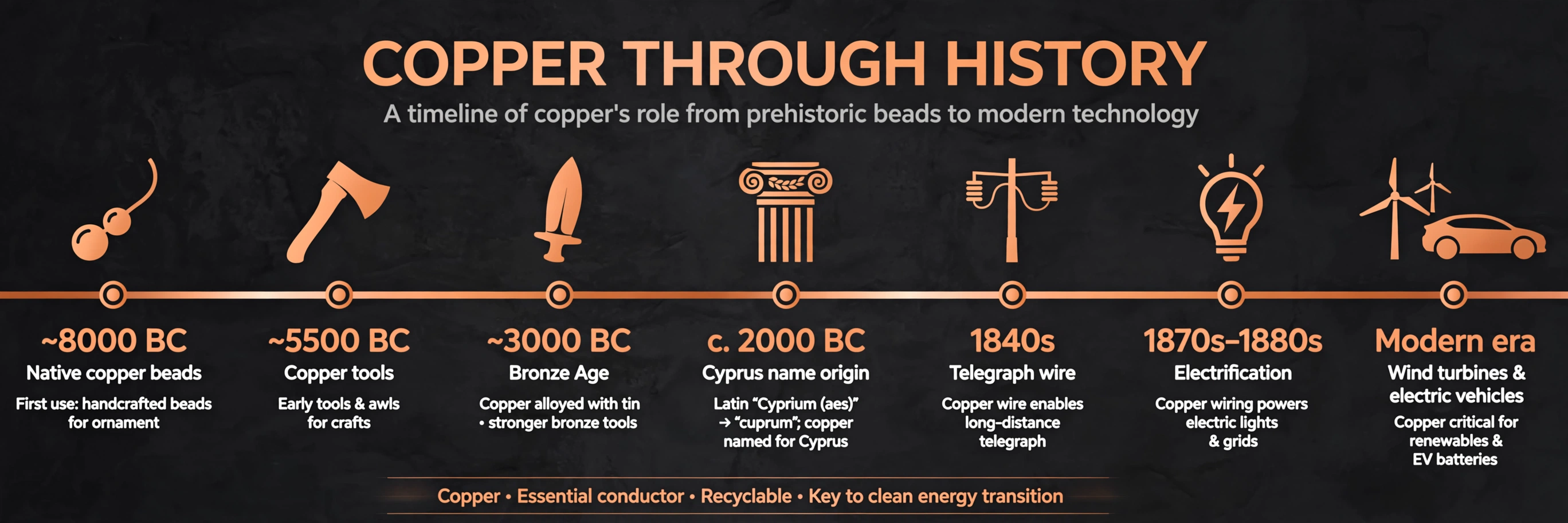
Long before anyone smelted anything, there was native copper — pure metal sitting in the ground in nuggets and veins, waiting to be found. The oldest copper object we know of is a pendant from what is now northern Iraq, dated to around 8700 BC. Somebody picked up a strange reddish stone, found that it dented instead of shattering, and hammered it into jewelry.
The U.S. Geological Survey dates early copper use in coins and ornaments to about 8000 BC and copper tools to about 5500 BC. People learned to heat the metal before hammering — annealing — which made it workable instead of brittle. For thousands of years, copper was the only metal known to humanity, and it had every metal job there was.
Around 5000 BC came the accident that changed everything: somebody heated copper ore — green malachite or blue azurite — hot enough in a low-oxygen fire to melt pure metal out of rock. Smelting meant copper no longer had to be found; it could be made. Production scaled, and tools got serious.
Then, around 3000 BC, came the alloy. Mix copper with tin and you get bronze: harder than copper, holds a sharper edge, casts better. The ancient Sumerians were among the first to work it, and the shift was so total that we named an entire age of civilization for it. The Bronze Age ran on copper the way our age runs on silicon.
Copper is one of the few elements named for a place. The island of Cyprus was so central to ancient copper production that its Greek name, Kypros, became the Latin aes Cyprium — "metal of Cyprus" — which shortened over the centuries into "copper." Say the word and you are saying the island.
Phoenician traders built shipping networks around the Cypriot copper trade, and ancient powers fought over the supply. Ten tons of copper ingots went down with the Uluburun shipwreck off the Turkish coast in the Bronze Age — a single cargo from one of history's first commodity supply chains. The metal has been global trade since before trade had a name.
In 1800, Alessandro Volta built the voltaic pile — the first true battery — by stacking alternating discs of copper and zinc separated by salty cloth. For the first time, electricity could be generated on command instead of merely observed. Copper was half the machine.
In 1831, Michael Faraday moved a magnet through a coil of copper wire and induced an electric current. That coil is the ancestor of every generator and transformer on earth. Copper was not just carrying electricity by then — it was the medium that made generation possible, flexible, abundant, and second only to silver in conductivity.
In the 1840s, Samuel Morse and Alfred Vail gave copper wire a voice: dots and dashes traveling city to city over copper lines. Within years the wires were crossing nations, and in 1858 the first transatlantic cable carried a message from Queen Victoria to President James Buchanan across the ocean floor on copper conductors.
The message took seventeen hours to arrive, but it arrived. Copper had shrunk the planet, and the world never went back. The telephone, the power grid, and eventually the internet all followed the same copper path.
By the 1870s and 1880s, inventors stopped sending electricity as messages and started distributing it as power. Copper wired the cities, then the countries. Every motor, every transformer, every mile of distribution line ran on it — and still does.
Now copper is having its biggest century. An electric car carries far more copper than a gas one. Wind turbines, solar farms, and data centers are copper-hungry by design. Demand keeps climbing, mines keep digging, and the oldest metal in human history is somehow also the metal of the future.
Which brings the story full circle to my counter: because copper never degrades, the ten-thousand-year-old metal in your walls is the same metal as the ingots on the Uluburun wreck. When it comes out of a teardown, it goes right back into the loop. That is the whole business, and it is older than money.
The oldest known copper objects date to around 8700 BC — a copper pendant found in what is now northern Iraq. The U.S. Geological Survey dates early copper use in coins and ornaments to about 8000 BC, and copper tools to about 5500 BC. Copper was likely the first metal humans ever worked.
About 3000 BC, when people learned that alloying copper with tin produced bronze — a harder metal that held an edge. The discovery marked such a turning point that an entire age of human civilization is named for it.
From Cyprus. The island was so dominant in ancient copper production that its Greek name, Kypros, evolved through the Latin aes Cyprium — metal of Cyprus — into the modern word copper.
Copper wire carried the first worldwide communication network. In the 1840s, Morse and Vail's telegraph code traveled over copper lines between cities, and in 1858 the first transatlantic cable used copper conductors to send a message from Queen Victoria to President James Buchanan.
It was the first metal worked, the basis of the Bronze Age, the carrier of the telegraph, and the wire of electrification. Ten thousand years after the first copper pendant, it still carries the electricity running your house.
More than ever. Electric vehicles, wind turbines, solar panels, data centers, and the power grid all run on copper. Demand keeps climbing, and because copper recycles forever, the scrap loop is part of how the world keeps up.
Every quote, pickup, and payment runs through one person who answers the phone: Sonny Johns at 312-880-8174. No portals, no ticket queues, no waiting on a committee.
I bought my first pound of copper before I knew any of this. Now I know the metal in my hand has a ten-thousand-year resume, and honestly it makes the work better. You are not just handling scrap. You are handling the metal that built civilization — and it is still building.
Suggested next read: Where Copper Hides in Your Home — the copper audit, room by room.