Your Friendly Guide to All Things Electrical Wire
The hub page: learning paths, the full wire family, and every tool in one place.
VIEW HUB →I am Sonny, and MC cable is what comes out of every commercial demo I buy from — offices, stores, strip malls. Here is what it is, how it differs from old BX, and when it beats conduit.
This page explains what MC cable is and how it differs from AC cable and conduit, so you can understand the work and speak the language. Commercial electrical work belongs to licensed electricians — it is permitted, inspected, and held to the National Electrical Code. Every reference here names the NEC article and edition so you can verify it, and you should always check your local amendments.
MC stands for metal-clad cable, and the name describes the construction exactly. Inside are ordinary THHN insulated copper conductors — the same wire electricians pull through conduit — plus one dedicated green insulated equipment ground wire. Around all of them goes a corrugated armor of interlocked aluminum (steel versions exist too), which is the "metal clad" part. The armor is mechanical protection: it lets the cable be run exposed or fished through commercial walls without a separate pipe. The whole product is governed by NEC Article 330. This guide is part of your friendly guide to all things electrical wire — the hub where the full wire family lives.
The single most important thing about MC is the green wire inside it. Standard MC carries a full-size, insulated equipment grounding conductor as part of the cable, and the armor is not part of the grounding path. That is the opposite of its famous cousin, AC cable, and it is the detail that confuses everyone. There are specialty MC variants — hospital-grade and all-purpose types — that add a bonding conductor alongside the ground wire for sensitive installations, but the everyday MC on commercial jobs is simple: conductors, green ground, armor.
MC is the default wiring method for light commercial work: offices, retail stores, restaurants, strip malls, and anywhere Romex is not allowed but full conduit would be overkill. It fishes through walls and ceilings, runs exposed where the code permits, and handles branch circuits and feeders alike. Standard MC is rated for dry locations; versions with a PVC outer jacket and wet-rated conductors are listed for wet locations and even direct burial — but only if the cable is marked for it. Read the markings, match them to the location, and never assume.
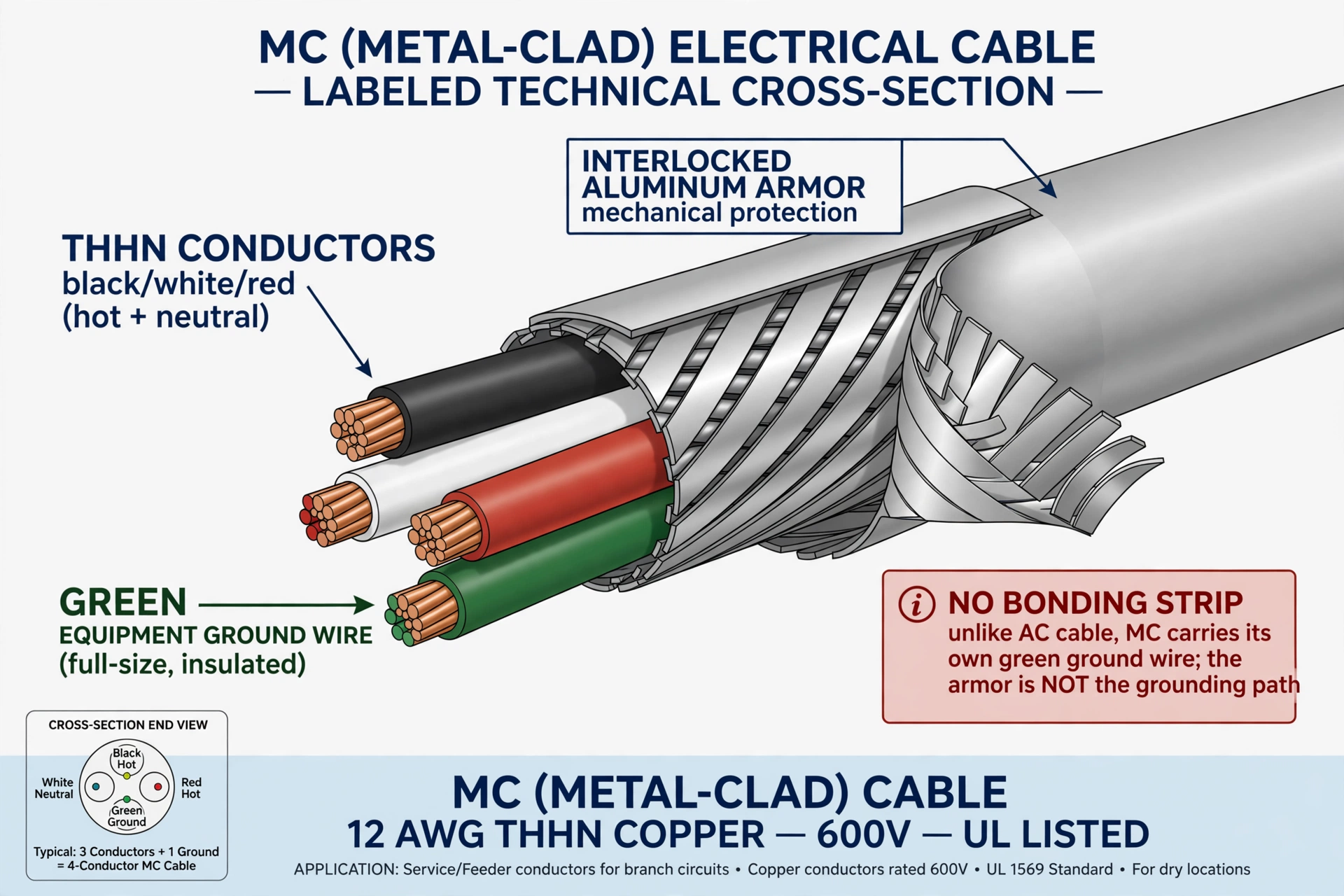
Ask for "BX" at a supply house and you will probably be handed MC. The whole trade does it, and the whole trade is technically wrong. BX is not a product — it is an old trade name for AC (armored) cable, a different cable governed by NEC Article 320. The two look similar from the outside and work nothing alike on the inside, and mixing them up is how grounding mistakes happen.
AC cable wraps its insulated conductors in armor like MC does, but instead of a green ground wire it has a thin aluminum bonding strip running under the armor. The armor plus the bonding strip together serve as the equipment grounding path — there is no separate ground wire. The conductors are typically wrapped in paper, and the cable is limited to the 60°C ampacity column (NEC 320.80), like NM cable. AC is for dry locations, and because the armor is the ground path, the terminations and fittings matter enormously.
Grounding is the big one: AC grounds through its armor and bonding strip, while MC grounds through its green wire and its armor is not a grounding conductor. Ampacity follows: MC's THHN conductors use the 75°C column (where terminations allow), while AC is capped at 60°C. Support spacing differs too — MC is secured at intervals up to 6 feet and within 12 inches of boxes, while AC is held to 4.5 feet. And the little red anti-short bushings (the "redheads") that protect conductors from the cut armor edge are required on AC but not on MC. When in doubt, read the cable's own markings: real MC is printed "MC" and real AC is printed "AC." The printing settles every argument.
On commercial work, the real decision is rarely MC versus AC. It is MC versus conduit — cable against pipe — and each wins in different situations. Understanding the tradeoff is what separates someone who knows the products from someone who knows the job.
MC installs dramatically faster. There is no bending, no threading, no pulling wire through pipe — you cut it to length, fit the listed connectors, and run it. For straightforward branch-circuit runs in walls and ceilings, the labor savings are real, and on bid work that matters. It also fishes beautifully through existing construction, which is why it dominates commercial remodels. The price is higher per foot than the equivalent THHN, but the total installed cost usually comes out lower.
Conduit wins everywhere the future matters. Wires in conduit can be pulled out and replaced, added to, or upgraded without opening walls — cable is permanent once it is in. Conduit gives superior physical protection, it looks cleaner in exposed industrial work, and some occupancies and cities simply require it. Chicago is the famous example: the city's electrical code has long required conduit (EMT) in most occupancies where the NEC would happily allow cable. Local amendments like that one are exactly why every page in this guide ends with "check your local amendments" — the NEC is the floor, and your city may build higher.
Strip away the armor and MC is the same copper as everything else: THHN conductors sized like any other wire. A 250-foot coil of 12/2 MC holds on the order of 15 pounds of copper between its insulated conductors and the green ground wire — roughly comparable to Romex of the same gauge, because the conductors are the same size. The aluminum armor is light and is a separate, low-value material; the money is in the copper inside.
Commercial demos and office gut-jobs produce MC by the dumpster-load, and most of it gets tossed with the drywall. The pros I buy from strip the armor and keep the copper conductors — or just coil the cable and sell it as insulated copper wire. Either way, keep it separate from Romex and from bare copper, because each grades differently. When the pile is worth a call, you know the number.
MC stands for metal-clad cable: insulated THHN copper conductors plus a dedicated green equipment ground wire, all wrapped in a corrugated interlocked aluminum (or steel) armor. It is governed by NEC Article 330 and is the standard wiring method for commercial buildings — offices, stores, restaurants, and strip malls.
No. BX is the old trade name for AC (armored) cable, a different product governed by NEC Article 320. AC cable has a thin bonding strip under its armor and uses the armor plus strip as the grounding path, with no separate ground wire. MC cable has no bonding strip — it carries its own green insulated ground wire, and its armor is not part of the grounding path.
MC cable installs much faster than conduit — no bending, no threading, no pulling — so it wins on labor for straightforward runs. Conduit wins when wires may need to be replaced or added later, when maximum physical protection is required, or when the local code requires it. Chicago, famously, requires conduit in occupancies where the NEC would allow cable.
Standard MC is for dry locations. Listed versions with a PVC outer jacket and wet-rated conductors can go in wet locations, and some are rated for direct burial — but the cable must be marked for it. Never assume: read the cable's own markings and match them to the location.
Roughly comparable to Romex of the same gauge, since the copper conductors are the same size — a 250-foot coil of 12/2 MC holds on the order of 15 pounds of copper in its insulated conductors plus the ground wire. The aluminum armor is light and is a separate, low-value material.
No. This page explains what MC cable is and how it differs from its cousins so you can understand the work, but commercial wiring belongs to licensed electricians. Every code reference here names the NEC article and edition — check your local amendments before any real work.
Commercial work leaves MC everywhere. Cutoffs from branch circuits, ends from homeruns, and full demo pulls from office gut-jobs. On most crews it goes into a bucket, and on most crews the bucket gets split.
MC grades as insulated copper wire, bought by weight — and the copper inside the armor is the same THHN as everything else. Keep it separate from Romex and bare copper, keep the aluminum armor pieces out of the copper pile, and never mix aluminum conductors in. When the bucket is full, call Sonny at 312-880-8174 for a number on it. One call, one person, and the commercial leftovers turn into money.
Suggested next read: How to Choose Electrical Wire — the full decision process, start to finish.
Every quote, pickup, and payment runs through one person who answers the phone: Sonny Johns at 312-880-8174. No portals, no ticket queues, no waiting on a committee.