Your Friendly Guide to All Things Electrical Wire
The hub page: learning paths, the full wire family, and every tool in one place.
VIEW HUB →I am Sonny, and Romex is the cable I see more than any other — every house rewire leaves a pile of it. Here is what it actually is, how to read the markings, and where the code says it can and cannot go.
This page explains what Romex is and where the code allows it, so you can understand the work and spot problems. Running new circuits, opening panels, and making terminations belongs to licensed electricians — the work is permitted and inspected under the National Electrical Code. Every reference here names the NEC article and edition so you can verify it, and you should always check your local amendments.
Romex is not a type of wire. It is a brand name — Southwire's registered trademark for its nonmetallic-sheathed cable, and it became so common that the whole trade uses it for any NM-B. The official name is NM-B, which stands for nonmetallic-sheathed cable, type B. This matters because the code book never says "Romex": it says NM-B, in NEC Article 334, and that article is the entire legal life of this cable. This guide is part of your friendly guide to all things electrical wire, so if you ever want the full family picture, start there.
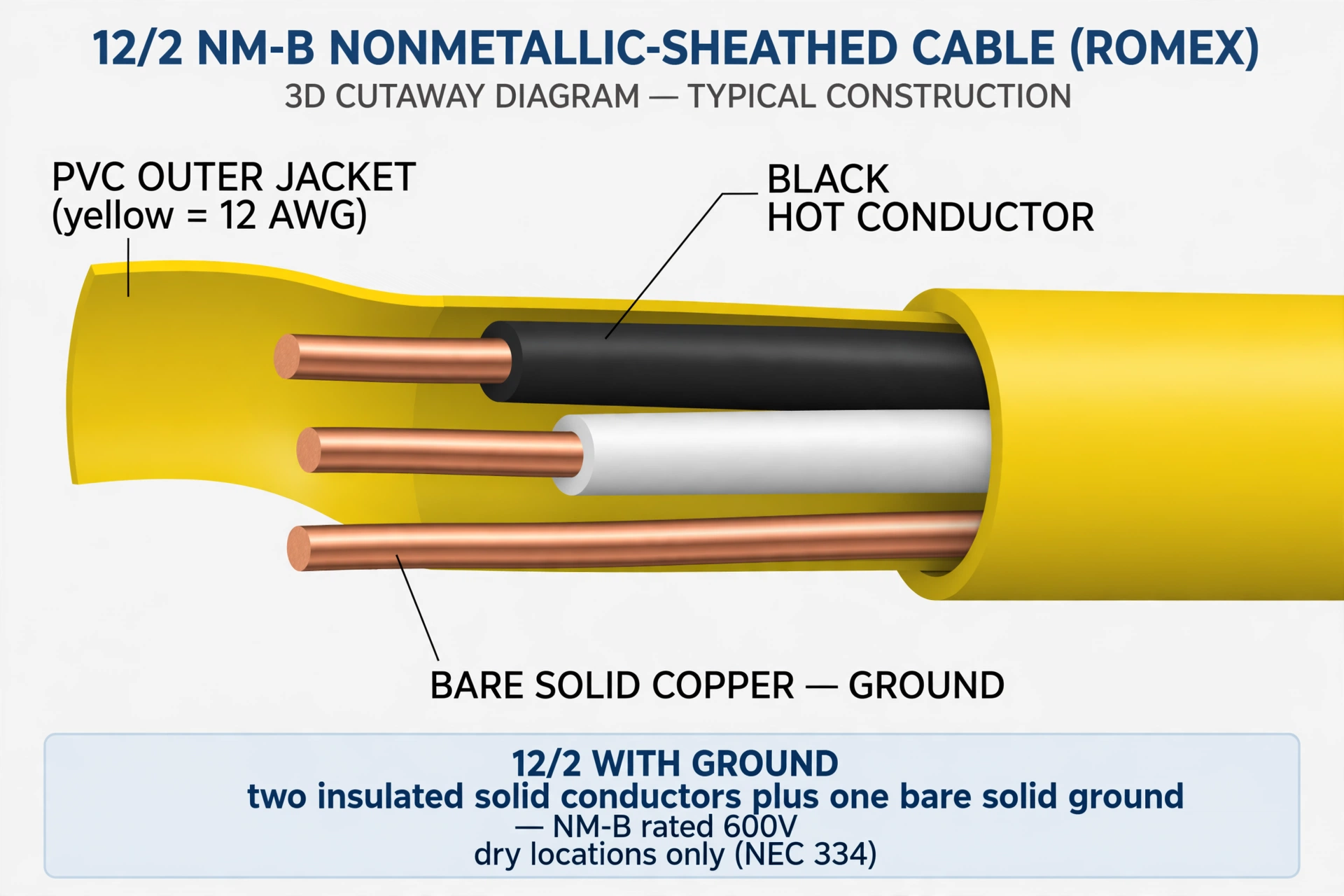
Cut a piece of Romex open and you find a simple stack. The outer layer is a PVC (polyvinyl chloride) jacket — the colored plastic skin. Under it sit two or three insulated solid copper conductors, each in its own colored insulation: black for hot, white for neutral, and red for the second hot in three-conductor cable. Alongside them runs one bare solid copper wire with no insulation at all: the equipment ground. That is the whole cable. No armor, no shielding, no mystery — which is exactly why it is cheap, fast to install, and limited to the gentlest environments.
Modern NM-B jackets are color-coded by gauge, and once you know the code you can read a wall of cable at a glance. White jacket means 14 AWG. Yellow means 12 AWG. Orange means 10 AWG. Black means 8 or 6 AWG. The color is a manufacturer convenience, not a code requirement — the printed markings on the jacket are the official identification — but on a real job site, the colors save everyone time. Old Romex from decades past often has a white or gray jacket regardless of gauge, so on old work, read the printing, not the color.
Every Romex jacket is printed with its full identity. Learn to read it and you never have to guess what you are holding. The format is always gauge first, then conductor count: 14/2, 12/2, 10/3, and so on.
The first number is the AWG gauge — the thickness of each conductor. The second number is how many insulated current-carrying conductors are inside. So 12/2 means 12-gauge wire with two insulated conductors: one black (hot) and one white (neutral). 10/3 means 10-gauge with three insulated conductors: black, red, and white, for circuits that need two hots plus a neutral, like a dryer or a range. The bare ground wire is never counted in that second number. When a listing includes it, it reads "12/2 with ground" — two insulated conductors plus the bare ground riding along.
After the size, the jacket carries the ratings that matter: 600V (the voltage rating), the temperature marking, "NM-B," the UL listing mark, and the footage markers printed every foot so you can measure a run without a tape. One detail worth knowing: the individual conductors inside are insulated to 90°C, but NEC 334.80 limits the cable's ampacity to the 60°C column — so 12 AWG Romex is a 20-amp cable and 14 AWG is a 15-amp cable, full stop. Our wire gauge chart lays out every common gauge with its ampacity from NEC 2023 Table 310.16.
14/2 is the lighting and general receptacle cable of most homes, on 15-amp circuits. 12/2 is the workhorse: 20-amp circuits for kitchens, bathrooms, laundry, and garages. 10/2 feeds 30-amp 240-volt loads like water heaters and small air conditioners. 10/3 and 8/3 feed dryers and ranges where a neutral is needed alongside the two hots. And 6/3 feeds the big stuff — subpanels and large ranges. The small-conductor rule (NEC 240.4(D)) caps the overcurrent protection at 15 amps for 14 AWG, 20 for 12 AWG, and 30 for 10 AWG, regardless of what the ampacity table says.
NEC Article 334 gives NM-B a clear, narrow territory: normally dry locations, for exposed or concealed work. In practice that means inside the walls, ceilings, and floors of homes and similar buildings — fished through studs, stapled along joists, run through bored holes in framing. It can run in the air voids of masonry block or tile walls, as long as those walls are not wet or damp locations. That is the whole list, and it covers the vast majority of residential wiring in America.
The flip side is just as important, because misused Romex is one of the most common code violations in the field. NM-B does not go in wet or damp locations. It does not go underground or in direct burial. It does not go embedded in concrete. It does not go where it is exposed to physical damage — that is what armored cable and conduit are for. And it is not for running inside conduit as a wiring method (the jacket is not rated for it, and it wastes conduit fill). For outdoor, wet, or underground runs, the right products are UF-B cable or THHN/THWN-2 conductors in conduit — the how to choose electrical wire guide walks through the decision.
Where it is allowed, Romex still has rules. It must be secured and supported — stapled or strapped at the intervals the code requires — and protected from damage where it passes through framing, which is why you see those metal nail plates on studs. It cannot be used as a substitute for a flexible cord, and it cannot just lie across an attic floor where people walk without protection. These are installer details, and they are exactly the kind of thing the licensed pro on the job handles. The takeaway for the reader: if you see Romex somewhere damp, buried, or battered, something is wrong.
Here is the part I think about as a buyer. Romex is roughly 60 to 70 percent copper by weight, depending on the gauge — the rest is the PVC jacket and insulation. Southwire publishes the numbers on its own spec sheets: 14/2 carries about 37 pounds of copper per 1,000 feet (about 61 percent of the cable's weight), 12/2 carries about 59 pounds per 1,000 feet (about 68 percent), and 10/2 carries about 91 pounds per 1,000 feet (about 72 percent). Thicker gauges carry a bigger copper share because the jacket does not grow as fast as the conductors do.
A standard 250-foot coil of 12/2 — the coil every residential electrician has opened a hundred times — holds about 15 pounds of copper. The cutoffs from a single house rough-in, the half-coils left in the truck, the demo pulls from a rewire: it adds up fast, and it adds up in pounds, not pennies. Keep Romex separate from other wire types when you collect it, because the insulation and the mix of conductors grade differently than bare copper or THHN. When the pile is worth a call, you know the number.
Effectively, yes, in everyday language. NM-B is the cable type: nonmetallic-sheathed cable, governed by NEC Article 334. Romex is Southwire's registered brand name for its NM-B cable, and the name became so common that everyone uses it for any NM-B. When a pro says Romex, they mean NM-B.
The first number is the gauge (12 AWG) and the second is the count of insulated current-carrying conductors (2). So 12/2 is two 12-gauge insulated conductors — almost always one black and one white — plus a bare copper ground wire that is not counted in the number. When ground is included in the description, it reads 12/2 with ground.
No. NM-B is limited by NEC Article 334 to dry interior locations, and it is not rated for wet locations, direct burial, or exposure to physical damage. Outdoor and underground runs call for UF-B cable or THHN/THWN-2 conductors in conduit. Running Romex outside is one of the most common code violations there is.
So you can identify the gauge at a glance: white jacket is 14 AWG, yellow is 12 AWG, orange is 10 AWG, and black is 8 or 6 AWG. The color is a convenience, not a code requirement — the printed markings on the jacket are the official identification.
Roughly 60 to 70 percent of Romex by weight is copper, depending on the gauge. Per Southwire's own specifications, 14/2 is about 61 percent copper, 12/2 about 68 percent, and 10/2 about 72 percent. A 250-foot coil of 12/2 holds about 15 pounds of copper.
No. This page explains what Romex is and how it is used so you can understand the work, but installing new circuits and working in panels belongs to licensed electricians. Every code reference here names the NEC article and edition — check your local amendments before any real work.
Residential work leaves Romex everywhere. Cutoffs from the rough-in, short ends from device boxes, half-coils that never got used, and full demo pulls from rewires. On most crews it goes into a bucket, and on most crews the bucket gets split.
Romex grades as insulated copper wire, and it is bought by weight — roughly two-thirds of every foot is copper. Keep it separate from bare copper and from other cable types, keep the aluminum out, and do not bother stripping it yourself unless you enjoy the work. When the bucket is full, call Sonny at 312-880-8174 for a number on it. One call, one person, and the leftovers from the job turn into money.
Suggested next read: The MC Cable Guide — the armored cable of the commercial world.
Every quote, pickup, and payment runs through one person who answers the phone: Sonny Johns at 312-880-8174. No portals, no ticket queues, no waiting on a committee.