Baseline the current life
Pick a representative job and record parts per edge with the current parameters. Without a baseline, every change is a guess and every improvement is unverifiable.
Tool life is not luck. It is the output of disciplined speeds, smart toolpaths, correct coolant, and monitoring that catches wear before it becomes failure. Here is the process.
Optimized tool life starts with removing variation. The shop that runs the same proven numbers every time beats the shop chasing magic parameters.
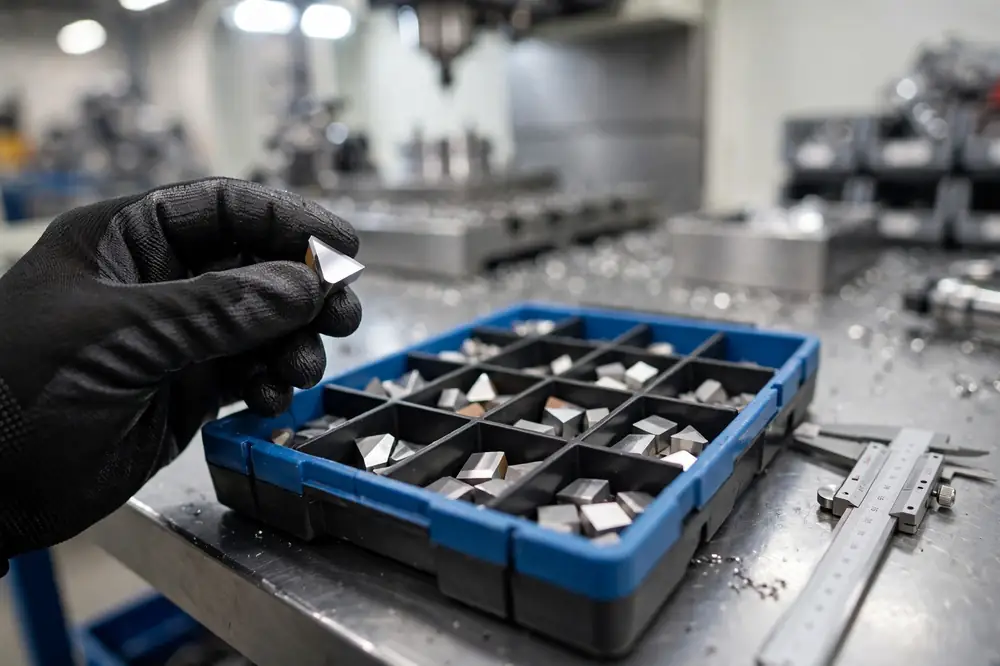
Speeds and feeds discipline is the base layer. Proven parameters get documented per tool, per material, per operation — and operators run the documented numbers instead of improvising. Every improvisation is an uncontrolled experiment on tool life. The shops with the best tool life are usually the shops with the least parameter variation.
Toolpath strategy is the multiplier. Constant-engagement toolpaths — trochoidal milling, adaptive clearing — keep the radial load steady instead of slamming the tool into corners at full engagement. The tool experiences one continuous moderate load rather than alternating shock and air, and tool life climbs dramatically. In turning, consistent depths of cut beat aggressive-then-timid programming.
Pick a representative job and record parts per edge with the current parameters. Without a baseline, every change is a guess and every improvement is unverifiable.
Set proven parameters from the tool manufacturer's data, document them on the setup sheet, and require sign-off to deviate. Eliminate the variation first; optimize second.
Measure runout, minimize stick-out, verify workholding rigidity. No parameter set survives a shaky setup — mechanical problems masquerade as tool-life problems constantly.
Move to constant-engagement strategies where the control supports them. Reduce air cutting, smooth the entries and exits, and keep the chip load steady through corners and direction changes.
Match coolant delivery to the operation: flood where heat must leave, air blast or dry where thermal shock threatens, through-spindle where the cut is deep. Aim the nozzles at the cutting zone, not the general area.
Track parts per edge, watch spindle load trends, and index or replace inserts on a count — before failure, not after. Predictable indexing is the entire payoff: no scrapped parts, no crashed tools, no surprises.
Optimization pays in one number: tooling cost per part.
Tool price divided by parts per edge. A 20% tool-life improvement is a 17% tooling-cost reduction on the same job — before counting the avoided scrap parts, the avoided crashes, and the reclaimed spindle time. Run the math on your highest-volume jobs first; that is where optimization returns the most.
There is a second payoff the budget rarely credits: predictable wear creates a sortable scrap stream. Tools retired on schedule come out as clean, identifiable, single-grade lots — the easiest carbide to grade and the best-paying. Compare that to the mystery bin of crashed, mixed, unidentifiable tooling. Optimization does not just cut tooling cost; it raises the recovery value of everything the shop consumes.
Do not over-optimize the edge: stretching an insert past its reliable life to save pennies risks scrapping a part worth hundreds. Index on schedule with margin. The pulled insert still has full scrap value — running it to catastrophic failure helps no one.
The spindle load meter is the cheapest tool-life monitor ever built. A rising load trend on the same program means the edge is degrading — long before the finish or the tolerance says so. Shops that log load at the start of a tool's life and index when it climbs a set percentage catch wear in the act. For unattended and lights-out work, load monitoring graduates from good practice to essential: it is the difference between a worn insert and a crashed tool at 2 AM.
A century ago, F.W. Taylor showed that cutting speed dominates tool life: a small speed increase costs a large chunk of tool life, while feed changes cost far less. The practical translation has not changed in a hundred years — when a job needs more output, raise the feed before raising the speed, because speed is the expensive dial. Every modern speeds-and-feeds chart is Taylor's discovery wearing new clothes.
The disciplined practice of maximizing the parts each cutting edge produces: proven speeds and feeds, smart toolpaths, correct coolant, rigid setups, and monitoring that retires tools on schedule instead of on failure.
It varies by starting point, but shops moving from improvised parameters to disciplined process commonly see double-digit percentage gains — and the bigger win is predictability: no surprises, no scrapped parts, no crashed tools.
Variation and mechanical problems. Improvised speeds and feeds, runout, weak workholding, and wrong coolant strategy destroy more tool life than any parameter choice. Fix the setup before tuning the numbers.
Yes — it is the single most useful tool-life metric a shop can keep. It turns arguments about tools into data, sets the indexing schedule, and feeds the cost-per-part math that justifies every tooling decision.
The opposite. Predictably retired tools come out as clean, sortable, single-grade lots — which grade better and pay better than a mystery bin of crashed tooling. Optimization raises recovery value.
That predictable wear is a predictable revenue stream. There are no minimums: scheduled pull-outs in any quantity count, and on bigger lots we handle the freight so you do not lift a finger. Call 312-880-8174.
Optimized tools wear predictably — predictable wear means a steady, sortable scrap stream instead of a mystery bin. Every insert retired on schedule is clean, identifiable carbide worth real money. There are no minimums: the smallest shop's scheduled pull-outs count, and on bigger lots we handle the freight so you do not lift a finger. Call 312-880-8174.