Measure the real spend
Pull twelve months of tooling purchases and divide by revenue and by parts shipped. You need the baseline before any move matters — most shops discover their tooling cost per part is a guess until they do this.
Tooling runs about 3–6% of a machine shop's revenue, according to American Machinist — and most shops leak a meaningful share of it. Here is the owner's playbook for getting it back.
You cannot cut what you do not measure. Tooling cost benchmarks give the target.
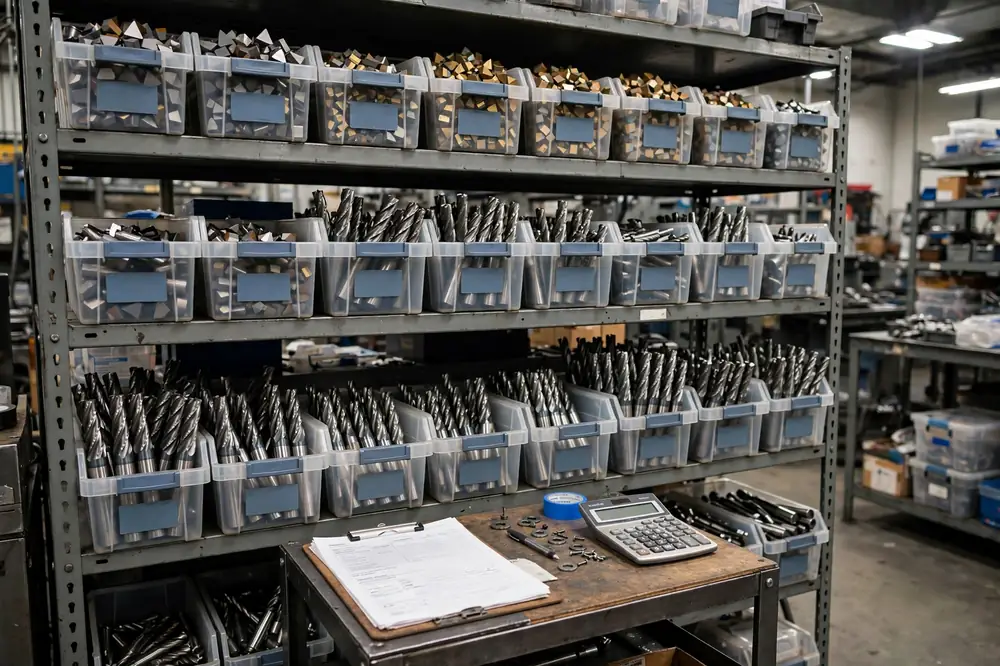
Industry benchmarks put tooling spend at roughly 3–6% of shop revenue (American Machinist). A $1M shop spends $30,000–$60,000 a year on cutting tools. That number is the budget line to manage — and the opportunity most owners underestimate is how much of it comes back through the moves below.
The deeper metric is tooling cost per part: tool price divided by parts produced per edge. It is the only number that lets you compare a cheap tool against an expensive one honestly. A $45 insert that cuts 300 parts beats a $18 insert that cuts 80 — $0.15 per part versus $0.23 — and the shops that run this math stop buying on sticker price.
Pull twelve months of tooling purchases and divide by revenue and by parts shipped. You need the baseline before any move matters — most shops discover their tooling cost per part is a guess until they do this.
Fewer suppliers means better pricing, fewer duplicate inventories, and simpler reordering. Standardize on fewer insert grades across machines: it cuts crib inventory, simplifies training, and — as a bonus — your scrap sorts itself, and sorted carbide pays better than mixed.
Regrinding end mills and drills costs a fraction of new — industry reporting puts savings at 35–80% versus new, per Cutting Tool Engineering. Sort dull tools at the machine, track post-regrind diameters, and keep a new-tool buffer so turnaround never stops production.
Tools dying young are the most expensive tools you own. Fix the runout, rigidity, and speeds-and-feeds problems that kill edges early — every premature failure is a tool you bought twice. The troubleshooting guides on this site walk through each one.
This is the line item most budgets miss entirely. Worn inserts, dead end mills, grinding sludge — it is all tungsten carbide with real value. Shops recovering their carbide stream typically see 4–10% of tooling spend come back. Put the bins out and it is found money.
Ask most shop owners what their worn tooling is worth and you get a shrug. That shrug is money.
On $50,000 of annual tooling spend, a 4–10% recovery rate returns $2,000–$5,000 a year — for putting labeled bins at the machines and making a phone call when they fill. No new process, no capital, no risk. It is the highest-ROI move in this entire playbook because the material is already paid for and currently going in the trash.
The program is simple: a bin at each machine for worn inserts and end mills, a separate container for grinding sludge if the shop grinds, and a sorting habit — solid carbide apart from brazed tooling. Sorted streams pay better than mixed mystery bins, and the sorting happens naturally if the bins are labeled from day one.
The full setup guide: our machine-shop recycling program walks through the 10-minute bin setup, sorting rules, and pickup scheduling: Machine Shop Carbide Recycling Program.
Once a year, audit the tool crib like an accountant. Count the duplicate grades doing the same job, the orphan tooling for machines you no longer run, and the dead stock ordered for jobs that ended years ago. Most shops find hundreds or thousands of dollars in capital sitting on shelves — some of it sellable as surplus tooling, some of it convertible to scrap value, all of it better than gathering dust. An organized crib also sorts its own scrap: worn tools go straight to the labeled bin because the bin is part of the system.
The purchasing habit that saves the most money is also the simplest: quote tooling on cost per part, not price per tool. Run the trial, track parts per edge, and let the data pick the winner. The cheapest insert in the catalog is frequently the most expensive insert in the machine — and the purchasing agent who knows the per-part numbers has the strongest negotiating position with every vendor.
Industry benchmarks put it at roughly 3–6% of shop revenue, per American Machinist. Above that range, something is leaking — premature tool failure, overbuying, or no regrind program are the usual culprits.
Industry reporting puts regrind savings at 35–80% versus buying new, according to Cutting Tool Engineering. The savings are biggest on larger tools and standard geometries; tools under about 1/4 inch usually do not pencil out.
Yes, on three fronts: better pricing from volume, less duplicate inventory sitting in the crib, and simpler reordering. Most shops carry tooling from far more suppliers than they need.
Two things in one afternoon: start a regrind sort at the machines (regrind candidates vs scrap), and put out labeled carbide bins. The first cuts next quarter's tooling bill; the second starts the recovery revenue line.
Tool price divided by parts produced per edge or per tool. Track it on your real jobs for a month and the expensive-vs-cheap tool debate settles itself with data.
Put the bins out and call 312-880-8174. There are no minimums — a small shop's bucket counts exactly as much as a big shop's drum. On bigger lots, we handle the freight so you do not lift a finger. Most shops see 4–10% of tooling spend come back.
Scrap recovery returns 4–10% of tooling spend — put the bins out and it is found money. Every worn insert and dead end mill your shop produces is already-paid-for tungsten with a buyer waiting. There are no minimums: the smallest job shop's bucket counts, and on bigger lots we handle the freight so you do not lift a finger. Call 312-880-8174.