Plumbing Guide
The hub: every plumbing guide in one place, organized by your level.
VIEW HUB →I have watched a lot of young guys enter this trade, and the ones who make it are the ones who understood the roadmap early. Here is the whole path — apprenticeship, journeyman, master — with the real hours, the real exams, and the real money.
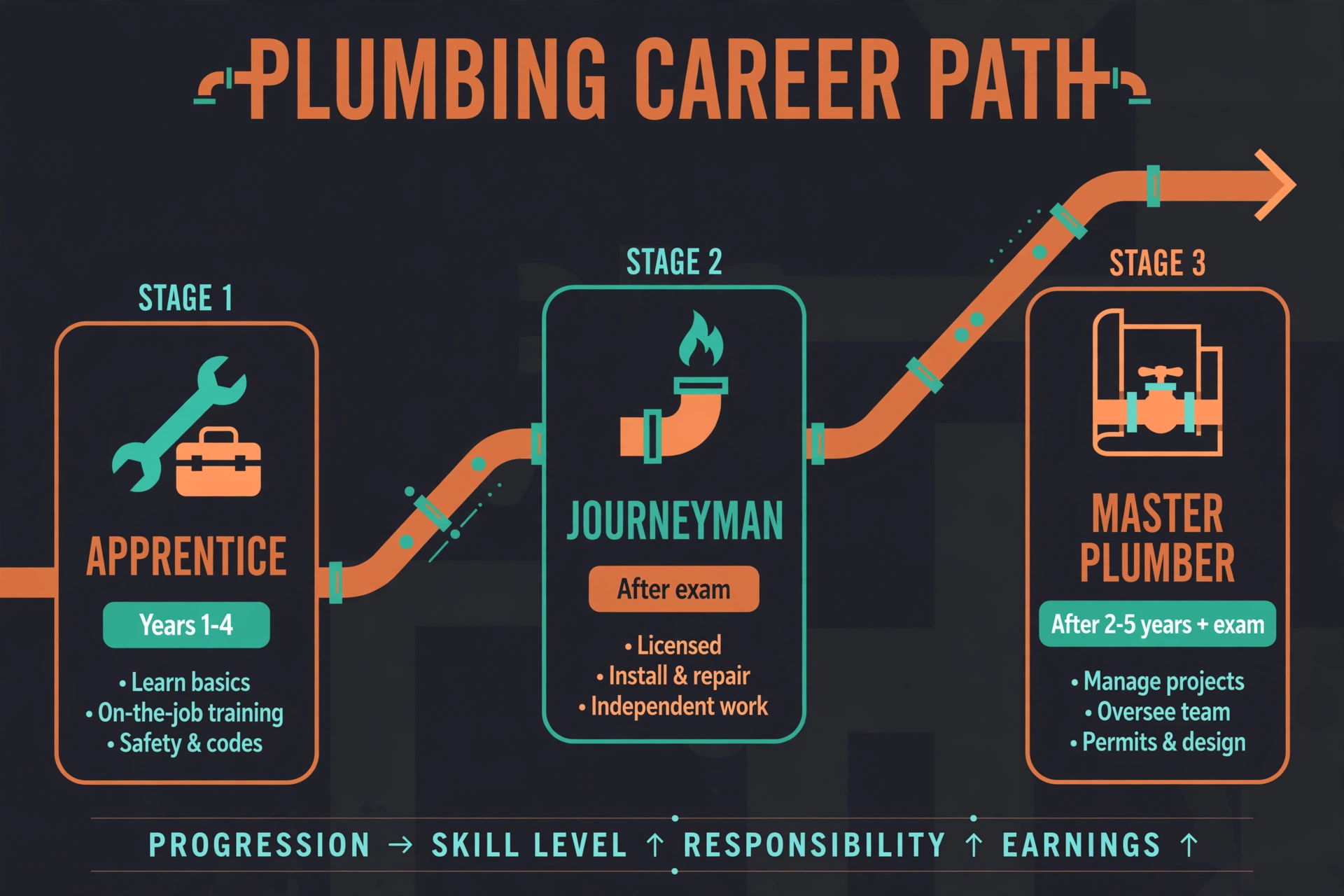
Plumbing work is licensed for a reason. Bad plumbing makes people sick — contaminated water, sewer gas, scalding temperatures — so nearly every state requires plumbers to hold a license to do the work. The license is not paperwork for its own sake. It is proof that you know the code, you have done the hours, and you can be trusted inside somebody's walls.
That also means the path is structured, which is good news for you. There is no mystery to it. Do the apprenticeship, pass the exams, put in the years, and the license — and the pay that comes with it — is yours. Licensing varies by state and sometimes by city, so everything below is the national shape of the path. Always check your state board for the exact rules where you work.
Three stages, each with its own work, its own timeline, and its own exam. Here is what each one actually looks like.
The apprenticeship is where every plumber starts. You work full time for a plumbing contractor or through a training program, learning on the job under licensed plumbers, and you take classroom instruction alongside the field work: code, blueprint reading, math, safety, and theory. Apprenticeships usually run 2 to 5 years, and 4 to 5 is the most common shape nationally — Illinois, for example, generally requires 4 years of experience before you can sit for the license exam.
You get paid from day one, starting below journeyman wages and stepping up as you progress. As an apprentice you do real work — carrying material, cutting and fitting pipe, setting fixtures, assisting on rough-ins — but you do it under supervision. The discipline of the apprenticeship is the trade teaching you judgment: which pipe goes where, how a system is supposed to behave, and what a mistake looks like before it becomes a callback.
Finish the apprenticeship and pass the journeyman licensing exam, and you are a licensed plumber. The exam covers plumbing theory, code knowledge, and safety — it is the trade's way of confirming that the apprenticeship actually taught you something. As a journeyman you work independently: installs, repairs, service calls, remodels. You supervise apprentices. You are the person the customer talks to.
This is also where the money gets serious and the specialties open up. Service plumbers run their own calls and keep what they fix working. New-construction plumbers rough in whole buildings. Pipefitters, sprinkler fitters, and gas fitters are adjacent licensed specialties with their own demand. A journeyman with a good reputation in a busy market can write their own ticket.
The master plumber license is the top of the ladder. After working as a journeyman — typically 1 to 5 years depending on the state — you pass a harder exam covering the full plumbing code, system design, and business-side knowledge. The master license qualifies you to design plumbing systems, pull permits, supervise other plumbers, and be the license-holder a plumbing business operates under.
Most shop owners are master plumbers. If your goal is to run your own company instead of working for one, the master license is the doorway. From first day as an apprentice to master, plan on roughly 6 to 10 years total — which sounds long until you realize it is also roughly how long it takes to get genuinely great at the work.
There are three common ways to start an apprenticeship, and the license at the end is the same from all of them. The first is to get hired directly by a plumbing contractor as a helper or apprentice — many shops will sponsor promising newcomers and some pay for the schooling. The second is a trade school or community college plumbing program, which teaches the classroom side first and often helps with placement into an apprenticeship. The third is a union apprenticeship, typically run through a local joint training committee, with structured pay raises and benefits built in.
Non-union routes exist too, often through merit-shop associations or employer programs, and they lead to the same license. Pick based on the quality of the program near you — talk to working plumbers, ask who trained them, and look for programs with real job placement — not based on the label. What matters is hours under good plumbers and classroom time that actually prepares you for the exam.
What to bring on day one: a high school diploma or equivalent, basic math comfort, a driver's license, and the willingness to do the unglamorous work well. The apprentices who become journeymen fastest are not the strongest ones. They are the ones who show up early, ask good questions, and treat every journeyman like a teacher.
Here is something worth knowing if you work in my home market. Illinois issues a state plumber license through the Illinois Department of Public Health, under the Illinois Plumbing License Law. Chicago issues its own license as well. One license, recognized across the state — that is how it should work.
The reason this matters: it is a genuine difference from electrical work in Illinois. There is no statewide electrician license here — electricians in Illinois are licensed at the city level, and Chicago has its own licensing. So a plumber in Illinois carries one state credential, while an electrician's credential depends on the municipality. If you are choosing between the trades, that difference is real and worth knowing.
Wherever you are, the rule is the same: find your state board, read the actual requirements, and plan your apprenticeship around them. Licensing details change, boards update rules, and the only source that counts is the board itself.
The Bureau of Labor Statistics reported a median annual wage of $63,800 for plumbers, pipefitters, and steamfitters in May 2025. The lowest 10 percent earned less than $40,670 and the highest 10 percent earned more than $105,150 — the spread mostly reflects the difference between apprentices, journeymen, and masters, plus overtime and on-call pay. Apprentices earn less than fully trained plumbers, but their pay increases as they learn to do more.
Demand is the stronger part of the story. The BLS projects about 42,000 openings a year for plumbers, pipefitters, and steamfitters through 2035, with 7 percent employment growth — much faster than the average for all occupations. Many of those openings come from workers retiring or changing occupations, not just new construction. Buildings keep aging, pipes keep failing, and the existing housing stock needs plumbers whether or not anyone is building new.
One more honest note: plumbers are often on call, and evening and weekend work is common. That is part of why the pay holds up — when a pipe bursts at 2 AM, the person who answers the phone earns their money.
Nobody tells you that the trade teaches you material value as a side effect. You will handle copper pipe and brass fittings every single day, and you will learn fast that the cutoffs are not trash. Most crews keep a bucket and split it — that is the trade's open secret, and it is worth more than most apprentices expect in year one.
Nobody tells you that code knowledge is a career accelerant. The journeymen who can cite the code get the complex jobs, the inspection respect, and the faster path to master. Read the code book like it is a playbook, not homework.
Nobody tells you that your knees and back are business assets. The plumbers who last thirty years are the ones who used knee pads, lifted right, and learned to work smart in crawl spaces instead of muscling through them. Protect the body and the body pays you back.
Most plumbing apprenticeships run 2 to 5 years, and 4 to 5 is the most common. You work full time under licensed plumbers while taking classroom instruction on code, math, and theory. Illinois, for example, generally requires 4 years of experience before you can sit for the plumber license exam.
A journeyman has finished the apprenticeship and passed the licensing exam, and works independently on installs and repairs. A master plumber has worked additional years as a journeyman and passed a harder exam, which qualifies them to design systems, pull permits, supervise other plumbers, and run a plumbing business.
The Bureau of Labor Statistics reported a median annual wage of $63,800 for plumbers, pipefitters, and steamfitters in May 2025. The lowest 10 percent earned less than $40,670 and the highest 10 percent earned more than $105,150. Apprentices start lower and step up as they progress through the program.
Yes. Illinois issues a state plumber license through the Illinois Department of Public Health under the Illinois Plumbing License Law, and Chicago issues its own license too. This is a real difference from electrical work in Illinois, where there is no statewide electrician license and licensing happens at the city level.
Yes. The Bureau of Labor Statistics projects about 42,000 openings a year for plumbers, pipefitters, and steamfitters through 2035, with 7 percent employment growth — much faster than average. Most openings come from retirements, and pipes in existing buildings keep needing repair regardless of new construction.
Both paths produce good plumbers. Union apprenticeships, often run through local joint training committees, typically offer structured pay raises and benefits. Non-union routes through merit shops or employer programs offer the same license at the end and sometimes faster placement. The license you earn is the same either way, so pick based on the program quality near you, not the label.
Here is something your apprenticeship will teach you in the first month: every plumbing job leaves metal behind. Copper pipe cutoffs, brass fittings and valves, stubs and elbows from the rough-in — it all goes into a bucket, and on most crews that bucket gets split.
The recoverable material in plumbing work is copper pipe, brass fittings, and valves, and it is some of the cleanest scrap in any trade — no insulation, no sorting headaches, just weight. When your bucket fills up, call Sonny at 312-880-8174 for a number. Send photos of the pile and get a real quote back. If you liked this guide, read DWV Explained next — vents are the part of the trade that separates the good plumbers from the lucky ones.