Do I need a license to be a plumber?
Yes, in nearly every state. Plumber licensing is handled at the state level in most of the country, which is a real difference from electrical work in states like Illinois, where electricians are licensed by the city. Illinois issues a state plumber license through the Illinois Department of Public Health, and Chicago issues its own as well. Always check your state board for the exact rules where you work.
How long does it take to become a plumber?
The apprenticeship runs 2 to 5 years in most states and commonly 4 to 5, combining on-the-job hours with classroom instruction. After that you pass the journeyman exam and work as a journeyman, and then a master plumber license follows 1 to 5 years of journeyman experience plus another exam. Plan on roughly 6 to 10 years from day one to master.
How much do plumbers make?
The Bureau of Labor Statistics put the median annual wage for plumbers, pipefitters, and steamfitters at $63,800 in May 2025. The BLS also projects about 42,000 openings a year through 2035, with 7 percent employment growth — much faster than the average for all occupations. Much of that demand comes from retirements, not just new construction.
What does DWV mean in plumbing?
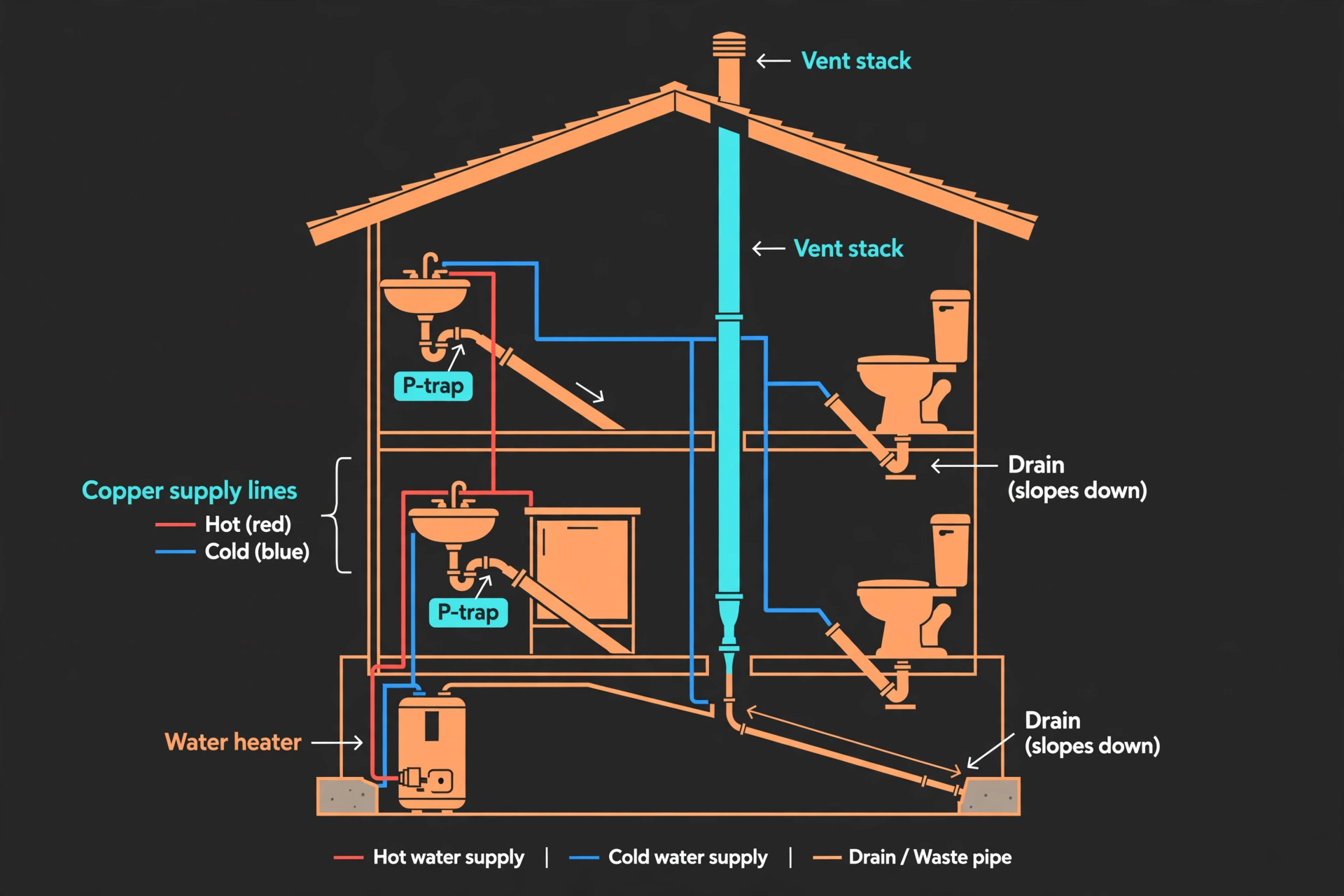
Drain, Waste, Vent. It is the gravity-powered half of a plumbing system: drains carry wastewater out of fixtures, waste lines move it through the building, and vents let air in and sewer gas out so water flows freely and traps keep their water seal. Every plumbing system has a pressure side that brings water in and a DWV side that takes it out.
Is PEX as good as copper for water lines?
Both are proven choices with different strengths. Copper has a 50-plus-year track record and handles heat and sunlight, but it costs more and can develop pinhole leaks in aggressive water. PEX installs faster, usually costs less overall, resists freezing far better, and ignores water chemistry — but it must stay out of sunlight and it is younger, with projected lifespans in the 40-to-50-year range. The full comparison is on our copper-vs-pex page.
Are these guides really free?
Yes. Every guide is free to read, with no sign-up and no paywall. Ironcrest Industrial Surplus publishes them as a resource for the trades. The business behind them is scrap buying: we buy copper pipe, brass fittings, and carbide from the same crews these guides are written for.
I have leftover copper pipe from a job. What should I do with it?
Keep it. Copper pipe, brass fittings, and valves from any job are worth real money, and on most crews the bucket gets split at the end of the job. When your pile is ready, call Sonny at Ironcrest at 312-880-8174 for a number — photo quotes available.