Plumbing Guide
The hub: every plumbing guide in one place, organized by your level.
VIEW HUB →Every apprentice searches this question at some point, and most of the answers read like a code book. Here is the friendly version: what each letter means, how vents actually work, and why the humble trap is the most important fitting in your house.
Every plumbing system in every building is really two systems that meet at the fixtures. The pressure side brings clean water in: the main line, the water heater, and the supply pipes running to every faucet, toilet fill valve, and appliance. That side runs on pressure — city pressure or well pump pressure — and its pipes can run uphill, sideways, anywhere.
The DWV side takes the dirty water out, and it runs on gravity alone. There is no pump pushing your shower water to the street. The pipes slope downward, water falls downhill, and the whole thing works silently behind your walls — as long as it was built right. DWV stands for drain, waste, and vent: three jobs, three sets of pipes, one connected system.
Here is why this matters to you. Most plumbing failures people actually experience — slow drains, gurgling toilets, sewer smells — are DWV failures, not supply failures. And the fixes are almost always about the three letters: something is blocked, something is sloped wrong, or something is not vented.
Drains are the pipes that carry wastewater away from individual fixtures: the sink tailpiece, the tub drain, the toilet's internal trapway. They start at the fixture and end where they join a larger pipe. A drain's job is simple — get the water out of the fixture and into the system — and it does it by falling downhill from the very first inch.
Waste lines (also called waste stacks and building drains) are the bigger pipes that collect multiple drains and carry the combined flow through the building and out to the sewer or septic system. The main waste stack in a house is the large vertical pipe — often 3 or 4 inches — that you see in the basement running up through the floors. Every drain eventually finds its way to this stack.
Vents are pipes that carry air, not water. They run from near the drains upward, join together, and exit through the roof. You have seen them: the little pipes poking out of rooftops all over your neighborhood are vent stacks doing their job. They have two duties. First, they let sewer gas escape safely above the roofline instead of building up in the pipes. Second — and this is the clever part — they let air into and out of the drainage system so water can flow freely.
Water cannot drain properly without air behind it. Here is the physics, minus the textbook.
Think about pouring water out of a bottle. Turn it straight upside down and it glugs — water fights air trying to get in, and the flow stutters. Now poke a second hole in the top of the bottle and it pours smooth and fast. That second hole is a vent.
A drain works the same way. When a slug of water rushes down a drain pipe, it pushes air ahead of it and drags air along behind it — like a plunger moving through a syringe. If there is nowhere for that air to go, pressure builds up in front of the water and suction builds up behind it. The fixture drains slowly, the toilet gurgles, and strange things happen to the traps downstream.
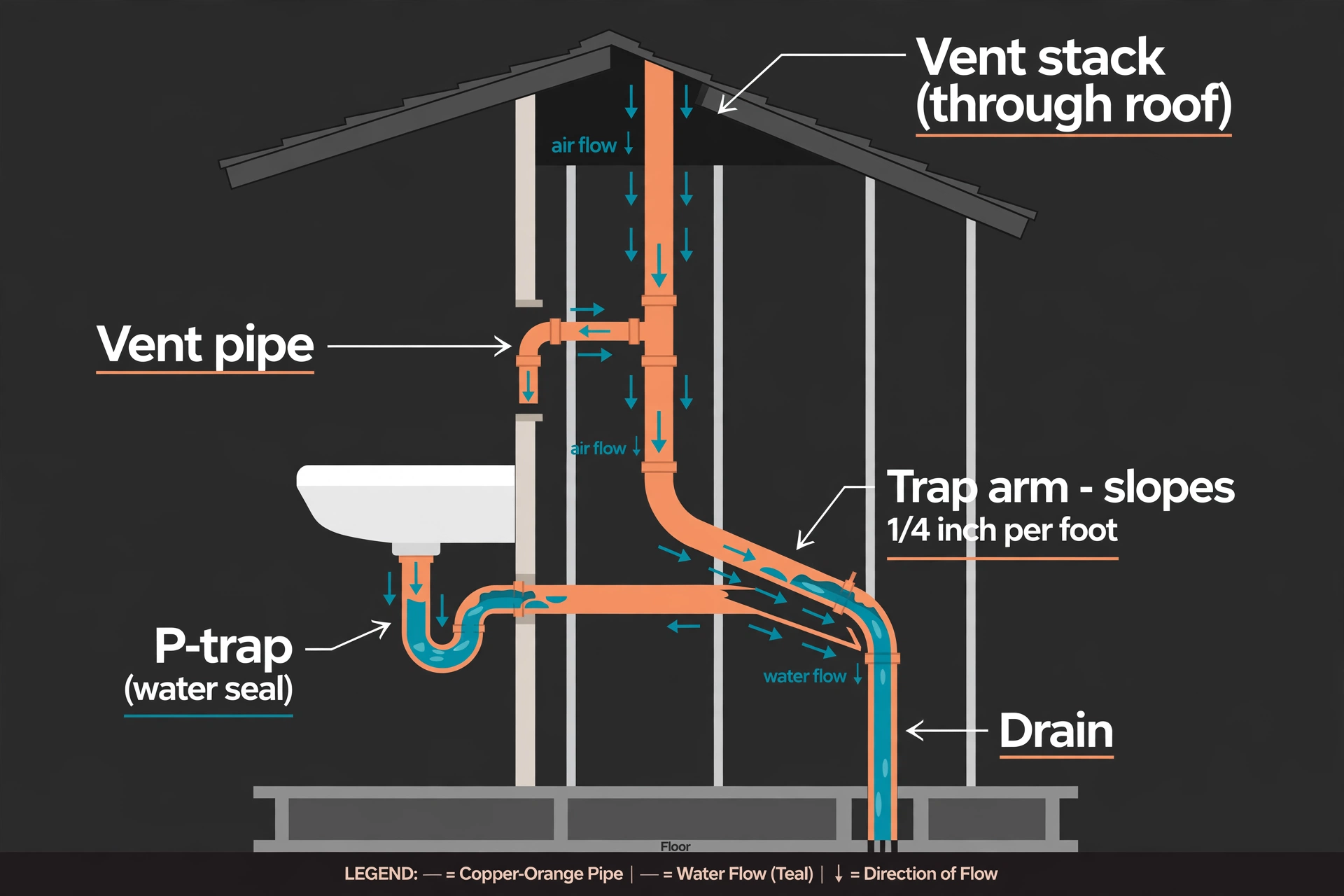
The vent pipe gives the air a path. It connects to the drain line near the fixture and runs up to the vent stack, which exits through the roof. Air flows freely through it in both directions: air pushed ahead of the water escapes out the roof, and fresh air flows in behind the water to replace what moved. The result is smooth, quiet, fast drainage — the glug-free pour.
This is also why vents and drains connect the way they do. A vent typically ties into the drain line close to the fixture's trap (the short horizontal pipe between the trap and the vent connection is called the trap arm), and then rises — vents always rise, because their job includes keeping water out. A vent that sags and fills with water stops being a vent.
The trap — the U-shaped or P-shaped bend under your sink — is the most important fitting in the drainage system, and its job has nothing to do with catching lost rings. After every use, the bend holds a plug of standing water. That water is a seal. It blocks sewer gas from flowing from the drain pipes up into your house. As long as the water sits there, the gas stays out.
Now imagine an unvented drain. A toilet flushes upstairs, sending a wall of water down the waste stack. Behind that wall of water, suction builds. That suction pulls on every trap connected to the stack — and if it pulls hard enough, it siphons the water right out of the trap. This is called trap siphonage, and it is exactly what vents prevent. The vent lets air in behind the falling water, so the suction never forms and the trap keeps its seal.
Pressure works the other way too. Water rushing down can compress air ahead of it and blow trap seals out from the other direction. Same fix: the vent gives the air somewhere to go. One air pipe, two problems solved.
The takeaway is simple and worth memorizing: a trap without a vent is a trap that will lose its water sooner or later, and a trap without water is an open door for sewer gas. That is why the code is so strict about venting — it is not bureaucracy, it is the difference between a house that smells fine and one that does not.
DWV pipe has no pump, so slope is the engine. Every horizontal drain pipe must fall steadily toward the waste stack or the sewer. Too flat and the water moves too slowly — solids settle out, sludge builds up, and you get a clog that was really a design problem. Too steep and you get the opposite problem: the water races ahead and leaves the solids behind, which also builds up and clogs. The correct slope keeps water and solids moving together.
The International Plumbing Code (IPC 704.1) sets minimum slopes by pipe size. Pipe 2.5 inches and smaller needs at least 1/4 inch of fall per foot of run. Pipe from 3 to 6 inches needs at least 1/8 inch per foot. Pipe 8 inches and larger needs at least 1/16 inch per foot. The Uniform Plumbing Code (UPC) typically requires 1/4 inch per foot for 3 inch pipe and smaller. Illinois has its own state plumbing code, so if you work here, the Illinois amendments are the ones that count.
The field trick is easy to remember: a quarter inch per foot on the small stuff — the branch drains in a house — and gentler on the big mains. Measure it with a level and do the math, because eyeballing slope is how callbacks are born. And always check your local amendments before you trust any number on the internet, including these.
Yes, drain pipe can be copper — but not the copper you sweat for water lines. Type DWV copper (yellow stripe) is made specifically for drain, waste, and vent systems. It has a thinner wall and it is not pressure-rated, which means it must never, ever be used on pressurized water lines. The color stripe system exists precisely so nobody mixes them up: green is Type K (thickest, underground and service lines), blue is Type L (standard interior water lines), red is Type M (thinner, light residential), and yellow is DWV only.
In practice, most residential DWV work today is PVC or ABS plastic. Plastic costs less, installs faster with solvent-welded joints, and never corrodes. Cast iron is still the premium choice where quiet drains matter — multi-family buildings, hotels, high-end homes — because its mass deadens the sound of falling water. Copper DWV is still code-legal and still found in older and high-end work, but plastic won the residential market on cost and speed.
What matters more than the material is the workmanship: correct slope, correct venting, supported pipe, and clean solid joints. A perfectly sloped PVC drain outlasts a sloppy copper one every time. The letters D, W, and V do not care what the pipe is made of.
Drain, Waste, Vent. Drains carry wastewater out of individual fixtures like sinks and toilets. Waste lines are the larger pipes that collect drains and move the water through the building. Vents are the air pipes — usually running up through the roof — that let air in and sewer gas out so the whole system drains freely.
Vents balance air pressure in the drainage system. When water rushes down a drain it pushes air ahead of it and pulls air behind it, like a plunger in a syringe. The vent gives that air somewhere to go — out through the roof — and lets fresh air in behind the water, so fixtures drain fast and quietly and the trap seals stay intact.
The trap — the U-bend under your sink — holds a plug of water that blocks sewer gas from coming into the house. Without a vent, draining water can create enough suction to siphon that water right out of the trap, or enough pressure to blow it out the other way. Once the water seal is gone, sewer gas flows straight into the room. The vent keeps the pressure near the trap balanced so the seal stays put.
The International Plumbing Code (IPC 704.1) sets minimum slopes by pipe size: 2.5 inches and smaller need at least 1/4 inch of fall per foot, 3 to 6 inch pipe needs at least 1/8 inch per foot, and 8 inch and larger needs at least 1/16 inch per foot. The Uniform Plumbing Code (UPC) typically requires 1/4 inch per foot for 3 inch and smaller. Too flat and solids settle; too steep and water outruns them. Always check your local amendments.
DWV copper (yellow stripe) is made for drain, waste, and vent systems only — it has a thinner wall and is not pressure-rated, so it can never be used on pressurized water lines. Supply copper (Type K green, Type L blue, Type M red) is pressure-rated for water lines. The stripe on the pipe tells you which is which.
Both work for DWV. Type DWV copper has been used for decades and is still code-legal, but PVC and ABS plastic dominate residential drain work today because they cost less and go in faster. Cast iron is still the choice where quiet drains matter, like multi-family buildings. What matters most is correct slope, correct venting, and solid joints — the material is secondary to the workmanship.
Drain work does not generate much copper — and that is exactly the point of knowing your materials. When a repipe or a remodel pulls old copper supply lines out of the walls, that pipe is the recoverable material, along with the brass fittings and valves that come out with it. DWV copper, where you find it, is copper too.
On most crews the bucket gets split at the end of the job, and copper pipe with brass fittings is some of the cleanest weight a crew ever handles. When your pile is ready, call Sonny at 312-880-8174 for a number. Send photos and get a real quote back. If you liked this guide, read Copper vs PEX next — the supply-side half of the story.