Your Friendly Guide to All Things Copper
Back up to the copper hub: every copper topic, four learning paths, and the tools.
VISIT HUB →I am Sonny, and old copper gutters are one of my favorite things to buy. They hung on a house for fifty years, turned green doing it, and the metal underneath is still worth real money. Here is the full story.
Here is the number that sells copper gutters: fifty to one hundred years. Aluminum gutters — the kind on most houses — give you twenty to thirty. Steel rusts. Vinyl cracks. Copper just hangs there, getting better looking, while three sets of aluminum gutters live and die on the house next door.
The reason is chemistry, and it is the friendliest kind. When copper sits in the weather, the surface reacts with oxygen, moisture, and carbon dioxide and grows a thin skin of copper carbonates and sulfates — the patina. That skin is tough, it bonds tight to the metal, and once it forms it effectively stops further corrosion. The copper underneath is preserved instead of consumed.
I have bought take-off gutters that were older than the seller and still structurally perfect. That is not marketing. That is what the metal does.
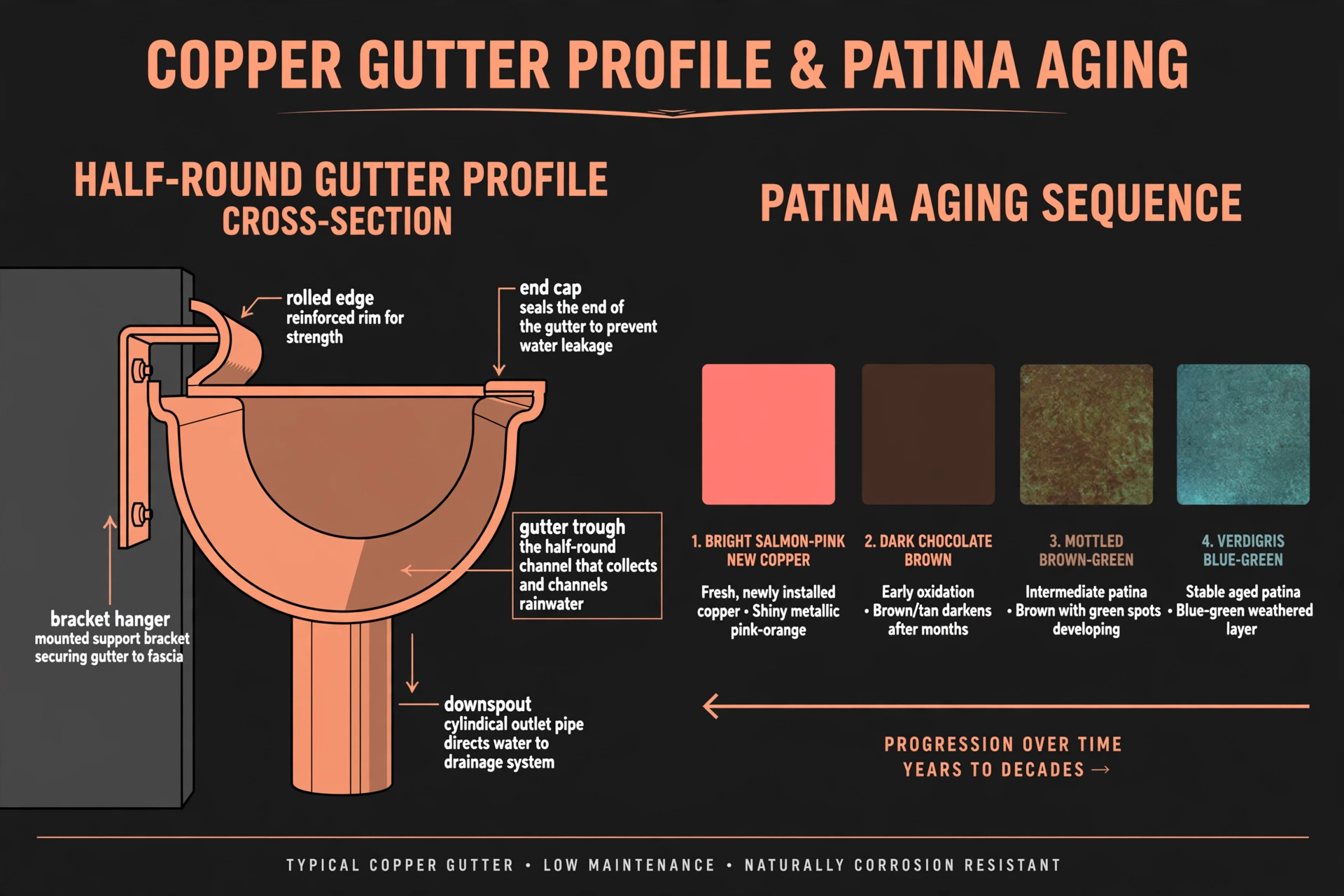
New copper gutters are startling — bright, reflective, salmon-pink, the kind of shiny that makes neighbors stop. That look does not last, and nobody expects it to. Within the first few years the surface deepens into a rich dark bronze, sometimes called chocolate brown. Then, slowly, the blue-green arrives.
How slow depends on where you live. In humid coastal air the full verdigris can show up in about five years. In a dry inland climate it can take twenty years or more. Chicago sits somewhere in the middle — expect the brown phase to last a while, with green creeping in over a decade or so. The Statue of Liberty is the famous example of the finished product: copper skin, fully greened, still standing.
If you want the deep science — what the green layer is made of and what it means for scrap value — our guide to why copper turns green goes all the way down. The short version: the patina is only a thin surface layer. The copper underneath is unchanged, and green gutters grade the same as bright ones when they come off the house.
Aluminum gutters are a parts system: snap this into that, screw it, seal it, hope the sealant holds. Copper gutters are a craft. The sections are joined with soldered seams — real metal-to-metal joints, melted and fused — and the corners, end caps, and downspout outlets are fabricated and soldered the same way.
This matters for two reasons. First, a soldered seam does not rely on caulk, and caulk is what fails on every other gutter. Second, the soldered joint moves with the copper as it expands and contracts through the seasons, instead of fighting it. A well-soldered copper gutter has almost no leak points, which is a strange thing to say about something whose whole job is carrying water.
It also means the installer matters enormously. Copper gutter work is sheet-metal craft, not handyman work. A bad solder job on expensive copper is the worst of both worlds — the price without the lifespan. If you are buying the job, buy the craftsman first and the material second.
Lifespan is the headline: fifty to one hundred years of service with minimal maintenance. No rust, ever — copper does not rust, it patinas. Almost nothing to maintain beyond keeping them clear of debris and checking the seams every few years. And the look: the green patina is one of the most recognized status signals in architecture, the same finish as courthouses and cathedrals.
Then there is the exit value, which nobody talks about and I think about constantly. When aluminum gutters come down, they are trash with a small rebate. When copper gutters come down after sixty years, they are clean, heavy, high-grade copper — real weight, real money. The material never stops being worth something.
Cost comes first and it is not close. Copper gutters run several times the price of aluminum, installed. On a house you plan to keep for decades, the per-year math works out beautifully. On a house you will sell in five years, you are buying beauty for the next owner.
Theft is real. Copper has scrap value — that is my whole business — and exposed copper on a vacant or under-construction property is a target. Occupied homes are rarely hit, but it is a genuine consideration during a build or a long vacancy.
Installation demands a specialist, and specialists are not everywhere. A general handyman should not be soldering your copper gutters. And one chemistry note: copper does not play well pressed directly against steel or aluminum in wet conditions — dissimilar metals in contact can corrode each other (galvanic corrosion), so hangers and fasteners should be copper or copper-compatible.
You can fight the patina. Clear sealants and lacquers will hold the bright look for a few years at a time, if you reapply on schedule. Some homeowners love the new-penny phase and commit to the maintenance. It is a valid choice — it is your house.
But know what you are signing up for: the coating needs attention every few years, and once it fails in spots the gutter goes patchy, which looks worse than either the bright or the green. Most owners, and most of the architects who spec copper, choose to let it age. The patina is protective, it is free, and it is the whole point of buying copper in the first place.
Fifty to one hundred years or more with proper installation. The patina that forms on the surface is a protective layer that halts further corrosion, which is why well-installed copper gutters routinely outlast aluminum and steel several times over.
Left to the weather, yes — eventually. New copper deepens to a dark bronze within the first few years, then slowly shifts toward the blue-green verdigris over roughly five to thirty years depending on climate. Sealing or lacquering the copper can slow or stop the change if you want to keep the bright look.
You can slow it with a clear sealant or lacquer, but it takes maintenance to keep up — every few years the coating needs attention. Most owners choose to let the patina happen. It is protective, it is free, and it looks like money.
If you plan to stay in the home, usually yes. They cost several times what aluminum costs, but they last two to four times as long, need almost no maintenance, and the material itself holds real scrap value at the end of its life. On a house you will sell in five years, the math is harder.
Less than any other gutter. Keep them clear of debris, check the soldered seams every few years, and make sure hangers stay tight. Never clean them with harsh acids or abrasive pads unless you want to restart the patina clock.
They get recycled — copper is infinitely recyclable, and old gutters are clean, high-grade copper. A full house of take-off gutters and downspouts is a real pile of weight. Call or text Sonny at 312-880-8174 for a number on yours.
Every quote, pickup, and payment runs through one person who answers the phone: Sonny Johns at 312-880-8174. No portals, no ticket queues, no waiting on a committee.
Every set of copper gutters I buy has a story — the house it hung on, the decades it served, the color it earned. Most sellers are surprised the old green metal is worth what it is. Now you know why: the patina is skin-deep, and the copper underneath never stopped being copper.
Suggested next read: Why Copper Turns Green — the full chemistry of the patina, in plain language.