Your Friendly Guide to All Things Copper
Back up to the copper hub: every copper topic, four learning paths, and the tools.
VISIT HUB →I am Sonny, and I have bought the copper out of hundreds of houses. Wire, pipe, gutters, flashing, line sets, motors — a house is a copper mine with drywall on it. Here is the full audit, room by room.
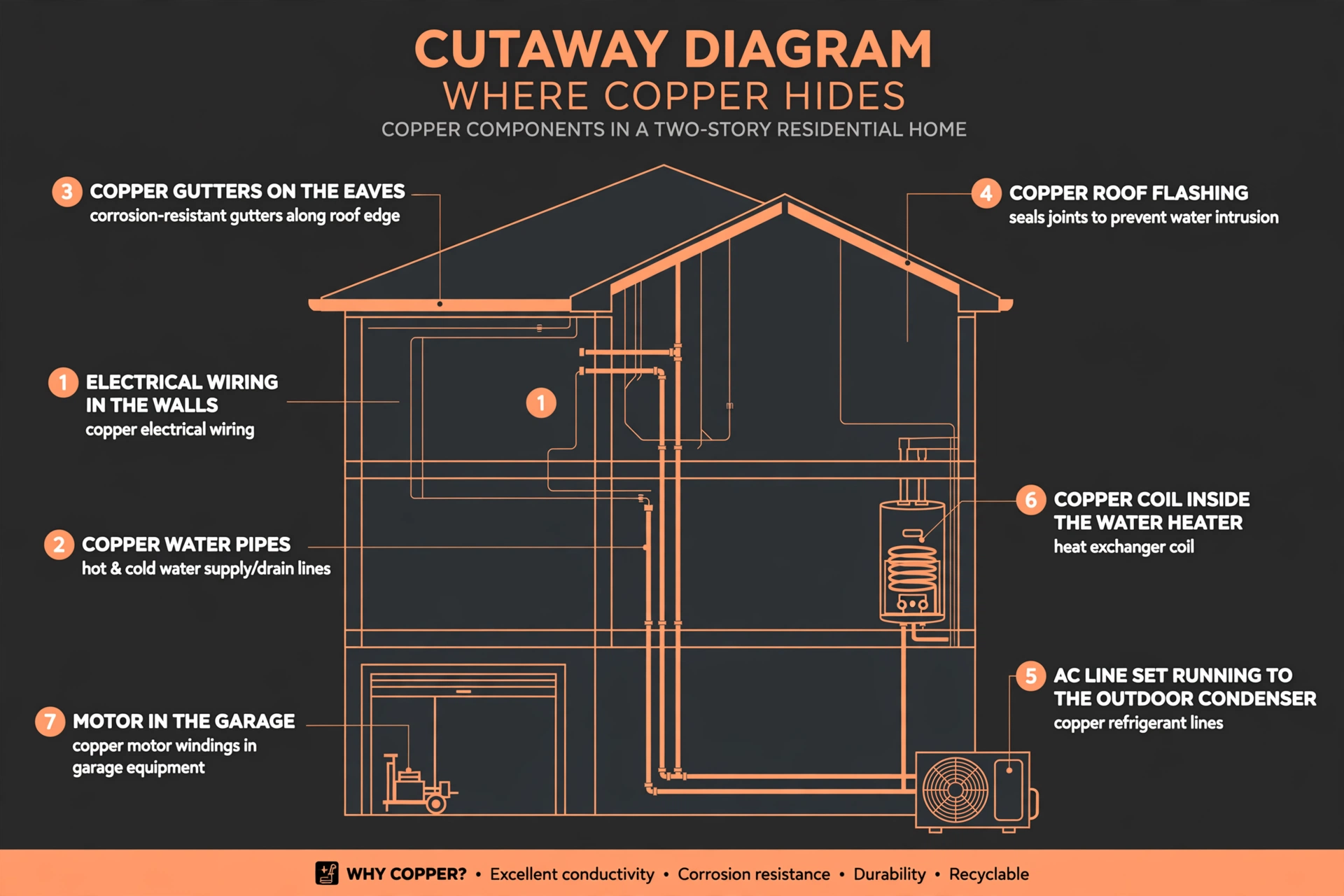
This is the big one. Every outlet, every switch, every light in a modern home is fed by copper wire — usually Romex (nonmetallic-sheathed cable) for branch circuits, with heavier feeders running to the panel, the range, the dryer, and the air conditioner. A whole-house rewire can pull hundreds of pounds of insulated copper out of the walls.
You will never see most of it, and that is fine. The time it becomes visible is during remodels, additions, and teardowns — which is exactly when it becomes sellable. Pulled Romex, old service cable, and leftover spools from the electrician's truck are all insulated copper, graded as-is. Our electrical wire guide covers every type you will meet.
Houses built from the 1960s through the early 2000s very often run copper supply lines: hot and cold water to every fixture, usually Type L (blue stripe) or Type M (red stripe). A full repipe pulls all of it out in one job — and a whole house of old copper pipe is one of the heaviest single copper hauls a home can produce.
Check the basement or crawl space where the pipes are exposed. Reddish-brown metal that a magnet will not stick to is copper. Gray and magnetic is steel. If you can read a stripe or an ink stamp, our pipe types guide will tell you exactly what you are looking at.
Copper gutters and downspouts show up on older and higher-end homes, and they are easy to spot once they green up — nothing else on a roofline turns that color. A full house of take-off gutters is clean, heavy, formed copper sheet, and it is some of the nicest scrap a home produces.
Do not forget the flashing: the copper strips and valleys worked into chimneys, skylights, and roof joints. Roofers pull it during re-roofs, and it goes straight into the copper pile. Our gutters guide covers the lifespan story and why the green patina never hurts the grade.
Follow the insulated tubes from your indoor coil to the outdoor condenser. That is the line set — two copper refrigerant tubes, one fat and one skinny, wrapped in insulation. Inside both the indoor and outdoor units, the coils themselves are copper tubing wrapped in aluminum fins.
This is also where the licensed-pro line sits. Refrigerant handling is federally regulated under EPA Section 608 — only certified technicians recover refrigerant and open the system. When the HVAC crew does a changeout, the line set and coils come out as part of their job, and that copper belongs in the conversation, not the dumpster.
Electric water heaters use copper heating elements, and every water heater — gas or electric — connects to the house with copper pipe and brass fittings. When the plumber swaps one out, the old unit leaves behind a small copper harvest in its connections alone.
Then there are the motors, and houses have more than you think: the furnace blower motor, the well pump if you have one, the garage door opener, the sump pump. Every one of them has copper windings inside. Dead motors are their own scrap category, and the copper inside is why.
Start outside: gutters, downspouts, the AC condenser and its line set. Move to the basement or crawl space: exposed water pipe, the water heater connections, the furnace and its blower motor. Note what you see and move on — this is a visual audit, not a demolition.
The rule for the whole walkthrough is simple: look, do not dismantle. Do not open the electrical panel. Do not cut into anything live. Do not break a refrigerant line. The copper that matters to you is the copper that comes out during real work — remodels, repipes, re-roofs, changeouts, teardowns — handled by the licensed tradesmen doing the job. That is the legitimate pipeline, and it is a rich one.
In the walls as electrical wiring, under floors and in walls as copper water pipe, on the eaves as gutters and downspouts, on the roof as flashing, outside as the air-conditioner line set, in the basement around the water heater, and inside motors like furnace blowers and well pumps.
Looking is fine; dismantling is licensed-pro work. Do not open electrical panels, cut into live circuits, break refrigerant lines, or disturb active plumbing. The legitimate sources of household copper are remodel and demolition leftovers, repipes, and take-off gutters — all handled by licensed tradesmen.
Yes. Pulled Romex and old branch-circuit wire is insulated copper, and it adds up fast on a rewire or a teardown. You do not need to strip it — buyers grade insulated wire as-is.
The line set — two copper refrigerant tubes running from the indoor coil to the outdoor condenser — plus copper tubing inside both coils. Refrigerant handling is federally regulated under EPA Section 608, so only certified techs should open the system.
No. Insulated wire is bought and graded as insulated wire. Stripping is labor-intensive and usually not worth your time unless you enjoy it — sell it as it sits and let the buyer handle it.
Copper pipe is reddish-brown, non-magnetic (a magnet will not stick), and often stamped with its type along the length. Gray magnetic pipe is steel; dull gray soft pipe is often lead in very old homes — leave that to a plumber.
Every quote, pickup, and payment runs through one person who answers the phone: Sonny Johns at 312-880-8174. No portals, no ticket queues, no waiting on a committee.
Walk your house with this page open and count what you find. Most people are shocked — they have been living inside a copper inventory for years without knowing it. Now you know where it all is, what it is worth keeping, and who to call when it comes out.
Suggested next read: How to Sell Copper Scrap — the seller's walkthrough, from sorting to getting paid.