Should I Strip Copper Wire?
The decision guide: recovery table, the one-pound test, and when stripping pays.
VIEW PAGE →I am Sonny, and I learned wire recovery the same way you will: with a scale, a pile of Romex, and a lot of questions. This page does the math for you. Pick your wire type, enter the pounds, and get an honest copper range — then decide whether stripping is worth your time.
Last updated: October 2026
Pick the wire type closest to your pile and enter the insulated weight in pounds. The calculator multiplies it by an honest low–high recovery range and shows every step of the math, so you can check it yourself. The output is pounds of copper — the phone call gives you today's number for it.
Recovery ranges are honest estimates from real-world stripping. Jacket thickness varies by brand and year, so treat this as a planning number — the one-pound test below gives you the exact figure for your pile.
The evergreen reference. THHN is the insulated building wire electricians pull through conduit. DLO is diesel locomotive cable — the thick stranded cable you see on welders and generators. Romex (NM-B) is the flat-sheathed cable inside your walls. For the deeper grading system behind these numbers, see the copper wire grades guide and insulated copper wire grades.
| Wire type | Recovery range | 100 lbs of this → |
|---|---|---|
| Heavy insulated wire (large THHN, DLO) | 70–85% | 70–85 lbs copper |
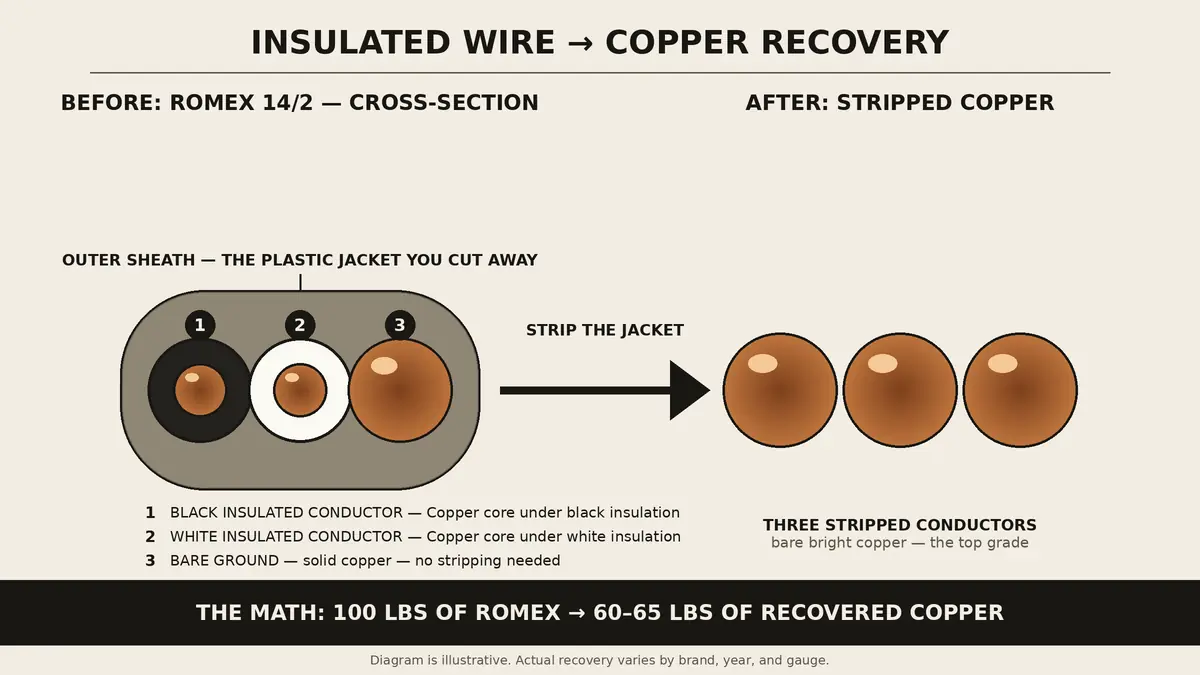
| Romex / NM-B | 60–65% | 60–65 lbs copper |
| Medium insulated wire | 50–55% | 50–55 lbs copper |
| Light wire and cords | 30–40% | 30–40 lbs copper |
| Christmas lights | Under 20% | Under 20 lbs copper |
| Bare bright copper wire | 99%+ | 99–100 lbs copper |
Recovery is the share of the insulated weight that is copper. These are honest ranges from real-world stripping, not lab numbers. Learn to recognize each grade with the copper identification guide.
Weigh one pound of your insulated wire. Strip it completely. Weigh the copper that comes out. That ratio is your pile's true recovery rate — multiply it by your total pounds and you know exactly what you are holding. No guessing, no generic chart.
Stripping is a mechanical job, full stop. Burning insulation to get the copper is illegal in most places, the fumes are toxic to breathe, and burnt copper comes out oxidized and discolored — buyers grade it down or turn it away. Score it, peel it, feed it through a stripper, or sell the wire insulated as-is. Those are your options, and all of them are legal. Read why burnt copper wire is the grade nobody wants.
It depends on the wire type. Heavy insulated wire like large THHN and DLO yields 70 to 85 pounds, Romex yields 60 to 65, medium insulated wire yields 50 to 55, light wire and cords yield 30 to 40, and Christmas lights stay under 20. For your exact pile, strip one pound and weigh the copper — that is your true recovery rate.
Strip heavy wire and sell light wire as-is. Thick cable like feeders, DLO, and large THHN has so much copper under the jacket that a tabletop stripper pays for itself fast. Thin wire, cords, and Christmas lights take so long to strip that the hours beat the copper. When in doubt, run the one-pound test and the time math on this page.
The one-pound test. Weigh one pound of your insulated wire, strip it completely, and weigh the copper that comes out. That ratio is your exact recovery rate for the whole pile — multiply it by your total pounds and you have your answer.
There is nothing to strip. Bare bright wire is already stripped, uncoated copper — 99 percent or better — so it goes straight to the top grade. Put your stripping time into the insulated piles instead.
Copper prices move every day, so any per-pound number printed here would be wrong tomorrow. This calculator works in pounds on purpose. When you know your copper weight, call or text Sonny at 312-880-8174 for today's number on it.
I built this calculator because I wish someone had handed it to me on my first pile of wire. I was guessing at recovery rates, stripping stuff that was not worth the hours, and leaving money on the table without knowing it. The scale does not lie: weigh it, strip one pound, and the math tells you everything.
I buy every wire type on this page — stripped or insulated, by the bucket or by the truckload. When you know your copper weight, you know my number: 312-880-8174. Call or text and I will give you today's number on it.
Suggested next read: How to Strip Copper Wire Fast — the right method for your volume.