Send photos
Photos of the material and containers, what operation produced it, and your location.
Shops use these words interchangeably, but they are different materials with different values. I'm Sonny, I buy all of it for top money, and here is the plain-English breakdown of each form, how each one is priced, and which drum in your shop is worth the most.
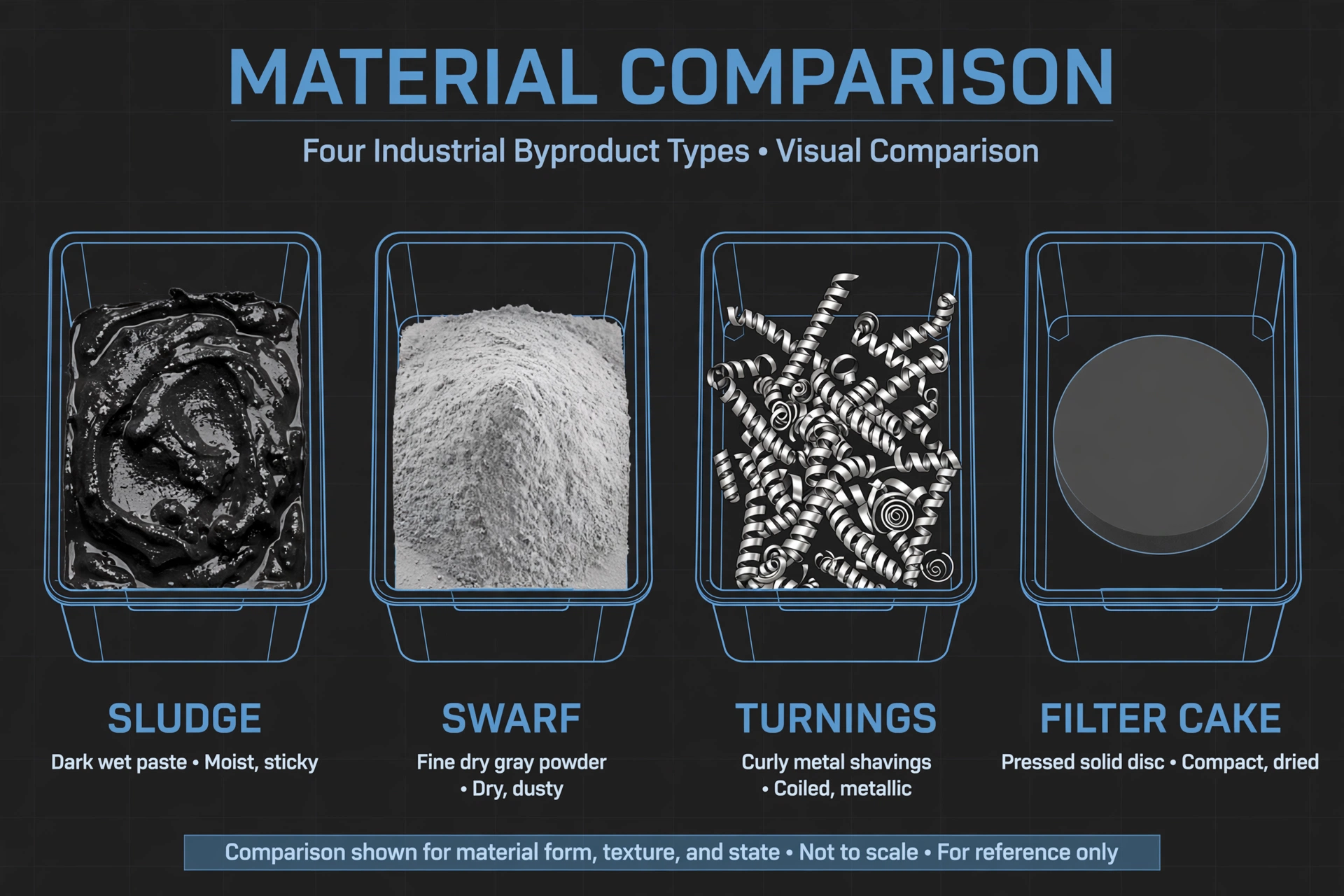 FIELD GUIDE
Sludge is what settles out of grinding coolant — a heavy gray mud at the bottom of drums, sumps, and coolant tanks. It is the finest material of the four: microscopic carbide particles washed off the grinding wheel, mixed with water, coolant, and cutting oil. Because it is wet, a large share of every drum is liquid you do not get paid for, which is why sludge is dried before assay and priced strictly on contained tungsten. Do not let the water fool you, though — the carbide in sludge is highly concentrated, and a full drum of settled sludge is one of the most valuable waste forms in the shop. If you want the money story, start with is carbide sludge worth anything.
Swarf is the dry cousin of sludge — fine carbide particles and small chips collected without coolant, usually from dry grinding, dust collection systems, or baghouse filters. It looks like dark metallic sand or powder. Because there is little or no liquid to drive off, swarf assays closer to its as-received weight, which makes the math simpler and the settlement faster. Clean, dry carbide swarf is excellent material: high tungsten content, minimal processing, and straightforward to sample. If your shop runs dry grinding or has dust collection on carbide operations, the collector bins are worth a photo.
Turnings are the larger chips and curls that come off machining and heavy grinding — bigger, coarser pieces you can pick up between your fingers. Carbide turnings are less common than steel turnings, because carbide is usually ground rather than turned, but they show up in shops doing heavy stock removal on carbide blanks and preforms. They are easy to identify, easy to keep clean, and they assay well because there is very little surface area for oil to cling to. A bucket of clean carbide turnings is straightforward, high-value material.
Filter cakes from coolant filtration systems and solids from sump cleanouts are the dark horses of grinding waste. This material has been settling and concentrating for months or years — every pass of the filter press squeezes out liquid and leaves the carbide behind. Sump cleanout material in particular can assay remarkably high, because years of fine carbide have settled into a dense layer while the coolant stayed on top. If you are doing a coolant system changeout or a sump cleanout, call me before the service company hauls it away. That is some of the best sludge-form material that exists.
All four forms are priced on contained tungsten — dry weight times assay percentage — but the path to that number differs. Sludge takes the biggest moisture deduction, because so much of the drum is liquid. Swarf and turnings take little or no moisture deduction and go nearly straight to assay. Filter cake sits in the middle: partially dewatered already, so less deduction than raw sludge. None of the four gets a flat per-pound board price the way clean inserts and end mills do — every lot is a custom quote based on the material, the operation behind it, and the lab result. The one constant: the cleaner and drier the material, the more of every pound is payable tungsten. That is true for all four forms, and it is why how you store and handle grinding waste matters as much as what you generate.
Pound for pound of contained tungsten, they are all tungsten — the metal does not care what shape it arrived in. The practical ranking comes down to concentration and handling. Dry swarf and turnings usually assay highest as-received, because there is nothing to drive off. Filter cake and sump solids come next, dense from years of settling. Wet sludge assays lowest as-received, but do not mistake that for low value — a full drum of sludge simply holds more total material, and the contained tungsten adds up fast. The real answer: the most valuable form is whichever one you have the most of, kept the cleanest. I buy all four, in any combination, and the quote sorts out exactly what each portion is worth.
Not sure which form you have? Text photos to 312-880-8174 and I will identify it and quote it.
Ironcrest's carbide sludge buying program →
Sludge, swarf, turnings, filter cake — whatever form your grinding waste takes, photos of the containers and the operation behind them are all it takes to start. Custom quote on assay, freight arranged on multi-drum lots, itemized settlement, payment within 24 hours.
For solid carbide tooling with a published price: see current scrap carbide prices per pound.
Photos of the material and containers, what operation produced it, and your location.
A written number based on the form, estimated assay, and the current tungsten market.
Drying and assay with an itemized settlement, then payment within 24 hours.
Send a photo, get a fast, free no-obligation quote — or call 312-880-8174.